
Static vs. Dynamic Secrets: Key Differences
Compare static (long-lived) and dynamic (on-demand) secrets—security, management, and best use cases for cloud and legacy systems.

When managing sensitive credentials like API keys or database passwords, understanding the difference between static and dynamic secrets is critical for security. Here's the breakdown:
- Static Secrets: Long-lived credentials that remain valid until manually updated. They're simple to use but pose high risks if compromised, as they provide constant access.
- Dynamic Secrets: Temporary credentials created on-demand with short lifespans. They automatically expire, reducing the risk of misuse and simplifying management.
Key Takeaways:
- Static secrets are common in legacy systems but require manual rotation and are harder to secure.
- Dynamic secrets are ideal for modern cloud-native environments, offering automated credential generation and revocation.
Quick Comparison:
| Aspect | Static Secrets | Dynamic Secrets |
|---|---|---|
| Lifespan | Long-lived, until manually rotated | Short-lived, expires automatically |
| Security Risk | High, if stolen, provides ongoing access | Low, limited to short timeframes |
| Management | Manual rotation required | Automated lifecycle management |
| Use Case | Legacy systems, third-party APIs | Cloud-native apps, CI/CD pipelines |
| Auditability | Limited tracking | Detailed per-request logs |
Static secrets are suitable for older systems, while dynamic secrets align with modern, automated workflows. Choosing the right approach depends on your infrastructure and security priorities.
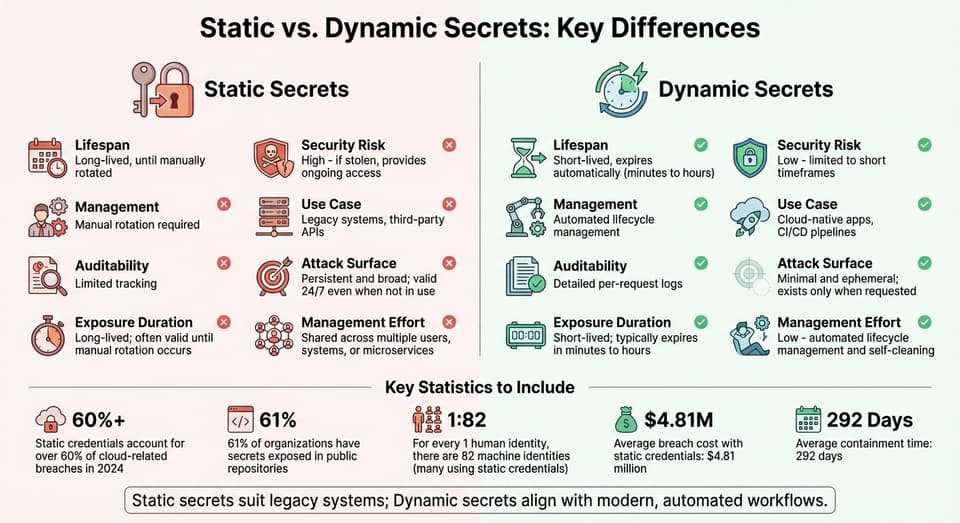
Static vs Dynamic Secrets: Security and Management Comparison
Rotated vs. dynamic secrets: Which should you use?
sbb-itb-d663cbd
What Are Static Secrets?
Static secrets are credentials like passwords, API keys, or SSL certificates that remain unchanged until someone manually updates or removes them. In DevOps workflows, these secrets are often accessed through a secrets manager, such as HashiCorp Vault, during runtime rather than being hardcoded into the source code.
The key feature of static secrets is their longevity. Once created, they are stored and reused whenever a system requires authentication, staying the same until explicitly modified.
How Static Secrets Work
Static secrets rely on a possession-based trust model. Once issued, anyone who has the secret can use it without restrictions until it gets rotated. The system doesn’t re-verify the user or process at the time of access.
This creates a "set it and forget it" scenario. For example, an API key for a third-party service like Stripe might be generated during initial setup and remain unchanged for months.
Where Static Secrets Are Used
Static secrets are common in legacy systems and on-premises infrastructure, where frequent credential updates can be difficult. They’re also widely used for third-party API integrations that don’t support automated credential management. Here are a few examples:
- Shared SSL/TLS certificates across multiple services
- API keys for platforms without dynamic authentication
- Database passwords in older systems that can’t generate temporary credentials
Security Risks and Management Challenges
Static secrets come with significant risks. If one is compromised, an attacker can maintain access until the secret is manually revoked. Since they don’t expire on their own, the damage can last indefinitely unless someone intervenes.
"Sharing secrets is always a risk, as a compromised secret has access to multiple applications and services. Managing many secrets is a challenge of its own." – HashiCorp Developer
Managing static secrets is operationally demanding. In microservice environments, manually rotating a credential across several repositories, pipelines, and configuration files can be a logistical nightmare. If rotations aren’t perfectly synchronized, services may break. This complexity often discourages teams from rotating secrets regularly, leaving them exposed for longer than intended.
Another issue is poor auditability. Shared credentials make it hard to track who accessed what, complicating forensic investigations after a breach.
Up next, we’ll dive into dynamic secrets and how they address these challenges.
What Are Dynamic Secrets?
Dynamic secrets are credentials that are created only when they’re needed. Instead of storing static credentials, you maintain a set of instructions - or a template - that generates these credentials on demand. When a user or application requests access, a secrets engine produces a temporary credential in real-time.
These credentials come with a short lifespan, known as Time to Live (TTL), which typically lasts from minutes to a few hours. Once the TTL expires, the system automatically revokes the credential, removing the need for manual intervention.
"Dynamic secrets do not exist until read, so the risk of being stolen is greatly reduced." – HashiCorp Developer
This approach flips the traditional model of credential management. Instead of creating and safeguarding long-term credentials, dynamic secrets are generated only when required and are destroyed immediately after use. Each request produces a one-time credential, meaning that even if intercepted, it cannot be reused or exploited in other systems.
How Dynamic Secrets Work
Dynamic secrets rely on role-based templates. Administrators define these templates to specify how credentials should be created - for instance, SQL commands for database users or IAM policies for cloud platforms. When a client accesses a specific path, the secrets engine uses the template to instantly generate a new credential.
Each credential is tied to a lease, which the management system monitors. Once the TTL expires, the system automatically invalidates the credential by reaching out to the target system (such as AWS or PostgreSQL). This ensures cleanup happens even if the application fails to delete the credential manually.
Take Amazon RDS as an example: using tools like Doppler, temporary database users can be created with a TTL as short as 30 minutes. During this time, the system grants specific permissions, such as read-only access, and then deletes the account once the TTL ends. This process makes dynamic secrets a natural fit for automated, cloud-native environments.
Where Dynamic Secrets Are Used
Dynamic secrets are particularly useful in cloud-native setups where tasks are short-lived and heavily automated. They shine in CI/CD pipelines, where deployment jobs last only a few minutes and require temporary credentials for operations like pushing code or provisioning infrastructure. They’re also ideal for Terraform runs, Kubernetes jobs, and serverless functions, all of which benefit from credentials that align with their brief lifecycles.
In database management, dynamic secrets help avoid the risks of shared administrative accounts. Instead, a secrets engine can create temporary, unique database users with limited permissions for each application instance. This makes it easier to trace specific actions back to individual services.
Cloud platforms like AWS, Azure, and GCP also integrate with dynamic secrets engines. They issue temporary IAM roles or access keys for specific tasks, eliminating the need to hard-code long-term credentials in configuration files or environment variables.
Security and Automation Advantages
Dynamic secrets bring both operational ease and enhanced security through automated protection. One of their standout benefits is the reduced exposure window. If a credential is accidentally logged or cached, it quickly becomes useless once it expires. This short lifespan significantly limits the opportunities for attackers to exploit leaked credentials.
Another major advantage is the elimination of manual credential rotation. There's no need to update credentials across repositories, pipelines, or configuration files. The entire lifecycle - creation, usage, and revocation - is automated. This ensures security policies are enforced consistently without requiring human oversight.
"Dynamic secrets generate credentials on demand that are short-lived and unique to each client." – HashiCorp Developer
Additionally, the uniqueness of each credential simplifies auditing and investigations. Since every action can be tied to a specific request, tracking and tracing activities becomes much more straightforward.
Security Comparison
Static secrets pose a constant risk, while dynamic secrets are designed to exist only briefly. Static secrets remain valid around the clock, creating persistent attack vectors - even when they’re not actively in use. Dynamic secrets challenge this model by existing only when requested and automatically expiring within a short timeframe, usually minutes to hours. This fundamental difference has a profound impact on overall system security.
"Static secrets create persistent attack vectors that plague cloud-native environments." – Dan Kaplan, Content Marketing Leader, Aembit
When static secrets are breached, attackers can gain extensive access across systems. In contrast, dynamic secrets confine the damage to a single session. Since dynamic secrets are unique to individual requests and expire quickly, the potential fallout from a breach is significantly reduced.
Dynamic secrets also simplify compliance and auditing. With static credentials, which are often shared across teams and services, it’s challenging to trace specific actions back to individual workloads. Dynamic secrets, however, offer detailed traceability by logging usage on a per-request basis. This level of granularity aligns with compliance standards like SOC 2, ISO 27001, and PCI DSS. According to IBM's 2024 Cost of a Data Breach report, breaches involving static credentials cost organizations an average of $4.81 million and take 292 days to contain - the longest remediation timeline among attack vectors.
The statistics are telling: static credentials account for over 60% of cloud-related breaches in 2024, and 61% of organizations report having secrets exposed in public repositories like GitHub. Additionally, for every human identity in an Identity and Access Management (IAM) program, there are roughly 82 machine identities - many of which rely on unmanaged static credentials.
Security Comparison Table
| Aspect | Static Secrets | Dynamic Secrets |
|---|---|---|
| Attack Surface | Persistent and broad; valid 24/7 even when not in use | Minimal and ephemeral; exists only when requested |
| Theft Risk | Higher - persistent credentials can be reused indefinitely if compromised | Lower - minimal exposure time makes stolen credentials quickly useless |
| Exposure Duration | Long-lived; often valid until manual rotation occurs | Short-lived; typically expires in minutes to hours |
| Uniqueness | Shared across multiple users, systems, or microservices | Unique per request; no two clients share the same credential |
| Compliance/Auditing | Limited; difficult to attribute specific actions to a single entity | Detailed; per-request tracking with identity-based logging |
| Management Effort | High; requires manual rotation and coordination to avoid breaking apps | Low; automated lifecycle management and self-cleaning |
To see how these security principles apply to your specific environment, you can schedule a demo with our team. The next section will explore the operational management differences between these two approaches.
Management and Operations
Managing secrets involves vastly different challenges when comparing static and dynamic approaches. Static secrets demand manual creation, secure storage, and careful rotation, which can become overwhelming as infrastructure scales. As HashiCorp Developer explains:
"If each team has to manually manage secrets for web services and applications, there are two potential problems. Either services would share secrets or it will be a challenge managing secrets".
This often results in credential duplication across repositories, CI/CD pipelines, and configuration files.
Dynamic secrets, on the other hand, flip the script. Instead of focusing on protecting stored credentials, the emphasis shifts to authenticating workloads at runtime. Tools like HashiCorp Vault create credentials on demand when a verified service requests them. These credentials automatically expire after a set time-to-live (TTL). This eliminates the need for manual rotation - applications simply request new credentials as needed, avoiding the reuse of static keys. These differences in approach set the stage for the distinct management efforts outlined below.
Management Effort Required
Managing static secrets often involves a reactive approach, such as the "scream test", where a credential is disabled to identify its dependencies. Yonit Glozshtein from Oasis Security highlights the limitations of this method:
"In many cases, secret rotation is performed only as a measure of last resort and brute force rather than programmatically operationalized".
This approach risks operational disruptions and makes it harder to track how credentials are being used.
Dynamic secrets eliminate manual intervention entirely. Tasks like provisioning, distributing, rotating, and cleaning up credentials are all automated through workflows. Applications must be designed to be aware of credential leases, meaning they need to check if credentials are valid or request new ones before they expire. While this requires upfront development effort, it significantly reduces long-term operational overhead. This automated process supports the kind of security and flexibility that modern DevOps teams need.
Scaling Capabilities
Dynamic secrets also shine when it comes to scaling. Static secrets struggle to keep up with the demands of modern infrastructure. For every human identity managed through an IAM program, there are roughly 82 machine identities operating outside of it, most of which rely on static credentials that often go unmanaged. Mathew Pregasen from Infisical explains:
"The challenge is not only volume, it's velocity. Modern applications scale dynamically, deploy frequently, and operate across hybrid environments where secrets must be available instantly while remaining completely secure".
Dynamic secrets are designed to handle this kind of velocity. They automate the generation and revocation of credentials, enabling thousands of requests to be processed without human involvement. Each request generates a unique credential, providing detailed tracking for auditing purposes, even in large-scale distributed systems. When services are retired, their associated credentials are automatically revoked, reducing the risk of "orphaned" credentials that could create vulnerabilities. To prevent performance bottlenecks, organizations adopting dynamic authorization should aim for sub-20ms response times for policy decisions.
Which Secrets Fit Your Environment
Deciding between static and dynamic secrets isn’t about finding the "best" option - it’s about aligning your choice with your infrastructure and security priorities. The right fit depends on your workload patterns and how your systems handle credentials.
Static secrets work well when your infrastructure doesn’t support automated credential generation. On the other hand, dynamic secrets thrive in environments where systems can create and manage users and permissions on demand. This makes them particularly suited for modern cloud platforms like AWS, Azure, and GCP, as well as databases such as PostgreSQL.
Performance is another factor to weigh. Static secrets typically respond in about 1 millisecond, while dynamic secrets can introduce a delay of 10–100 milliseconds per access. In latency-sensitive applications, this delay can even reach 200–800 milliseconds. Costs are another consideration - if your resource provider charges per user created, the frequent generation of dynamic credentials could result in unexpected expenses.
Static Secrets for Legacy Systems
Legacy systems often prioritize stability over agility, making static secrets essential. These systems, which lack API-based automation, still rely heavily on static credentials. Many third-party services and older environments are built around this approach.
Static secrets are especially suited for long-running services with persistent connections, where frequent credential rotation isn’t practical. However, this stability comes with risks: static secrets remain valid until manually changed. This increases the potential "blast radius" if the credentials are compromised. To mitigate this, organizations should implement automated rotation tools to reduce human error and limit the lifespan of static credentials.
Dynamic Secrets for Cloud-Native Systems
Modern cloud-native environments, with their need for agility, are a natural fit for dynamic secrets. These credentials work seamlessly with ephemeral workloads like CI/CD pipelines, serverless functions, and microservices. As Mathew Pregasen, Technical Writer at Infisical, puts it:
"Dynamic secrets excel with short-lived, ephemeral workloads like CI/CD pipelines and serverless functions."
Dynamic secrets are generated on demand and automatically expire. For instance, each CI/CD build can receive unique, temporary credentials, and database access can be secured by providing each application instance with a short-lived login. Even emergency access can be managed with credentials that self-destruct after use.
One of the standout benefits of dynamic secrets is the elimination of standing privileges - no user or system retains permanent access rights. A HashiCorp Developer highlights this advantage:
"Dynamic secrets don't exist until a user or system reads them, eliminating the risk of theft or unauthorized use by another client."
Dynamic secrets also improve auditing by linking every credential to a specific access request. This creates detailed records of who accessed what and when, offering greater transparency and control.
In the end, whether you choose static or dynamic secrets depends on your infrastructure’s capabilities and your security goals. For organizations looking to modernize, platforms like Automate Security can simplify secret management and strengthen your overall security strategy.
Take a closer look at your current secret management practices to see how transitioning from static to dynamic secrets could benefit your systems.
Moving from Static to Dynamic Secrets
Shifting from static to dynamic secrets is a gradual process. Many organizations operate with both simultaneously - static secrets often manage third-party API keys and legacy systems, while dynamic secrets protect cloud-native infrastructure and databases. The challenge lies in identifying where to begin and how to transition without disrupting current workflows. Here's how to evaluate and adapt your infrastructure effectively.
Review Your Current Secret Management
Start by pinpointing where your secrets are currently stored. Pay special attention to credentials in vulnerable spots, like hard-coded in source code, saved in plaintext files, or embedded within CI/CD environment variables. These should be your top priority for improvement.
Next, classify your systems based on their ability to support dynamic secrets. Platforms like AWS, Azure, and modern databases such as PostgreSQL are equipped for dynamic credential generation. This evaluation helps you identify systems ready for dynamic secrets and those that require static secrets with tighter rotation policies. By focusing on these areas, you can gradually introduce automated, dynamic secret generation where feasible.
How to Implement Dynamic Secrets
Once you've assessed your environment, the next step is to automate secret management in systems that support it. Begin by configuring secret engines for dynamic generation. For databases, this involves enabling specific plugins, such as the postgresql-database-plugin, and using administrative credentials to authenticate with your secrets manager. Write SQL templates using placeholders like {{name}} and {{password}} to handle user creation, renewal, and revocation. Tailor these templates to fit your database's requirements for production use.
Set strict TTL (time-to-live) values to reduce the risk of exposure. Typically, TTLs are set to 1 hour by default, with 30–60 minutes being ideal for short-lived workloads. As Goodness E. Eboh, a Cloud/DevOps Engineer, advises:
"If your secrets last longer than the workload, you've already created a risk."
Update your CI/CD pipelines to retrieve credentials dynamically instead of relying on static configuration files. This adjustment ensures your workflows authenticate with the secrets manager and generate temporary credentials only when needed. Before deploying these changes to production, thoroughly test credential generation and revocation in a development environment.
Conclusion
When deciding between static and dynamic secrets, the best choice depends on your infrastructure's specific needs. Static secrets are indispensable for legacy systems, third-party API keys, and applications that don’t support dynamic generation. They are simple to use and compatible across various platforms, but their persistent nature can increase security vulnerabilities.
Dynamic secrets, on the other hand, bring a modern approach to credential management, particularly in cloud-native environments. These credentials are generated on demand, have short lifespans, and are automatically revoked, drastically reducing the risk of theft. As HashiCorp Developer explains:
"Dynamic secrets do not exist until read, so the risk of being stolen is greatly reduced."
This just-in-time method not only enhances security but also eliminates the hassle of manual rotation and provides detailed audit trails. These advantages make dynamic secrets the go-to option for modern DevOps workflows, especially in CI/CD pipelines, cloud platforms like AWS and Azure, and database environments. However, static secrets still hold value for legacy systems and integrations that don’t support automation.
A practical approach is to adopt a unified secrets management platform that applies consistent security policies across your infrastructure, allowing for a gradual shift from static to dynamic secrets. For instance, solutions like Automate Security (https://automatesecurity.com) streamline the management of both types of secrets, ensuring secure operations for legacy systems and cloud-native environments alike.
FAQs
When should I keep using static secrets?
Static secrets work well for long-term credentials that require manual handling and aren't ideal for dynamic generation. Examples include API keys or passwords that don’t need to be rotated frequently. These types of secrets are often essential in situations where automation or dynamic solutions are either not feasible or unsupported in certain workflows.
What TTL should I set for dynamic secrets?
Setting the TTL (Time-to-Live) for dynamic secrets should align with both your security requirements and the lifespan of your workloads. Shorter durations - anywhere from minutes to a few hours - are generally recommended to minimize exposure. For instance, a TTL of 1 hour or even a few days might be appropriate, depending on how the secret is being used. The key is to find a balance that ensures security without disrupting operations.
How can I migrate to dynamic secrets without disrupting apps?
To make the transition seamless, start by pinpointing applications that rely on static secrets. Next, create dynamic secrets with proper expiration settings and update your applications to start using these new dynamic secrets incrementally. Be sure to test each application thoroughly to confirm everything works as expected before you deactivate the static secrets. This step-by-step method reduces interruptions and improves security by taking advantage of the automatic expiration and revocation capabilities that dynamic secrets offer.