
SOC 2 Compliance: Complete Guide for Cloud Teams
Practical SOC 2 guidance for cloud and SaaS teams: scope, Trust Services Criteria, cloud controls, evidence automation, and audit preparation.

SOC 2 compliance is a must-have for cloud and SaaS providers managing customer data. It’s not just about security - it’s about meeting business demands. Over 70% of enterprises require SOC 2, and without it, you risk losing deals worth $100,000 or more. SOC 2 focuses on five Trust Services Criteria: Security, Availability, Processing Integrity, Confidentiality, and Privacy. Security is mandatory, while the others depend on your services and client needs.
Here’s what you need to know:
- Why SOC 2 matters: It builds trust with clients and simplifies security audits.
- Key focus areas: Access controls, encryption, system monitoring, and change management.
- Types of audits: Type I (controls at a point in time) and Type II (effectiveness over 3–12 months).
- Steps to compliance: Define your scope, implement controls, automate evidence collection, and prepare for audits.
SOC 2 isn’t just a checkbox - it’s a framework that helps cloud teams secure data, reduce risks, and close deals faster.
SOC 2 Compliance: Everything You Need to Know in 2026
Implementing these standards often requires specialized cloud security services to ensure continuous monitoring and automated evidence collection.
sbb-itb-d663cbd
What Is SOC 2 and the Trust Services Criteria?
SOC 2 is built around five pillars called Trust Services Criteria: Security, Availability, Processing Integrity, Confidentiality, and Privacy. Instead of offering a simple checklist, SOC 2 provides a structured approach to assessing your security setup through an independent audit performed by a licensed CPA firm.
This framework is tailored for cloud-based service providers, including SaaS companies, data centers, and managed service providers. While Security is mandatory and includes 33 core requirements forming the foundation of every SOC 2 audit, the other four criteria are optional. These additional criteria should only be addressed if they align with your services or customer commitments.
Under the Shared Responsibility Model, your cloud provider is responsible for the physical security of the infrastructure, while you are accountable for securing everything built and configured on top of it. A SOC 2 report helps your customers verify that you’re managing risks effectively. You can also use your provider's SOC 2 report to meet physical infrastructure requirements in your own audit. SOC 2 audits come in two types: Type I, which evaluates controls at a specific moment, and Type II, which examines their effectiveness over a longer period (usually 3–12 months). Type II reports, valid for 12 months, are especially valuable as they demonstrate sustained security performance and require annual renewal.
Here’s a closer look at how each Trust Services Criterion applies to cloud teams.
Security: Core Protection Requirements
Security is the backbone of every SOC 2 audit and focuses on safeguarding your cloud infrastructure and data from unauthorized access - whether physical or digital. This includes implementing firewalls, multi-factor authentication (MFA), intrusion detection systems, and data encryption. For cloud teams, security controls span the entire digital environment, requiring network configurations that isolate data and limit access. Examples include:
- Setting up access controls and monitoring user authentication
- Blocking unauthorized activities
- Managing risks from third-party tools and cloud providers
The 33 core requirements under Security form the foundation for the other Trust Services Criteria.
"The controls within the security category, the common criteria, provide the foundation for the other four categories." - Vanta
Even in cloud setups, SOC 2 examines how data is stored in data centers and how physical access is managed. It also emphasizes monitoring third-party tools and cloud services to mitigate risks.
Availability: Maintaining System Uptime
The Availability criterion ensures your cloud systems remain operational and accessible, meeting commitments outlined in your Service Level Agreements (SLAs) or business needs. This is especially important for SaaS platforms and systems relying on continuous delivery, where downtime can disrupt client operations. To meet this criterion, cloud teams must:
- Manage capacity demands effectively
- Develop and maintain business continuity plans
- Ensure uptime commitments are met, even in distributed environments
Key controls include disaster recovery protocols, data backups, failover testing, and capacity monitoring. If system uptime is a critical promise of your service, this criterion should be included in your SOC 2 audit.
Processing Integrity, Confidentiality, and Privacy
Processing Integrity ensures that your systems handle data accurately, completely, and without unauthorized changes. This is essential for SaaS platforms performing calculations or data analysis for customers. Controls might include automated transaction monitoring, error logging, and input/output validation.
Confidentiality focuses on protecting sensitive business data, such as intellectual property or trade secrets, throughout its lifecycle. This involves enforcing least privilege access and ensuring secure data disposal.
Privacy addresses how you manage Personally Identifiable Information (PII) in line with your privacy policies. This includes obtaining consent, following data retention policies, and securely disposing of PII in shared environments. If your service involves collecting, storing, or processing customer PII, demonstrating strong privacy controls is a key part of SOC 2 compliance.
SOC 2 Controls for Cloud Teams
When working in the cloud, the Shared Responsibility Model defines the split between what your cloud provider handles and what your team must secure. Providers like AWS, Azure, and Google Cloud take care of the physical infrastructure, while you're responsible for securing applications, managing access, and handling data. While you can reference your provider's SOC 2 report for their infrastructure controls, everything you build and configure falls on your shoulders.
"In Azure specifically, Microsoft assumes responsibility for securing the physical data center... For all cloud deployment types, you own your data and identities." - Konfirmity Blog
Key SOC 2 Controls for the Cloud
The most critical controls align with the Trust Services Criteria. Here are some of the major areas to focus on:
- Logical Access Controls (CC6.1): Implement Identity and Access Management (IAM), Role-Based Access Control (RBAC), and Multi-Factor Authentication (MFA) to tightly control access to cloud resources.
- Data Protection (CC6.7): Ensure encryption at rest using tools like AWS KMS or Azure Key Vault, and encryption in transit (TLS 1.2 or higher) for secure communication.
- System Monitoring (CC7.1/CC7.2): Use tools like CloudTrail, Azure Monitor, or GCP Cloud Audit Logs to track administrative actions and data access events.
- Change Management (CC8.0): Adopt Infrastructure as Code (IaC) and CI/CD pipelines to ensure all changes are authorized, tested, and documented.
Take Acme SaaS as an example. This financial analytics provider achieved SOC 2 Type 2 compliance in December 2025 for its Azure-based environment. Using services like Azure App Service, SQL Database, and Storage, Acme implemented MFA for all users, configured Azure Privileged Identity Management (PIM) for admin roles, and enabled Transparent Data Encryption (TDE) for databases. By mapping controls to the Trust Services Criteria through Azure Policy, Acme passed a six-month audit and secured a $500,000 annual contract with a Fortune 500 client.
Applying Controls to Cloud Infrastructure
To meet SOC 2 requirements in the cloud, focus on these practical steps:
- Access Management: Limit broad roles like "Owner" or "Contributor" and adopt Privileged Identity Management (PIM) for just-in-time access. Use Conditional Access policies to enforce MFA and block access from untrusted devices or locations.
- Data Encryption: Enable encryption at rest for storage and databases using provider-managed or customer-managed keys. Ensure encryption in transit for APIs and application traffic meets modern standards (TLS 1.2 or higher).
- System Monitoring: Centralize logging for events like failed logins, privilege escalations, or network security changes. Use automated alerts to detect potential issues quickly.
- Change Management: Integrate IaC scanning into CI/CD pipelines to catch misconfigurations - like open SSH ports or unencrypted S3 buckets - before deployment. This "shift-left" approach reduces compliance risks and audit findings.
| SOC 2 Control Category | Cloud-Specific Implementation | Tool Examples |
|---|---|---|
| Logical Access (CC6.1) | MFA, RBAC, PIM, Conditional Access | Azure AD, AWS IAM, Okta |
| System Monitoring (CC7.1/CC7.2) | Centralized logging, anomaly detection | CloudTrail, Azure Monitor, GuardDuty |
| Data Protection (CC6.7) | Encryption at rest/in transit, key management | AWS KMS, Azure Key Vault, Cloud KMS |
| Availability (A1.2/A1.3) | Backups, disaster recovery, capacity management | Azure Backup, AWS Site Recovery |
| Change Management (CC8.0) | IaC scanning, CI/CD gates, peer reviews | Terraform, Snyk, Azure DevOps |
Documenting Control Evidence
SOC 2 audits demand continuous, immutable evidence that your controls worked effectively throughout the observation period (typically 6–12 months). Automating evidence collection is key to maintaining compliance.
"A configuration change on day 16 of a 365-day audit period can invalidate your compliance posture for the remaining 349 days." - Complimetric
To ensure data integrity, configure append-only storage or apply Write Once Read Many (WORM) policies for audit logs. Store logs, screenshots, and reports in a secure, centralized repository with version control. Maintain a control mapping matrix that links each Trust Services Criterion to specific controls and evidence types. For instance, Logical Access controls could map to quarterly access reviews and MFA enforcement reports.
Automate evidence collection for common controls like IAM policies, encryption settings, and backup logs using tools like AWS Audit Manager or Azure Policy. By following the SAVE methodology (Source, Analyze, Visualize, Evidence), you can streamline the process and generate audit-ready reports. Teams that automate evidence collection often cut audit time from 8–12 weeks to just 3–5 weeks, compared to the 550–600 hours required for manual processes.
| Control Category | Cloud Evidence Examples | Mapping (TSC) |
|---|---|---|
| Access Control | IAM policy screenshots, MFA reports, SSO logs, quarterly access reviews | CC6.1, CC6.3 |
| Change Management | Git pull request histories, peer review logs, CI/CD timestamps, Jira tickets | CC8.1 |
| Data Protection | KMS key rotation logs, encryption settings, TLS certificate records | CC6.7, C1.1 |
| System Monitoring | Vulnerability scan reports, SIEM alert logs, incident post-mortems | CC7.1, CC7.2 |
| Availability | Backup logs, disaster recovery test results, load balancer health checks | A1.2, A1.3 |
How to Achieve SOC 2 Compliance: Step-by-Step
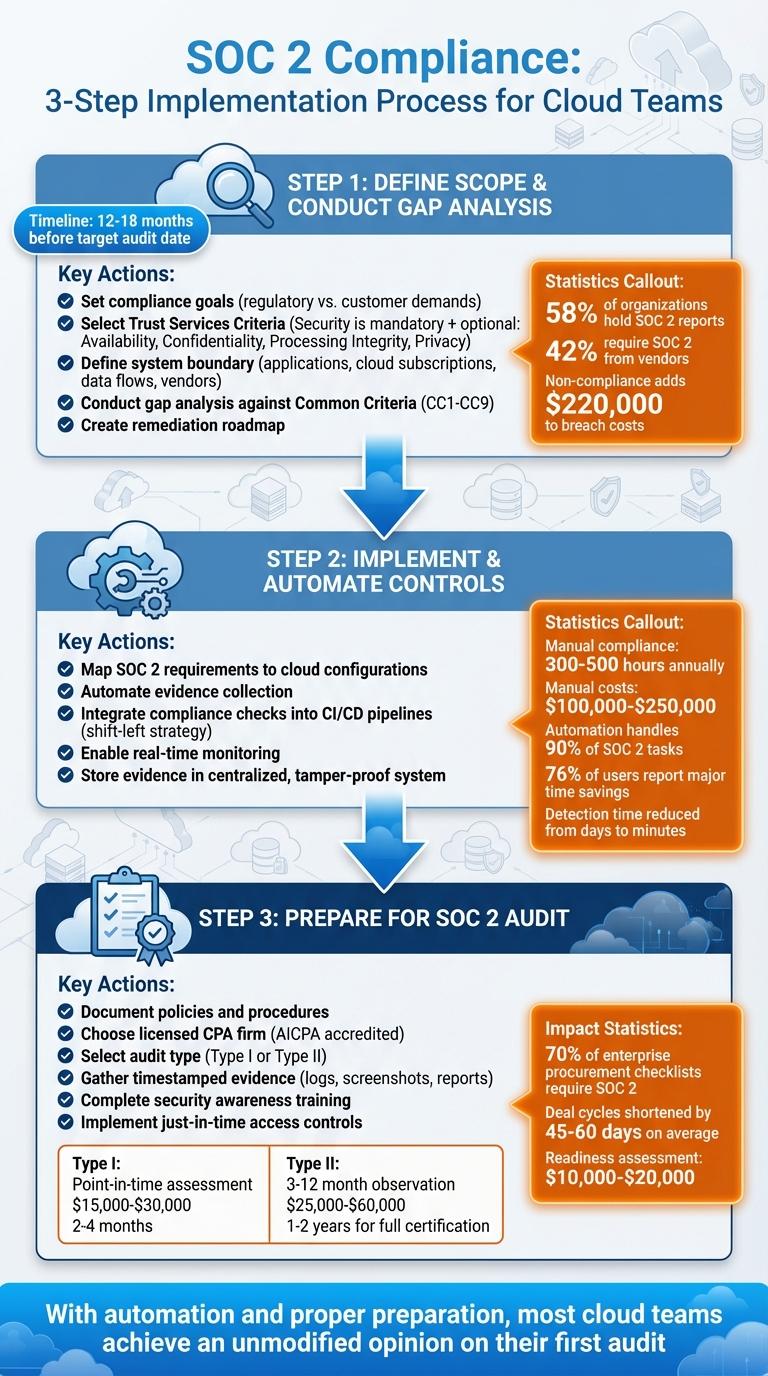
SOC 2 Compliance Implementation Process for Cloud Teams
SOC 2 certification follows a structured process, especially for cloud-based teams. Completing a Type II report typically takes 1–2 years, while Type I audits can be wrapped up in 2–4 months if a quicker validation is needed.
Step 1: Define Scope and Conduct Gap Analysis
Begin by clarifying your compliance goals. Are you aiming to meet regulatory standards or address customer demands for a security certification? For example, in May 2025, coaching platform Optify partnered with Automate Security to secure SOC 2 certification after losing enterprise deals due to a lack of certified security proof. Setting clear goals will help you focus on the relevant Trust Services Criteria.
Every SOC 2 audit must address Security, but you can choose additional categories - Availability, Confidentiality, Processing Integrity, and Privacy - based on your operations and customer contracts. For instance, if your SLAs guarantee 99.9% uptime, include Availability. If you deal with sensitive data like Social Security numbers or credit card info, add Privacy. Wealth, a digital estate planning platform, completed a six-month Type II process in May 2025, becoming the first in its sector to achieve SOC 2 Type II compliance, which they used as a sales advantage.
Next, define your system boundary. This includes listing all in-scope applications, cloud subscriptions (e.g., specific AWS accounts or Azure resource groups), data flows, employee roles, and third-party vendors. Be clear about which responsibilities fall to your providers and which you control, as outlined in the Shared Responsibility Model.
Conduct a gap analysis to compare your current setup against SOC 2’s Common Criteria (CC1 through CC9). This involves reviewing documentation, interviewing staff, and inspecting system configurations to pinpoint missing controls - like a lack of MFA enforcement or informal offboarding. Create a remediation roadmap with clear deadlines and responsibilities. Ideally, start this process 12–18 months before your target audit date.
"SOC 2 compliance is not the cost of doing business. It's the framework that enables you to do better business." - ISMS.online
The numbers speak volumes: 58% of organizations now hold a SOC 2 report, and 42% require one from their vendors. Plus, non-compliance can add nearly $220,000 to the cost of a data breach. For many, starting with a Type I audit - a point-in-time evaluation - lays the groundwork for the more rigorous Type II observation period.
Step 2: Implement and Automate Controls
Link each SOC 2 requirement to specific cloud configurations. For example, map CC6.1 (Logical Access) to MFA enforcement in Azure Active Directory, or CC6.7 (Data Protection) to encryption-at-rest settings in AWS Key Management Service. Tools like Azure Policy or AWS Config can help enforce these security baselines.
Automation is crucial. Manual compliance efforts can take 300–500 hours annually and cost between $100,000 and $250,000. Automate Security, for instance, reduces manual work by continuously monitoring infrastructure and automatically collecting audit evidence. In May 2025, SaaS company Formsort streamlined their process with automation, cutting two weeks off their sales cycle by eliminating manual security questionnaires.
Use a "shift-left" strategy by integrating compliance checks into your CI/CD pipelines. Scanning Infrastructure as Code (IaC) templates before deployment can catch misconfigurations - like open SSH ports or unencrypted storage buckets - before they hit production.
Real-time monitoring is another game-changer. Instead of periodic reviews, continuous scanning can reduce the time it takes to detect configuration issues from days to minutes. Keep all audit evidence in a centralized, tamper-proof system secured with cryptographic signatures.
Automation tools can handle up to 90% of SOC 2 tasks, with 76% of users reporting major time savings. Once these controls are in place, the next step is preparing for the audit itself.
Step 3: Prepare for the SOC 2 Audit
With your scope defined and controls automated, shift your focus to audit readiness. Start by documenting your policies and procedures. Auditors will need written evidence of how you manage security, handle changes, and respond to incidents. Assign owners to each policy and schedule regular reviews to keep everything up to date.
Choose a licensed CPA firm accredited by the AICPA to conduct your audit. Only these firms can issue official SOC 2 reports. Decide between a Type I audit, which assesses control design at a single point in time, or a Type II audit, which evaluates control effectiveness over a period (usually 3, 6, 9, or 12 months). A Type I audit costs $15,000–$30,000, while Type II audits range from $25,000 to $60,000. While Type I can suffice for startups, Type II is often preferred for enterprise-level deals.
Gather timestamped logs, screenshots, and audit reports to show that your controls are working effectively. For cloud environments, this might include AWS CloudTrail logs, Azure AD sign-in records, change approval tickets, and encryption configuration screenshots. Using API-driven tools to automate evidence collection can prevent last-minute scrambles.
Ensure your team completes security awareness training and keep records of participation - auditors often ask for this as proof of a strong control environment. Implement just-in-time access (e.g., with Azure Privileged Identity Management) to provide temporary administrative privileges, further demonstrating robust access control.
SOC 2 compliance is increasingly essential - 70% of procurement checklists in mid-to-large enterprises now include SOC 2 requirements. Achieving compliance can shorten deal cycles by 45–60 days on average. While a readiness assessment typically costs $10,000–$20,000, it’s a worthwhile investment to avoid surprises during the audit.
"Trust isn't built on promises - it's proven through evidence." - Sam Peters, ISMS.online
Auditors will issue one of four opinions: Unmodified (pass), Qualified (issues found), Adverse (failure), or Disclaimer (insufficient evidence). With thorough preparation and automation, most cloud teams achieve an unmodified opinion on their first try.
Maintaining SOC 2 Compliance in Cloud Environments
Earning your SOC 2 certification is just the beginning. Keeping that compliance intact becomes a constant challenge as your infrastructure evolves, teams grow, and vendors change. Relying solely on annual audits can leave you exposed - compliance gaps can emerge almost immediately after an audit is complete.
Continuous Monitoring and Threat Detection
To stay ahead, you need to move beyond periodic audits and embrace real-time validation. Annual reviews only provide a snapshot of your security posture, while continuous monitoring ensures your controls are functioning around the clock. This approach helps prevent "compliance drift", where even a small misstep - like accidentally leaving an S3 bucket open to the public - can compromise months of hard work.
Centralizing your security data is key. By consolidating logs from tools like AWS CloudTrail, Azure AD, GitHub, and various SaaS platforms into a single security data lake, you can gain better visibility and control. For example, in 2025, Docker's security team used Panther to triple their log coverage, cut false positives by 85%, and significantly reduce the time spent preparing for audits. Similarly, Cockroach Labs extended their searchable log history from 30 days to an entire year, slashing audit prep time by 90%.
"SOC 2 becomes unpredictable when evidence is only collected at the end. When security and compliance teams share one telemetry pipeline, the entire process becomes much steadier."
- Katie Campisi, Product Marketing at Panther
Treat failed compliance checks as urgent security alerts. If your system flags issues like an unencrypted database or disabled multi-factor authentication, it should immediately notify your team with clear steps for remediation. Remember, nearly all cloud security failures - 99% - stem from customer misconfigurations.
Platforms like Automate Security can help by continuously monitoring your cloud environment and collecting audit evidence in real time. They also maintain tamper-proof records of critical controls, such as MFA and encryption settings, ensuring you're always prepared for an audit.
While safeguarding your internal systems is crucial, keeping a close eye on third-party vendors is equally important.
Managing Third-Party Vendor Risk
Even with automated internal controls, third-party vendor oversight is a must for maintaining SOC 2 compliance. With 30% of data breaches involving third parties, it's concerning that only one in three companies actively monitor these relationships.
Start by categorizing your vendors based on their access to sensitive data and the criticality of their services. For instance:
- Tier 1 vendors (e.g., cloud providers storing customer data) should undergo quarterly reviews and provide full SOC 2 Type 2 reports.
- Tier 2 vendors handling less critical tasks may only need annual reviews.
- Tier 3 vendors with minimal access can provide self-attestations on an annual basis.
When reviewing a vendor’s SOC 2 report, don’t stop at the auditor’s opinion. Pay attention to "Management Responses" to any exceptions and review Complementary User Entity Controls (CUECs), which outline actions your team needs to take to meet SOC 2 standards.
If a vendor’s report period doesn’t align with your audit schedule, request a bridge letter. This document confirms that no significant changes have occurred in the vendor’s control environment since their last audit, helping you avoid compliance gaps. Additionally, include contractual safeguards like right-to-audit clauses, uptime SLAs, and breach notification timelines (preferably within 24–48 hours) to further reduce risk.
Automating your vendor management process can save time and reduce errors. By integrating tools like Okta and your finance system, you can identify shadow IT and maintain an up-to-date inventory of all third-party relationships. A centralized repository for vendor SOC 2 reports, ISO 27001 certificates, and security questionnaires makes audit preparation smoother by providing a single source of truth.
Conclusion
Achieving SOC 2 compliance reshapes how cloud teams approach security. It’s more than just meeting a standard - it’s about creating a system where access rights are clearly documented, backup strategies are regularly reviewed, and incidents are tracked with precision. This framework builds what experts call a "structured trust framework", turning security into an auditable process rather than a guessing game. With over 70% of enterprise procurement checklists now requiring SOC 2 compliance, it’s clear that this certification doesn’t just enhance security - it speeds up deal closures and reinforces trust.
After certification, the focus shifts to maintaining and improving compliance. This involves three main steps: defining your scope and identifying gaps, implementing and automating controls, and preparing for audits. Without automation, these efforts can be time-consuming and expensive, often requiring 300–500 hours annually and costing between $100,000 and $250,000 in direct expenses. That’s where automation becomes a game-changer.
Tools like Automate Security streamline the process by continuously monitoring your cloud environment and automating the collection of audit evidence. This can reduce evidence collection time by up to 90%. Danny Macias, VP of IT & Enterprise Security at Newfront, highlighted the impact:
"cut our audit time in half, saved us well over six figures in costs, and helped us build more trust with enterprise prospects".
By integrating these tools into existing DevOps workflows, compliance becomes a seamless part of your operations, enhancing both security measures and business outcomes.
The future of compliance is moving toward continuous audit models and policy-as-code approaches. These systems catch violations before deployment, integrating compliance checks into CI/CD pipelines and maintaining constant surveillance to prevent configuration drift. This is especially critical for cloud teams managing ever-changing infrastructures. In today’s landscape, trust built on evidence is at the heart of modern security.
SOC 2 compliance isn’t just about meeting regulatory demands - it’s a way to achieve operational excellence. With the right strategies and tools, compliance evolves from an annual challenge into a strategic advantage that boosts both your security posture and customer confidence.
FAQs
Which Trust Services Criteria should we include beyond Security?
In addition to Security, the Trust Services Criteria to consider are Availability, Processing Integrity, Confidentiality, and Privacy. These criteria work together to ensure your systems remain dependable, data is managed accurately, and sensitive information stays secure.
What’s the fastest path from Type I to Type II for a cloud team?
The quickest path for a cloud team to transition from SOC 2 Type I to Type II lies in strategic planning, automation, and a documentation-first approach. By prioritizing these practices, organizations can shrink their preparation timeline to just 3-6 months, often slashing the time it takes by as much as 50%.
How do we prevent compliance drift after we pass the audit?
To avoid slipping into non-compliance after completing a SOC 2 audit, prioritize continuous monitoring, maintain regular oversight, and weave compliance practices into your daily workflows. Make it a habit to routinely review your controls to confirm they stay effective and meet SOC 2 standards throughout the year.