
7 Ways AI Improves Real-Time Incident Response
Seven AI-driven practices that accelerate cloud incident response—real-time detection, automated triage, root-cause analysis, predictive analytics, and...

AI is transforming how security teams respond to incidents, especially in fast-moving cloud environments. Here's what you need to know:
- Faster Detection: AI identifies anomalies and threats in seconds, cutting detection times significantly.
- Automated Triage: AI reduces noise by 95% and prioritizes threats, so teams focus on real risks.
- Root Cause Analysis: AI connects data across systems to provide clear attack timelines.
- Predictive Analytics: AI spots threats before they escalate by analyzing long-term patterns.
- Threat Mitigation: Automated responses isolate threats in under 10 minutes.
- Contextual Intelligence: AI integrates data from multiple sources for a complete view of incidents.
- Continuous Improvement: AI learns from every incident, refining processes and reducing manual work over time.
These methods lead to faster resolutions, lower costs, and less downtime, with organizations reporting up to a 90% reduction in investigation time and saving millions per breach.
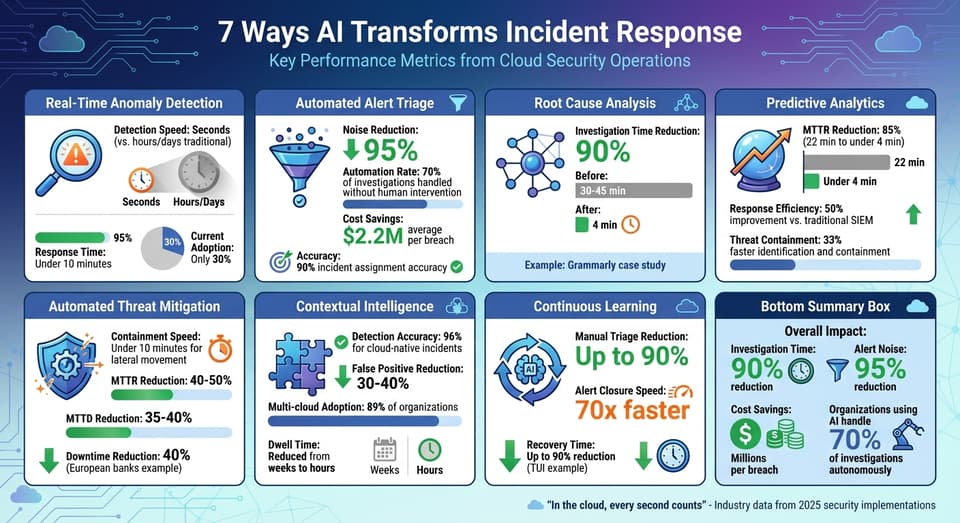
AI-Powered Incident Response: Key Performance Metrics and Benefits
1. Real-Time Anomaly Detection
Real-time detection capabilities
AI has the ability to establish behavioral baselines for users, systems, and workloads, quickly learning what "normal" activity looks like. It flags deviations - like unusual API calls, unexpected access paths, or odd workload actions - almost instantly. For example, modern AI systems can define normal traffic patterns in just seconds, enabling them to detect zero-day exploits on the spot. This speed is a game-changer, especially when you consider that only around 30% of organizations currently have real-time detection capabilities. While traditional methods might take hours or even days to identify an issue, AI-driven systems can detect and respond to threats in under 10 minutes.
"AI enables detection of zero-day attacks, insider threats, and subtle anomalies that might otherwise slip through static defenses." - Andrew Dennis, Senior Content/Growth Manager, Lumos
Integration with cloud environments
AI-powered anomaly detection seamlessly integrates with cloud environments, keeping an eye on everything from container operations to serverless functions and multi-cloud telemetry. Machine learning models analyze data from platforms like AWS, Azure, and hybrid setups, providing a unified view of potential risks. These systems also work with cloud-native tools like AWS CloudTrail, Azure Monitor, and VPC logs, offering deeper contextual insights. One standout feature is their ability to capture forensic data from short-lived workloads (like EC2 instances) before they are terminated, ensuring no critical information is lost. Beyond detecting anomalies, they also pinpoint misconfigurations and privilege escalations in real time, tackling vulnerabilities that traditional tools often overlook. This level of analysis makes automated response processes more efficient and effective.
Automation of incident response processes
AI-driven automation takes incident response to the next level by filtering out benign anomalies and prioritizing alerts based on their risk level. This cuts down noise by 95%, allowing security teams to focus on genuine threats instead of being bogged down by false positives. Impressively, AI systems now handle around 70% of investigations without human intervention. A real-world example? In November 2025, FinTrust implemented an ML-based anomaly detection system that reduced their mean time to resolution (MTTR) by 85%, from 22 minutes to under 4 minutes. Over a 90-day period, they also saw a 40% drop in false positives and an improvement in SLA compliance from 93% to 99.7%.
"Previously, our engineers sifted through fragmented dashboards and logs for over 30 minutes before taking action. Now, correlated alerts with context and suggested remediation steps are pushed to Slack, cutting our triage time by 70%." - Ops Lead, FinTrust
sbb-itb-d663cbd
AI for SOC Automation: A Blueprint for the New world of Incident Response
2. Automated Alert Triage
AI-powered triage takes incident response to the next level by cutting through the noise and delivering immediate context. Instead of sifting through endless control-plane events, identity activities, and workload signals, AI filters out irrelevant alerts and highlights what truly matters. It consolidates identity logs, configuration histories, and metadata in seconds, giving teams a clear starting point for investigations. What used to take minutes of manual effort is now done with impressive speed and precision.
Modern AI triage systems use scoring (on a 0–100 scale) and color-coded alerts to help SOC analysts spot the most critical threats, such as ransomware or nation-state attacks, right away. These systems prioritize incidents by evaluating factors like internet exposure, privilege levels, data sensitivity, and network reachability. AI doesn’t just flag issues - it also offers incident classifications and containment recommendations, making it easier for teams to act quickly.
"AI is most effective in the earliest phase of incident response – triage, enrichment, and context assembly – where analysts normally spend the majority of their time stitching together identity activity, configuration history, and resource metadata." - Wiz
Ability to Minimize Downtime and Improve Efficiency
The speed and precision of automated triage directly translate into quicker resolutions and less downtime. A great example of this comes from January 2025, when Microsoft's Azure Core Insights Team introduced the "Triangle System." This AI framework used "Local Triage" agents to evaluate incidents based on Troubleshooting Guides (TSGs). The results were impressive: the system achieved 90% accuracy in incident assignment, and one team reduced their Time to Mitigate by 38%. By routing alerts accurately from the start, AI eliminates inefficiencies like "alert bouncing" between departments and redundant assignments.
"The biggest gains come from consistency, not autonomy. AI standardizes how investigations begin, ensuring every analyst – regardless of experience – starts with the same complete picture of an alert." - Wiz
Organizations leveraging AI-driven triage systems can handle about 70% of security investigations without human intervention, saving an average of $2.2 million per breach. With intelligent routing, automated enrichment, and prioritization, critical servers are addressed first, ensuring that high-impact issues are resolved before they can cause significant damage.
3. Event Correlation and Root Cause Analysis
AI is reshaping how security teams handle incidents by piecing together low-level alerts into a cohesive story. It automatically pulls evidence from multiple domains - like identity activity, configuration changes, and resource metadata - to create a clear, chronological timeline of an attack. This approach uncovers complex attack patterns, such as lateral movement or credential misuse across accounts or services. By seamlessly connecting these dots, AI lays the groundwork for tighter integration with cloud environments.
Integration with Cloud Environments
AI's real-time detection capabilities become even more effective when paired with cloud-native telemetry. By tapping into cloud data in real time, AI uses a "Security Graph" to map relationships between identities, resources, and configuration changes. This eliminates the need for manual intervention, as it reconstructs the event sequence automatically. Natural Language Processing (NLP) takes it a step further, allowing analysts to query cloud data using plain English, like asking, "What unusual API calls came from IP address X?" This simplifies investigations, making them faster and more intuitive. Some platforms go further by automating the capture of transient assets, like EC2 instances, as soon as an alert is raised, ensuring no critical evidence is lost.
Minimizing Downtime and Improving Efficiency
This advanced correlation doesn't just improve accuracy - it slashes response times. For example, in May 2025, Grammarly's security team adopted an AI-driven workflow to automate the process of gathering context from identity logs and configuration data. What used to take 30–45 minutes now takes just four minutes, thanks to AI reducing investigation time by a staggering 90%.
"The investigative agent automates the most time-consuming part of investigations - gathering and correlating evidence from multiple sources. Instead of spending an hour on manual log analysis, you can spend most of that time on making containment decisions." - AWS Security Blog
4. Predictive Threat Analytics
AI doesn't just respond to threats - it anticipates them. Predictive threat analytics leverages machine learning to define what "normal" looks like and flags deviations before they can escalate. This means detecting unusual identity behaviors or unexpected access patterns that traditional rule-based systems might completely overlook. Unlike older methods that react to alerts, predictive analytics equips teams to foresee and neutralize threats before they become critical.
Real-Time Detection Capabilities
Predictive analytics takes automated triage and event correlation a step further by identifying threats before they fully emerge. Its strength lies in recognizing long-term, subtle patterns that hint at potential risks. While traditional tools might catch glaring attacks, AI models excel at spotting gradual privilege escalation or slow, methodical probing attempts that unfold over extended periods. Using time-series analysis models like Isolation Forest and Prophet, AI monitors metrics such as CPU usage, memory consumption, and network latency to detect unusual activity in real time. For example, in one fintech use case, this approach achieved an 85% drop in Mean Time to Recovery (MTTR), cutting recovery time from 22 minutes to under 4 minutes during peak trading hours.
Integration with Cloud Environments
Predictive analytics becomes even more powerful when integrated with cloud-native telemetry. By synthesizing data from workloads, infrastructure, and identities, AI can detect lateral movement that might otherwise go unnoticed. With 89% of businesses now operating across multiple cloud providers, AI helps close diagnostic gaps by capturing fleeting telemetry from short-lived resources like containers. These systems evaluate contextual factors - such as internet exposure, privilege levels, and resource importance - to focus on genuine risks while filtering out harmless anomalies. This forward-looking detection significantly enhances incident response and reduces downtime.
Minimizing Downtime and Boosting Efficiency
By predicting incidents before they violate Service Level Agreements (SLAs), AI enables teams to move from reactive crisis management to proactive resilience planning. Organizations using predictive analytics have reduced threat identification and containment times by 33% and improved incident response efficiency by up to 50% compared to traditional SIEM systems. In one case, an AI-powered triage system helped a production team achieve a 38% reduction in Time to Mitigate (TTM), allowing them to address critical threats faster and maintain consistent service availability.
5. Automated Threat Mitigation
After detecting a threat, AI doesn’t just stop there - it immediately jumps into action. Automated threat mitigation allows for swift containment measures the moment a threat is identified. For known threats, AI can act instantly by isolating infected workloads, revoking compromised credentials, or blocking malicious IP addresses. This quick response is especially important in cloud environments, where resources like containers can vanish before manual intervention even starts. Such speed ensures incidents are contained efficiently and effectively.
Automation of Incident Response Processes
AI-powered platforms like Security Orchestration, Automation, and Response (SOAR) systems are game-changers in incident response. These platforms follow predefined playbooks to take action as soon as a threat is confirmed. Impressively, they handle nearly 70% of security investigations without needing human involvement, allowing analysts to focus on more complex, critical issues. Automated triage and data enrichment also slash the time it takes to build a full picture of an incident - from almost an hour to just a few minutes. For example, in January 2025, a major healthcare provider adopted AI-driven automated mitigation. When a credential leak attempt was detected, the system quarantined compromised containers, revoked exposed API keys, and rotated credentials - all within 90 seconds. This swift response stopped attackers before they could exploit the breach.
Integration with Cloud Environments
AI’s integration with cloud environments takes automated mitigation to another level. These systems can instantly query infrastructure, inventory assets, and review creation histories. By working with tools like AWS Lambda, ArgoCD, and Azure Logic Apps, AI enables precision actions, such as isolating compromised nodes or updating security groups in real time. Google has demonstrated how this approach can reduce attacker dwell time from the industry norm of weeks to just hours using automated detection and response. Beyond that, AI acts as a virtual analyst, simplifying complex cloud threats into plain language and helping junior team members navigate investigations without requiring deep expertise.
Ability to Minimize Downtime and Improve Efficiency
One of the standout benefits of automated mitigation is its ability to limit the damage caused by attacks. By spotting lateral movement and triggering specific countermeasures in under 10 minutes, AI prevents incidents from spiraling out of control. European banks, for instance, have reported a 40% drop in system downtime just six months after deploying AI-driven security tools. Additionally, these platforms cut Mean Time to Respond (MTTR) by 40–50% and Mean Time to Detect (MTTD) by 35–40%. They also reduce noise by an incredible 95%, allowing teams to focus solely on real threats instead of wasting time on false alarms. Over time, AI continues to refine its responses, making threat mitigation even more efficient.
6. Contextual Threat Intelligence Integration
AI doesn’t just stop at detecting threats - it goes a step further by integrating contextual data to provide a clearer, more comprehensive view of potential risks. This means AI can automatically piece together data from various sources within your cloud environment to create a unified picture of what’s happening. In mere seconds, it pulls information from identity logs, configuration histories, and workload metadata. By correlating data across workloads, cloud infrastructure, and user identities, AI uncovers the full extent of an attack, including lateral movements that might otherwise go unnoticed. This level of integration not only enhances detection but also sets the stage for automated incident responses, seamlessly linking threat identification to swift action.
Real-Time Detection Capabilities
Contextual threat intelligence takes cloud security to the next level by enriching every alert with vital background information. AI-powered systems boast an impressive 96% accuracy in identifying cloud-native cyber incidents, thanks to their ability to weigh critical contextual factors. Instead of treating every alert as equally urgent, these systems evaluate elements like internet exposure, privilege escalations, and data sensitivity to prioritize the most pressing risks. They also tap into trusted external sources like AbuseIPDB and internal tools such as Microsoft Intune to deliver instant reputation checks and device compliance updates during triage. In fast-paced cloud environments, where resources can disappear in seconds, AI-driven forensics kick in immediately, preserving key evidence that might otherwise be lost when anomalies are detected.
Automation of Incident Response Processes
With precise detection as its foundation, AI-driven automation transforms raw data into actionable insights. Contextual intelligence reshapes how security teams operate by automatically reconstructing event timelines and linking related cloud resources. AI systems now handle around 70% of security investigations independently, correlating low-level alerts into meaningful incidents.
"AI is most effective in the earliest phase of incident response - triage, enrichment, and context assembly - where analysts normally spend the majority of their time stitching together identity activity, configuration history, and resource metadata." - Wiz
Integration with Cloud Environments
Modern AI systems excel at synthesizing data across different cloud providers and services, creating a unified threat landscape. With 89% of organizations now using multi-cloud setups, this capability addresses diagnostic blind spots that could otherwise leave teams exposed. For instance, in January 2025, a healthcare provider implemented AI-driven contextual intelligence across its hybrid AWS and Azure infrastructure. This system detected a privilege escalation attempt within just 90 seconds by correlating identity behaviors, configuration changes, and workload anomalies. It then automatically initiated containment protocols, successfully preventing unauthorized access to sensitive patient data.
Ability to Minimize Downtime and Improve Efficiency
The efficiency gains from contextual intelligence are hard to overstate. By filtering out benign activity and cutting false positives by 30–40%, AI enables security teams to focus on genuine threats rather than wasting time on unnecessary alerts. Google has shown how this approach can slash industry-average dwell times from weeks to mere hours, thanks to automated detection and contextual response workflows. This streamlined process ensures security teams can maintain operational continuity while responding to critical threats with pinpoint accuracy.
7. Continuous Learning and Playbook Optimization
Continuous learning takes incident response to the next level, transforming it into a cycle that improves itself over time. By building on automated detection, triage, mitigation, and contextual intelligence, it shifts incident management from reactive to proactive.
AI doesn’t just handle incidents - it learns from them. Unlike static, rule-based playbooks that need constant manual updates, AI-driven systems evolve with every incident they process. Machine learning sharpens detection and response strategies by analyzing historical data and feedback, creating a continuous operations loop. This loop turns incident management into an ongoing learning system that systematically reduces the need for manual intervention over time.
Automation of Incident Response Processes
AI goes beyond simply executing playbooks - it refines them. By studying event streams and analyzing the outcomes of incidents, AI uncovers patterns and suggests automation opportunities based on proven success. This dynamic optimization doesn’t just improve playbooks; it leads to significant efficiency gains.
"An AI-powered continuous operations loop... turns incident management into an end‑to‑end learning system that captures what happens during every incident, feeds that knowledge back into AI and automation, and systematically reduces manual work over time." - David Williams, PagerDuty
Reducing Downtime and Boosting Efficiency
By learning from past incidents, AI dramatically cuts down on manual triage and speeds up alert closures. For example, automation powered by AI can reduce manual triage time by up to 90% and accelerate alert closures by 70x. A great example is travel network TUI, which adopted a learning-based incident management model in 2025. By reusing response playbooks across its global network, TUI slashed recovery times by up to 90%.
This approach also ensures that valuable institutional knowledge isn’t lost. AI automatically documents incident timelines and successful resolutions, so responders don’t have to start from scratch when dealing with recurring issues. Every incident adds to the system’s knowledge base, making it stronger and more responsive over time.
Conclusion
AI is transforming how incident response is handled, especially in the fast-paced world of cloud infrastructure. The seven methods discussed - real-time anomaly detection, automated alert triage, event correlation and root cause analysis, predictive threat analytics, automated threat mitigation, contextual threat intelligence integration, and continuous learning - combine to build a security framework that significantly cuts response times and minimizes operational disruptions.
The results are hard to ignore. Organizations leveraging AI and automation report a 33% reduction in mean time to identify and contain incidents and a 95% drop in alert noise, freeing DevOps teams to focus on genuine threats rather than chasing false alarms. For example, Grammarly has experienced a dramatic improvement in investigation efficiency, reducing review times from 30–45 minutes to just 4 minutes - a nearly 90% improvement.
"In the cloud, every second counts." - Eric Carter, Sysdig
Platforms like Automate Security are built with DevOps teams in mind, offering tools that handle complex tasks like context assembly, intelligent prioritization, and guided remediation. At the same time, they maintain a human-in-the-loop approach, ensuring that security professionals remain in control of critical decisions. This approach levels the playing field, providing all analysts - regardless of experience - with a comprehensive and context-rich view of incidents.
FAQs
What data sources does AI need to detect cloud incidents in real time?
AI works by examining data from sources such as cloud activity logs, API calls, network traffic, identity and access management (IAM) permissions, and resource metadata. By analyzing these inputs, it can spot unusual patterns and detect potential incidents as they happen. This enables faster responses and strengthens overall security.
How do you keep automated containment from breaking production systems?
To prevent unnecessary disruptions, automated containment tools need built-in safeguards that prioritize both speed and stability. AI-powered systems excel at pinpointing threats and delivering precise responses, reducing the chances of false positives or overly broad actions. Customizable workflows allow organizations to tailor containment strategies to their specific needs, often incorporating options for human oversight to ensure critical decisions are well-informed. By testing containment measures in controlled environments or simulations, teams can uncover potential issues and fine-tune processes, striking the right balance between stability and effective real-time incident management.
How can a team measure ROI from AI-driven incident response?
To gauge ROI from AI-powered incident response, focus on key metrics like Mean Time to Respond (MTTR) and Mean Time to Detect (MTTD) - both of which AI can dramatically shorten. Look at cost savings achieved through quicker resolutions and reduced reliance on manual efforts. For instance, automation can slash investigation workloads by as much as 70%. Pair these measurable benefits with qualitative feedback on improved threat detection and response processes to get a well-rounded view of ROI.