
Top 10 Cloud Security Automation Tools in 2026
AI-driven cloud security tools for 2026 that automate threat detection, enforce compliance, and cut incident resolution times and costs.

Cloud security in 2026 demands automation and AI to keep up with increasingly complex multi-cloud environments. This article highlights the top 10 AI-driven cloud security tools that help organizations detect threats, manage compliance, and reduce manual workloads.
Key Takeaways:
- Automated Threat Detection: AI-powered tools like Microsoft Sentinel and Tenable reduce false positives and speed up incident response.
- Integrated Compliance: Platforms like Vanta and Qualys automate compliance tasks, saving time and ensuring adherence to frameworks like SOC 2 and GDPR.
- Multi-Cloud Scalability: Tools such as Splunk and SentinelOne provide unified security across AWS, Azure, GCP, and Kubernetes.
- Cost Impact: Leveraging AI can cut breach costs by up to $2 million and reduce incident resolution times by 50%–75%.
Featured Tools:
- Automate Security: AI-driven detection, DevOps-friendly, real-time monitoring.
- Microsoft Sentinel: Cloud-native SIEM/SOAR with over 350 integrations.
- Splunk Enterprise Security: Combines SIEM, SOAR, and UEBA for multi-cloud setups.
- ArcSight: Advanced analytics and SOAR for hybrid cloud systems.
- Vanta: Automates compliance across 35+ frameworks with an AI Agent.
- Tenable: Prioritizes risks with AI-driven exposure assessments.
- Qualys VMDR: Focuses on vulnerability management and automated remediation.
- Palo Alto Cortex XDR: Unified protection for endpoints, networks, and cloud.
- Lacework (FortiCNAPP): AI-based behavioral analysis for cloud workloads.
- SentinelOne: AI-powered threat detection with low false positives.
Why It Matters:
With 99% of cloud security failures caused by misconfigurations and 52% of non-human identities holding excessive permissions, organizations can no longer rely on manual methods. AI-powered tools not only address these challenges but also streamline security operations, enabling faster responses and reducing operational costs.
For a quick comparison of these tools and their features, check out the table below.
Quick Comparison
| Tool | Key Features | Best For | Integration Support |
|---|---|---|---|
| Automate Security | AI-based threat detection, DevOps-ready | Real-time monitoring | AWS, Azure, GCP, Kubernetes |
| Microsoft Sentinel | Cloud-native SIEM/SOAR, AI insights | Large-scale multi-cloud environments | 350+ integrations |
| Splunk Enterprise | SIEM, SOAR, UEBA combined | Multi-cloud setups | AWS, Azure, GCP |
| ArcSight | Advanced analytics, SOAR capabilities | Hybrid cloud systems | Google Security Operations |
| Vanta | Compliance automation, AI Agent | Governance, Risk, and Compliance | 400+ integrations |
| Tenable | AI-driven risk prioritization | Exposure management | AWS, Azure, GCP |
| Qualys VMDR | Vulnerability management, automated fixes | CI/CD pipelines | AWS, Azure, GCP, Oracle |
| Palo Alto Cortex | Unified endpoint, network, and cloud security | Enterprise-wide protection | Multi-cloud, Kubernetes |
| Lacework (FortiCNAPP) | Behavioral analysis, compliance mapping | Cloud workload protection | AWS, Azure, GCP |
| SentinelOne | Low false positives, AI lifecycle security | Multi-cloud and hybrid environments | AWS, Azure, GCP, OCI |
These tools represent the forefront of cloud security, ensuring organizations stay ahead of threats while meeting compliance requirements.
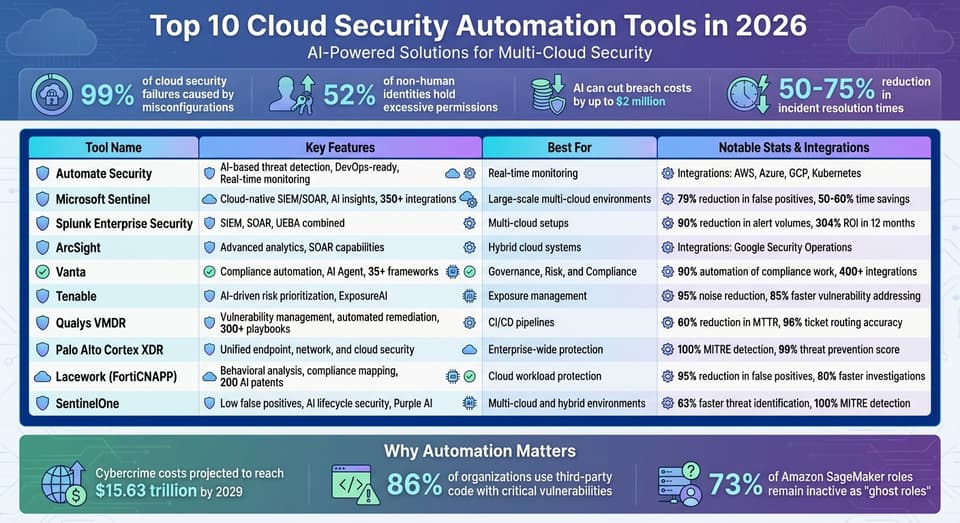
Top 10 Cloud Security Automation Tools Comparison 2026
Using AI Agents to Solve Cloud Vulnerability Overload
sbb-itb-d663cbd
1. Automate Security
Automate Security is tailored for DevOps teams and security leaders who need to safeguard cloud infrastructures without disrupting deployment workflows. By combining AI-driven threat detection with automated incident response, it ensures cloud environments stay secure while maintaining efficiency. Let’s break down its key features.
AI-Powered Threat Detection and Response
This platform leverages autonomous AI to investigate, enrich, and respond to security alerts without needing manual input[15, 16]. This approach dramatically cuts down dwell time - the crucial period between a threat entering your system and its detection. Instead of static rules, Automate Security uses behavioral anomaly detection to create dynamic baselines of normal activity for networks and users[15, 17, 18]. For instance, unusual service account behavior or unexpected lateral movements immediately trigger alerts.
It processes millions of logs and events in real time across the entire cloud infrastructure. This real-time, autonomous detection integrates smoothly into a variety of cloud setups.
Integration with Cloud Environments and DevOps Workflows
Automate Security works seamlessly with major platforms like AWS, Azure, GCP, and Kubernetes, fitting directly into existing DevOps pipelines. It monitors workloads across hybrid and multi-cloud environments, making it easier to manage interconnected components across different providers.
Automation for Compliance and Incident Management
Going beyond basic playbooks, Automate Security uses AI-driven reasoning to evaluate complex scenarios and make instant, policy-based decisions. This hyperautomation handles the entire incident lifecycle - covering detection, triage, investigation, containment, and remediation.
2. Microsoft Sentinel
Microsoft Sentinel is a cloud-native SIEM/SOAR platform designed for multi-cloud security environments. By eliminating the need for on-premises infrastructure, it automatically scales to handle massive data volumes. With over 350 native connectors, it seamlessly integrates with platforms like Azure, Microsoft 365, AWS CloudTrail, and Google Cloud Platform.
AI-Powered Threat Detection and Response
In January 2026, Microsoft introduced a UEBA behaviors layer that translates high-volume logs into actionable insights, aligning them with MITRE ATT&CK tactics. This feature helps cut through the noise, making it easier to identify genuine threats quickly. Additionally, the Microsoft Security Copilot leverages generative AI to summarize incidents, craft Kusto Query Language (KQL) queries, and guide response actions. This innovation has reduced mean time to resolution (MTTR) by 30%.
For example, in 2024, Danfoss adopted Microsoft Sentinel to process logs from 20 applications and thousands of devices. According to Director Chunqui Chen, the platform reduced time spent on false positives and manual operations by 50%–60%, while also achieving a 79% reduction in false positives across deployments.
This advanced detection capability integrates smoothly into DevOps workflows, boosting security automation and efficiency.
Integration with Cloud Environments and DevOps Workflows
Microsoft Sentinel's Codeless Connector Framework (CCF) allows teams to create custom, no-code connectors for any data source using REST-API, Syslog, or Common Event Format. The automation rules API supports CI/CD pipelines, enabling security teams to manage automation workflows as code. Meanwhile, Azure Logic Apps enable SOAR playbooks that integrate with tools like Jira and ServiceNow, streamlining processes like ticketing and remediation.
A CIO in the retail sector highlighted the benefits of consolidating security operations within Sentinel, emphasizing how it eliminates the need for managing multiple tools from different vendors.
Scalability and Suitability for Enterprise or Multi-Cloud Environments
Microsoft Sentinel is built to scale for enterprise-level demands. The Microsoft Sentinel Data Lake, available since September 2025, centralizes security data at scale, separating data ingestion from analytics for cost-effective, long-term storage. Additionally, Azure Lighthouse allows service providers and enterprises to manage multiple subscriptions and tenants through a unified interface.
Users report 44% lower costs compared to legacy SIEMs and a 35% reduction in the likelihood of security breaches. The platform is supported by a team of over 10,000 security experts and engineers at Microsoft, ensuring robust performance and reliability.
3. Splunk Enterprise Security
Splunk Enterprise Security brings together detection and response tools to tackle the challenges of securing multi-cloud environments. By integrating SIEM, SOAR, and UEBA with AI into one platform, it eliminates the need for multiple tools, helping security teams work more efficiently. It’s designed to work seamlessly with AWS, Microsoft Azure, and Google Cloud Platform, making it a strong choice for multi-cloud setups.
AI-Powered Threat Detection and Response
Splunk's AI Assistant simplifies incident analysis by allowing analysts to use natural language queries to summarize events. Meanwhile, its UEBA feature uses machine learning to spot unusual activities, such as compromised credentials or insider threats, across both cloud and on-premises systems. Risk-Based Alerting (RBA) further refines the process by assigning a 0-100 score to alerts, prioritizing the most critical threats and cutting down alert volumes by as much as 90%. The results speak for themselves: organizations have seen a 64% improvement in threat identification, a 55% reduction in incident resolution times, and a 304% return on investment within just 12 months. These capabilities are bolstered by automation tools that simplify incident management even further.
Automation Capabilities for Compliance and Incident Management
Splunk's automation features enhance its threat detection tools. The SOAR integration works with over 300 third-party tools and supports more than 2,800 automated actions. Its no-code Visual Playbook Editor allows teams to design and execute complex workflows without writing code. Automated notifications keep external teams informed through platforms like Slack, Microsoft Teams, or ticketing systems, speeding up incident resolution. For example, Novuna, a financial services company, handled 80,000 security events in 2025 using Splunk SOAR, saving $500,000 by optimizing licensing and reducing on-call hours. Similarly, Tide, a business financial platform, automated 95% of its incident responses, slashing resolution times from hours to minutes. Ojasvi Chauhan, a Threat Detection Engineer at Tide, highlighted the benefits:
"We now have visibility into all of our tools and resources, whether they're homegrown or third-party applications. That information raises security consciousness and informs the actions we take across the business."
Integration with Cloud Environments and DevOps Workflows
Splunk's Federated Search and Analytics allow teams to analyze data stored in cloud environments like Amazon S3 or Amazon Security Lake without ingesting all the data, cutting costs while maintaining visibility. The cloud-only Detection Studio supports the entire detection lifecycle, enabling engineers to test, deploy, and monitor detections aligned with the MITRE ATT&CK framework. Additionally, the platform’s automation engine now requires Python 3.13 for custom playbooks, ensuring it stays up-to-date with modern security standards. This approach aligns security workflows with DevOps practices, making it easier to integrate into CI/CD pipelines.
4. ArcSight
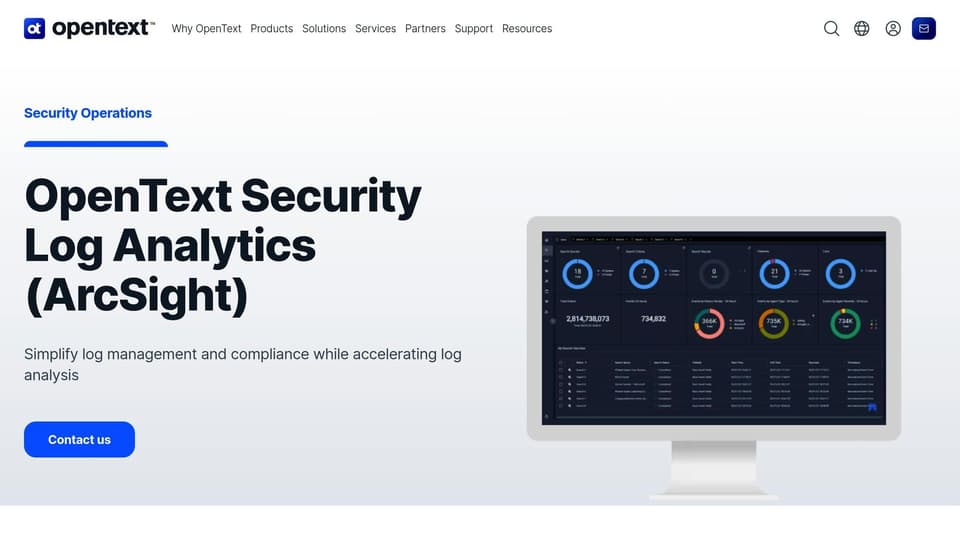
ArcSight, now part of OpenText, has transitioned from being a traditional SIEM solution to an AI-driven platform designed for hybrid and multi-cloud systems. By employing advanced analytics and machine learning, it correlates data from diverse sources like network devices, servers, and cloud applications. This capability helps uncover potential threats that static, rule-based systems might miss. Its real-time user behavior analysis ensures comprehensive visibility, even across intricate cloud environments, while enabling faster and more effective threat detection.
AI-Powered Threat Detection and Response
ArcSight's machine learning models excel at recognizing patterns and correlations that traditional systems often overlook. This feature significantly reduces the time needed to create detection rules - from days to just hours. Its built-in SOAR (Security Orchestration, Automation, and Response) capabilities enable automated playbooks to address threats before sensitive data is compromised. This is especially vital given the overwhelming volume of security alerts organizations face daily - often exceeding 300 - and the lengthy manual investigation times, which can stretch to 8 hours per alert.
Oliver Rochford, a respected voice in the SIEM industry, highlighted the market's growth, noting an increase from $5.03 billion in 2022 to $5.7 billion in 2023. This 13% annual growth reflects the rising demand for advanced threat detection and response solutions.
Automation Capabilities for Compliance and Incident Management
ArcSight's SOAR integration enhances incident response by automating context gathering and orchestrating playbooks for swift threat remediation. OpenText describes this capability as:
"ArcSight SOAR delivers an automated case response solution for repetitive security events and imparts a seamless security management experience by performing faster threat detection and remediation."
The platform also simplifies compliance management with pre-defined and customizable report templates. These templates automate auditing and reporting, helping organizations meet standards such as ISO 27001, GDPR, and HIPAA.
Scalability and Suitability for Enterprise or Multi-Cloud Environments
ArcSight ESM is designed to scale effortlessly for multi-cloud deployments. It integrates with cloud-native platforms like Google Security Operations, enabling near real-time translation and contextualization of correlation events. Its Security Events Connector can handle up to 1,000 alerts per iteration in cloud-based environments, while the API framework - operating on ports 443 and 8443 - allows external SOAR platforms to trigger actions across various tools.
For large enterprises, ArcSight supports multi-tenancy, mapping alerts to specific cloud segments or customer environments. This makes it an ideal solution for organizations managing complex DevOps workflows across AWS, Azure, and Google Cloud Platform.
ArcSight combines AI and automation to streamline both threat detection and compliance efforts, making it a strong choice for enterprises navigating the complexities of cloud-based security.
5. Vanta
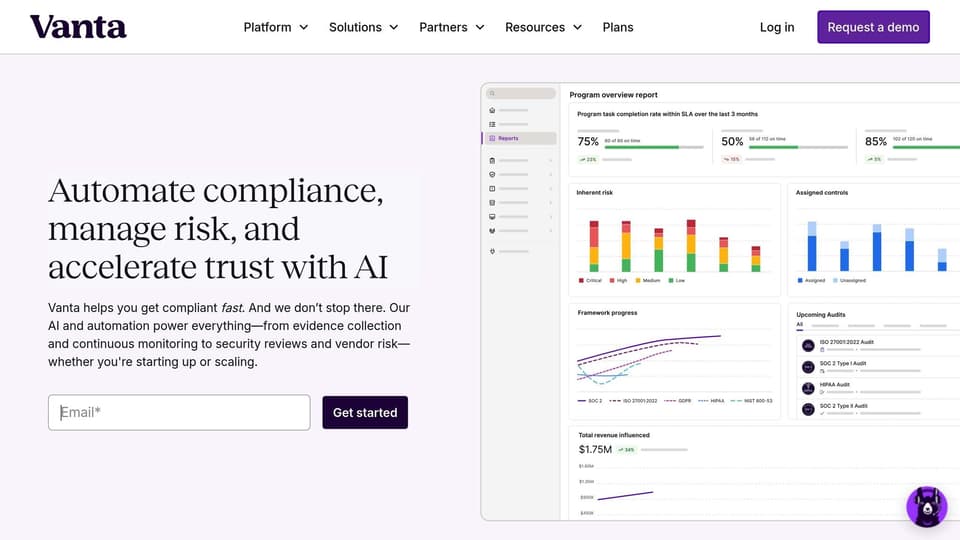
Vanta has grown from a compliance automation tool into what it calls an "Agentic Trust Platform", combining governance, risk management, and ongoing security monitoring with the help of its AI Agent. The Vanta AI Agent takes over repetitive GRC (Governance, Risk, and Compliance) tasks like drafting policies, completing security questionnaires, and spotting compliance issues early. With a 95% acceptance rate, the AI Agent saves teams an average of 4 hours each week on compliance-related work. These features highlight how Vanta is simplifying GRC and security management.
Automation for Compliance and Incident Handling
Vanta automates up to 90% of the work needed to achieve security and privacy certifications across more than 35 frameworks, including SOC 2, ISO 27001, HIPAA, and FedRAMP. It also provides continuous monitoring of over 40 AWS, 30 Azure, and 25 GCP resources to catch configuration issues and control failures in real time. When problems arise, the AI Agent steps in to analyze the issue and suggest fixes, including detailed remediation snippets for tools like Terraform, AWS CLI, and CloudFormation.
Tony English, CISO at WorkJam, shared his experience in late 2025:
"With AI in Vanta, we spend about an hour a week on compliance tasks instead of seven or eight. Compliance has moved from a resource-draining task into a function that strengthens our overall security posture."
Similarly, Anna Guillot, an Information Security Specialist at TravelPerk, noted in December 2025 that Vanta AI cut her team's time spent on security questionnaire responses in half.
Integration with Cloud and DevOps Tools
Vanta fits seamlessly into developer workflows through its MCP Server, linking security insights to AI-powered tools like VS Code, Cursor, and Windsurf. This integration allows teams to address security concerns during the coding process rather than after deployment. The platform also automates evidence collection by pulling data from over 400 integrations, including GitHub, Jira, AWS GuardDuty, and AWS Inspector, to identify vulnerabilities and track malicious activities.
Flexible Scaling for Enterprises and Multi-Cloud Systems
Vanta is built to scale from startups to large enterprises, offering multi-product, multi-region, and multi-industry support. Teams can use tags and filters to create compliance profiles tailored to their specific needs. The platform improves security review efficiency by 81%, with 91% of users reporting better audit readiness thanks to the AI Agent. For organizations with strict regulatory requirements, VantaGov operates on AWS GovCloud and supports federal frameworks like FedRAMP, offering machine-readable OSCAL exports. The company also boasts a 95% customer satisfaction score and holds ISO 42001 certification, making it one of the first to achieve this recognition for responsible AI management.
6. Tenable
Tenable provides a robust platform to secure AWS, Azure, and GCP environments, serving over 44,000 customers worldwide. With its ExposureAI technology analyzing over 1 trillion data points, it pinpoints and prioritizes exploitable risks. In 2024, Tenable Research identified 9 million AI application instances across more than 1 million hosts, highlighting its far-reaching visibility.
AI-Powered Threat Detection and Response
Tenable’s AI Aware solution detects hidden AI development activities and identifies vulnerabilities within AI libraries and plugins. Its AI-SPM tool sheds light on AI workloads, revealing concerning trends: 18% of organizations have overprivileged IAM roles, while 52% of non-human identities hold excessive permissions - far exceeding the 37% seen in human roles. Furthermore, 73% of Amazon SageMaker roles and 70% of Amazon Bedrock agent roles remain inactive, creating exploitable gaps for attackers.
These insights feed directly into Tenable’s automated tools for compliance and incident management, ensuring swift action against potential threats.
Automation Capabilities for Compliance and Incident Management
Tenable simplifies risk resolution with its one-click remediation feature, allowing security teams to address compliance issues instantly by selecting "Proceed" on actionable findings. The platform continuously evaluates multi-cloud configurations against standards like CIS, NIST, GDPR, HIPAA, and SOC2, while also generating remediation code in JSON, Terraform, and CloudFormation formats for seamless integration into DevOps pipelines.
"Using [Tenable Cloud Security] automation allowed us to eliminate exhaustive manual processes and perform in minutes what would have taken two or three security people months to accomplish."
– Larry Viviano, Director of Information Security at IntelyCare
Automated ticketing further enhances efficiency by routing root-cause findings to the appropriate teams, significantly reducing mean time to resolution (MTTR).
Integration with Cloud Environments and DevOps Workflows
Tenable integrates security measures early in the development process, using Infrastructure-as-Code (IaC) scanning and container image validation. It also enforces zero-trust principles through Just-in-Time (JIT) access, granting elevated permissions only when necessary.
"The one-click remediation functionality... makes implementing the recommendations seamless."
– Michael Bishop, Director of Architecture and Engineering at Barkbox
Gartner has praised Tenable for its leadership in AI-driven exposure assessment, stating:
"Tenable's asset and attack surface coverage, its application of AI and its reputation for vulnerability assessment makes it the front-runner in AI-powered exposure assessment."
Scalability and Suitability for Enterprise or Multi-Cloud Environments
Tenable’s unified platform offers a single inventory for managing AWS, Azure, and GCP resources, including workloads, identities, containers, and Kubernetes clusters. Its identity-first approach to Cloud Infrastructure Entitlement Management ensures efficient oversight. Robert Huber, Tenable’s Chief Security Officer, highlighted the evolving mindset around automated security:
"Automatic remediation, mobilization, and mitigation are no longer forbidden... teams will start to defy that long-held belief that automatic is forbidden."
For federal agencies, Tenable’s GSA OneGov agreement provides FedRAMP-authorized solutions. Pricing for a 1-year Nessus Professional license starts at $4,390, with discounts available for multi-year commitments.
7. Qualys VMDR
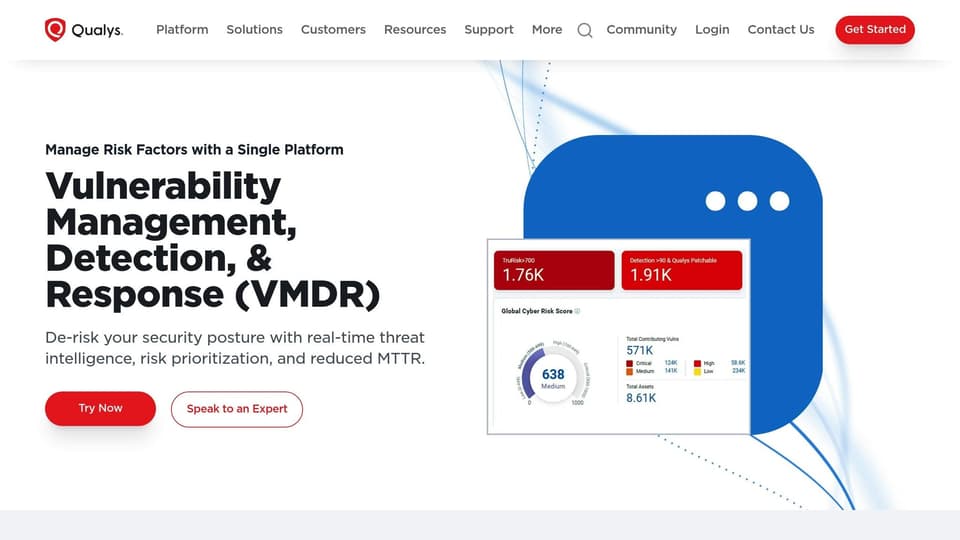
Qualys VMDR (Vulnerability Management, Detection, and Response) leverages advanced scanning and deep learning to safeguard cloud environments across platforms like AWS, Azure, GCP, and Oracle Cloud. With its TruRisk™ engine, the platform sifts through vulnerability data using insights from over 25 threat intelligence feeds and business context, cutting through irrelevant information. This approach reduces noise by 95% and focuses on exploitable risks, helping organizations address critical vulnerabilities by up to 85%. These capabilities create a strong foundation for automation and streamlined integration.
AI-Powered Threat Detection and Response
Qualys uses deep learning to analyze cloud network traffic and system behaviors in real time, detecting threats like zero-day vulnerabilities, fileless malware, and ransomware without relying on outdated signature-based methods. The platform identifies malware up to four hours faster than traditional systems and uncovers unknown threats in under a second.
"Qualys TotalCloud detects malware at least four hours faster than our previous approach. Earlier detection is crucial, because the sooner we can identify and act on threats such as zero-days, the lower the risk that an attack will succeed." – Nemi George, Vice President and Information Security Officer at Qualys
Its Agentic AI shifts security teams from reacting to threats to taking a more strategic approach, speeding up risk identification by 40% and cutting remediation times by 50%.
Automation Capabilities for Compliance and Incident Management
Qualys takes automation to the next level with QFlow™, which features over 300 prebuilt, no-code orchestration playbooks. These playbooks handle tasks like patch management, policy enforcement, and correcting configuration drift. Integrations with tools like ServiceNow and Jira ensure seamless workflows, achieving 96% accuracy in ticket routing and reducing Mean Time to Remediation (MTTR) by up to 60%.
"Qualys scans it, finds it, patches it. That's it. In terms of time, manpower, planning, and the cost reduction in savings of labor dollars...huge." – Tom Scheffler, Security Operations Manager at Cintas
The platform also supports compliance efforts by continuously monitoring against more than 40 global standards, including PCI DSS 4.0, HIPAA, NIST, and GDPR. This ensures organizations have real-time, audit-ready evidence.
"VMDR detected ten times more vulnerabilities than in the same period the previous year." – Raphael Ferreira, Cybersecurity Manager at Banco PAN
Integration with Cloud Environments and DevOps Workflows
Qualys VMDR integrates effortlessly with DevOps workflows. Its FlexScan™ technology combines agent-based, agentless, and API-driven scanning to eliminate blind spots across hybrid and multi-cloud setups. Through TotalAppSec, the platform integrates directly into CI/CD pipelines, scanning Infrastructure as Code (IaC) and APIs to catch misconfigurations before they make it to production.
"Deploying Qualys CDR for AWS and Azure with a few clicks across multiple AWS and Azure subscriptions was a game changer for our security team." – Mark Wootton, Head of Trust & Vulnerability Management at Centrica
Scalability and Suitability for Enterprise or Multi-Cloud Environments
With a flexible consumption model based on Qualys Units (QLUs), enterprises can allocate licenses across modules like VMDR, CSPM, and CDR to adapt to changing security needs. The Enterprise TruRisk Platform processes risk data on a massive scale, offering unified visibility across various security tools. Analysts have taken note, with Forrester naming Qualys a Leader in Cloud-Native Application Protection Platforms for 2026 and KuppingerCole recognizing it as a 2025 Market Leader for CNAPP and CSPM. Organizations can explore the platform with a 30-day free trial.
8. Palo Alto Networks Cortex XDR
Palo Alto Networks Cortex XDR combines endpoint, cloud, network, and identity data into one cohesive platform, trusted by 83 of the Fortune 100 companies and all six branches of the U.S. armed forces. It demonstrated impressive results in the MITRE ATT&CK Evaluations Round 6, achieving 100% detection without delays or configuration changes. Additionally, it scored an impressive 99% in both threat prevention and response in the 2025 AV-Comparatives EPR Test. Using the Cortex Extended Data Lake (XDL), the platform provides enterprise-wide scalability and a unified approach to multi-cloud protection - all powered by a single agent.
AI-Powered Threat Detection and Response
Cortex XDR leverages advanced AI tools like Precision AI and Agentic AI to deliver real-time, comprehensive protection. The Cortex AgentiX Assistant, with its adaptive AI agents, is designed to rapidly investigate and respond to threats, recognizing that cloud attacks can escalate in as little as 25 minutes. For cloud workloads, it uses machine learning-based runtime protection to block malicious Linux executables instantly, with minimal system impact. The platform excels in root cause analysis by connecting disparate data and alerts into a unified view of incidents and user behavior. Its AI-driven prioritization significantly reduces vulnerability noise - by up to 99% - allowing teams to focus on high-risk exposures. With over 10,000 detectors, including 600+ high-fidelity cloud threat detectors added in 2025, the platform is built to tackle evolving threats.
"Cortex XDR has transformed our security operations. Now we have visibility into every transaction and every vulnerability on the servers." – Chris DeBrunner, Vice President of Security Operations, CBTS
Organizations have seen tangible benefits with Cortex XDR. For instance, Asante Health modernized its SOC in 2025, cutting its Mean Time to Remediate (MTTR) from weeks to mere minutes. Similarly, North Dakota IT (NDIT) leveraged the platform to protect citizen data, achieving a 99.6% reduction in open security alerts. These cases highlight the platform's ability to streamline and enhance security operations.
Automation Capabilities for Compliance and Incident Management
Cortex XDR integrates Security Orchestration, Automation, and Response (SOAR) functionalities, automating manual remediation tasks. With over 1,000 prebuilt playbooks and 700+ integrations, it simplifies processes for handling ransomware, phishing, and malware analysis. Companies using Cortex XSIAM have reported a 98% reduction in incident response times and a 75% drop in manual security tasks.
The platform also secures applications across the software development lifecycle, from initial code through CI/CD pipelines to production runtime. For example, Kavak incorporated Cortex XDR into its security operations in 2025, cutting SecOps costs by 50% and boosting security productivity fivefold. Similarly, a digital-first homeownership company automated 90% of its threat response by consolidating its security framework with Palo Alto Networks tools.
Scalability and Suitability for Enterprise or Multi-Cloud Environments
Cortex XDR's design supports seamless integration with DevOps processes while scaling to meet enterprise needs. By using the Cortex Extended Data Lake (XDL), it correlates data from endpoints, networks, cloud, and identity sources. A single XDR agent ensures consistent Cloud Detection and Response (CDR) across multiple cloud providers, reducing cloud resource usage by up to 50% without sacrificing security. Currently protecting 54% of the Global 2000, the platform has earned recognition as a Leader in the 2025 Gartner Magic Quadrant for Endpoint Protection Platforms and The Forrester Wave: Extended Detection and Response (XDR) Platforms, Q2 2024.
With 89% of security leaders advocating for the integration of cloud security and SOC operations, Cortex XDR’s unified "Code to Cloud to SOC" approach aligns perfectly with the industry's evolving needs. This streamlined approach helps organizations achieve better efficiency and stronger protection in an increasingly complex threat landscape.
9. Lacework
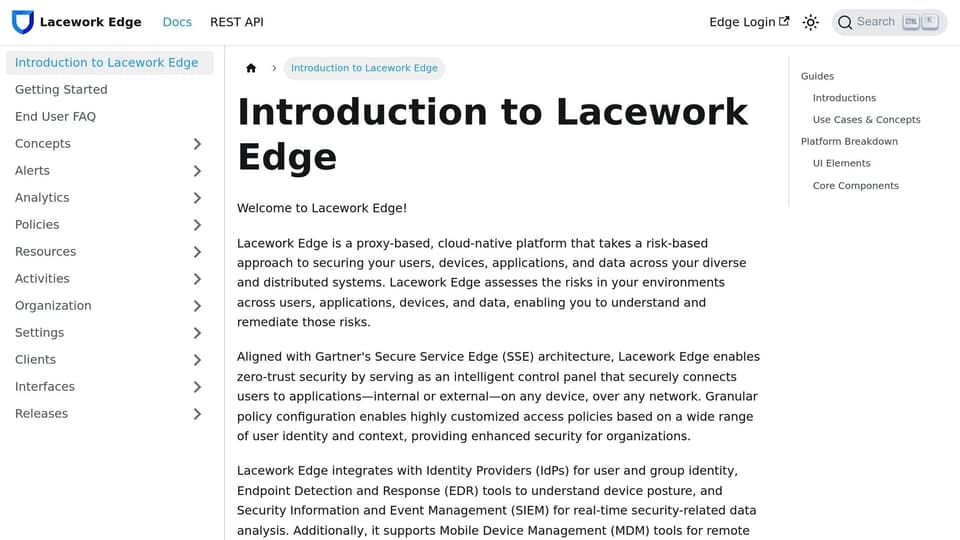
Lacework, now integrated as FortiCNAPP following its acquisition by Fortinet in June 2024, has redefined cloud security with its AI-driven capabilities. Recognized with the 2025 SC Award for Best Cloud Workload Protection Solution, it leverages nearly 200 AI patents to deliver a cutting-edge approach to securing cloud environments. At the core of its functionality is Polygraph technology, a patented machine learning system that establishes behavioral baselines for processes, containers, and users, enabling the detection of anomalies without relying on manual rule creation.
AI-Powered Threat Detection and Response
FortiCNAPP’s AI capabilities drastically improve threat detection and response times. By reducing investigation times by 80%, cutting false positives by 95%, and limiting critical alerts to an average of 1.4 per day, it streamlines security operations. The platform excels at identifying zero-day threats, such as compromised credentials, ransomware, and cryptojacking, by spotting irregularities before traditional attack patterns emerge.
A standout feature, Lacework AI Assist, acts as a virtual assistant, offering tailored explanations for alerts and actionable steps for remediation.
"Lacework was founded on the premise that harnessing your cloud data through deep ML/AI capabilities is the way to bring safety and scale to cloud security." - Fortinet
FortiCNAPP also prioritizes data privacy, adhering to a strict policy that ensures analyzed data remains within the customer’s cloud environment. While earlier versions faced challenges with noise in high-traffic production settings, the introduction of Lacework Query Language (LQL) provided security teams with the flexibility to create custom detection rules when necessary.
Automation Capabilities for Compliance and Incident Management
The platform simplifies compliance by mapping cloud assets to major frameworks like PCI DSS, HIPAA, SOC 2, and ISO 27001 across AWS, Azure, and Google Cloud. It reduces vulnerability noise by up to 90%, contextualizing risks to prioritize the most critical issues.
FortiCNAPP’s Cloud Infrastructure Entitlement Management (CIEM) feature automatically identifies effective permissions for cloud identities, offering remediation guidance to enforce least-privilege access. Additionally, it integrates seamlessly with DevOps workflows, incorporating SAST, SCA, and IaC security to catch vulnerabilities before deployment. These automation tools make it easier for organizations to maintain compliance while managing complex environments.
Scalability and Suitability for Enterprise or Multi-Cloud Environments
Built for scalability, FortiCNAPP secures environments across AWS, Azure, Google Cloud, and private cloud infrastructures, accommodating enterprises of any size. It consolidates fragmented tools into a unified platform, serving as a single source of truth for security, operations, and development teams working in hybrid setups.
As part of the Fortinet Security Fabric, FortiCNAPP integrates seamlessly with broader security infrastructures, providing comprehensive visibility and response capabilities across diverse environments. Its approach aligns with the industry’s growing focus on AI-powered, integrated cloud security solutions.
"If your current rules-driven cloud security solution can't scale, then discover how you can automate security and compliance across AWS, Azure, Google Cloud, and private clouds with FortiCNAPP." - Fortinet
10. SentinelOne
Rounding out the top 10 cloud security automation tools for 2026, SentinelOne stands out with its blend of AI-driven threat detection and seamless scalability. The platform has earned its reputation as a leader, holding a top spot in the Gartner® Magic Quadrant™ for Endpoint Protection Platforms for five consecutive years as of 2025. Trusted by four of the Fortune 10 and numerous Global 2000 companies, SentinelOne provides enterprise-level protection across major cloud providers like AWS, Azure, Google Cloud Platform, Oracle Cloud Infrastructure, DigitalOcean, and Alibaba Cloud.
AI-Powered Threat Detection and Response
At the heart of SentinelOne’s capabilities is Purple AI, a generative security analyst designed to streamline threat detection and investigations. With this tool, teams can identify threats 63% faster and resolve them 55% faster, as shown in the 2024 MITRE ATT&CK® Enterprise Evaluations, which recorded 100% detection and 88% fewer alerts compared to the median vendor. The platform’s Verified Exploit Paths™ feature prioritizes critical fixes by highlighting the most vulnerable and accessible attack paths in cloud environments.
Ashwath Kumar, Head of Security at Razorpay, praised the platform’s precision:
"Singularity Cloud Security has helped us significantly reduce Mean Time to Detect (MTTD) by pinpointing the exact location of vulnerabilities, including mapping CVEs to specific assets and containers." – Ashwath Kumar, Head of Security, Razorpay
SentinelOne also tackles advanced threats like autonomous "shadow agents" capable of running code within enterprise systems. Its AI Lifecycle Security protects AI systems from vulnerabilities throughout their lifecycle, guarding against issues like prompt injection and model poisoning.
These advanced capabilities not only enhance detection but also simplify compliance and incident response processes.
Automation Capabilities for Compliance and Incident Management
SentinelOne’s no-code/low-code workflow engine allows security teams to create custom workflows for triage, investigation, and response using an intuitive visual interface. Supporting over 29 compliance frameworks - including CIS, SOC2, HIPAA, PCI DSS, and NIST - the platform includes more than 2,000 prebuilt configuration checks to identify misconfigured assets. Its Offensive Security Engine simulates safe attacks on cloud infrastructure to reveal verified exploit paths, reducing false positives and ensuring critical alerts are prioritized. Users have reported up to a 95% reduction in detection time and a 91% drop in false positives. Additionally, its secrets scanning engine detects over 750 types of hardcoded credentials in code repositories, minimizing the risk of credential exposure.
"When no human intervention is required Singularity Cloud Workload Security detects and remediates nearly instantaneously." – Senior Software Engineer, PeerSpot Reviews
Scalability and Suitability for Enterprise or Multi-Cloud Environments
SentinelOne’s scalability makes it a perfect fit for complex enterprise environments. Its agentless onboarding connects to multi-cloud environments in under five minutes. The platform consolidates security management across public, private, hybrid, and on-premises clouds, supporting a wide range of technologies, including VMs, containers, Kubernetes, serverless functions, and physical servers. With a 4.9 out of 5 rating on G2 and over 240 awards, SentinelOne boasts a 99% recommendation rate from verified users. Pricing is workload-based, calculated by aggregating resources across virtual machines, containers, serverless functions, and container image repositories.
"The offensive security feature is something no other product offers." – Cloud Security Engineer, Financial Services
Conclusion
Cloud security in 2026 requires tools that can keep up with the speed of modern threats - manual processes simply can’t match the pace of millisecond-level attacks. AI-powered automation has shifted from being a luxury to a necessity. These platforms not only reduce false positives by about 90%, but they also integrate security into the early stages of development. By scanning code and infrastructure templates within DevOps pipelines, vulnerabilities are addressed before they ever reach production. This shift highlights why automation and AI are critical for today’s cloud security challenges.
Some striking statistics underline the urgency: 52% of non-human identities have excessive permissions, 86% of organizations rely on third-party code that contains critical vulnerabilities, and 73% of Amazon SageMaker roles remain inactive as "ghost roles". These figures illustrate how traditional methods fall short in addressing the complexities of multi-cloud environments. AI-driven tools step in by establishing behavioral baselines, identifying unusual patterns in users and workloads, and focusing on remediation efforts based on real exploitability.
As Eric Doerr, Chief Product Officer at Tenable, emphasizes:
"Basic cyber hygiene remains the best defense".
Automation enhances these foundational practices by addressing issues like ghost roles, implementing Just-in-Time (JIT) access, and prioritizing exposure management to tackle the most pressing risks.
When selecting cloud security tools, look for solutions that integrate seamlessly with your existing CI/CD pipelines and support major cloud providers such as AWS, Azure, and GCP. Unified visibility across hybrid environments is another critical feature to consider. For rapid deployments, evaluate whether agentless scanning meets your needs. Additionally, document your current mean time to detect (MTTD) and mean time to respond (MTTR) before implementing new tools - this will help you measure their impact and return on investment.
The right automation platform not only reduces your workload but also strengthens your defenses against ever-evolving threats. With cybercrime costs projected to hit $15.63 trillion by 2029, adopting a scalable, automated solution is essential for protecting your infrastructure. As cloud technology evolves at breakneck speed, AI-driven automation has become a cornerstone of modern security strategies.
FAQs
Which tool fits my cloud environment best?
When it comes to choosing the best cloud security automation tool, it all boils down to your specific needs and the type of infrastructure you’re working with.
For security monitoring and compliance, tools like Vanta are a great fit, especially if you're working with frameworks like SOC 2 or ISO 27001. If your setup involves a multi-cloud environment, look for tools that specialize in posture management and risk assessment to ensure consistent security across platforms.
On the other hand, if AI-driven threat detection or infrastructure automation is a priority, consider AI-powered solutions or platforms like Terraform and AWS CloudFormation. The key is to align the tool with your platform and the priorities that matter most to your organization.
How do I measure ROI after adopting automation?
To gauge ROI after implementing automation, keep an eye on metrics like time savings, cost reductions, and process efficiencies. Look for tangible improvements such as faster vulnerability scans, shorter remediation times, and streamlined tool usage. Key data points to track include:
- Number of assets managed: Assess how automation impacts the scope and scale of asset management.
- Percentage of containerized environments: Measure the shift toward modernized, container-based setups.
- Time saved on alerts: Quantify how much manual effort is reduced in handling alerts.
By focusing on measurable gains in productivity and risk mitigation, you can present a clear picture of the value automation brings to your operations.
Do I need agent-based or agentless scanning?
Agentless scanning is a popular choice for cloud security because it offers a clear view of resources without needing to install software agents on workloads. By using cloud provider APIs and temporary snapshots, it identifies all resources and configurations, ensuring nothing slips through the cracks. This approach cuts down on operational hassle while keeping cloud environments secure with minimal effort.