
Policy-Based Access Control in Zero Trust Architecture
How Policy-Based Access Control enables dynamic, least-privilege access in Zero Trust using policy-as-code, JIT permissions, and real-time context.

Zero Trust Architecture is reshaping cloud security with its "never trust, always verify" approach. It ensures that every user, device, and access request is authenticated and authorized continuously. At the heart of this model is Policy-Based Access Control (PBAC), which evaluates access requests dynamically using real-time data like user roles, device health, and location.
PBAC replaces static, hardcoded permissions with centralized policies, offering fine-grained control and flexibility. Unlike older Role-Based Access Control (RBAC), PBAC considers contextual factors, enabling smarter, real-time decisions. It also supports least privilege access and just-in-time (JIT) permissions, reducing risks tied to over-permissioned accounts.
Key advantages include:
- Real-time decision-making with latency under 1 millisecond.
- Centralized policy management for multi-cloud environments.
- Enhanced auditability and reduced misconfigurations (90% faster remediation).
- Temporary, task-specific access to minimize exposure.
PBAC, powered by tools like Open Policy Agent (OPA), strengthens Zero Trust by making access control smarter and more dynamic, aligning security with modern cloud demands.
𝗦𝘁𝗲𝗽𝘀 𝘁𝗼 𝗦𝗲𝗰𝘂𝗿𝗲𝗱 𝗮𝗻 𝗘𝗻𝘁𝗲𝗿𝗽𝗿𝗶𝘀𝗲 𝘄𝗶𝘁𝗵 𝗭𝗲𝗿𝗼 𝗧𝗿𝘂𝘀𝘁 (𝗦𝘁𝗲𝗽-𝗯𝘆-𝗦𝘁𝗲𝗽)
sbb-itb-d663cbd
Zero Trust Principles That Enable PBAC
Zero Trust principles bring Policy-Based Access Control (PBAC) to life by ensuring constant validation and dynamic control. While PBAC provides the technical framework for enforcing access rules, Zero Trust serves as the guiding philosophy, demanding that every access request undergo strict scrutiny. Together, these approaches bolster security in cloud environments by emphasizing two key principles: continuous verification and least privilege access.
Continuous Verification and Policy Enforcement
In a Zero Trust model, authentication isn't a one-and-done process at login. Instead, every resource request is re-evaluated, ensuring ongoing validation. PBAC achieves this through its Policy Decision Point (PDP), which evaluates requests in real time using signals like device status, location, time, and risk assessments.
This process enables adaptive access, where permissions can be dynamically adjusted or revoked based on changing conditions. For instance, if a device becomes non-compliant or access is attempted from an unapproved location, access is immediately restricted. This adaptability addresses cloud-specific vulnerabilities and ensures that access policies remain responsive to real-time threats. Given that over 50% of internal security incidents stem from outdated configurations or mismanaged access rules, this capability is critical.
"Zero Trust is a security model that assumes no trust, even within the network, and requires verification of every user and device trying to access resources." - Abhishek Jha
Centralizing the authorization logic within a policy engine is another advantage. It allows security teams to update policies instantly, a crucial feature when 70% of enterprise applications still rely on hardcoded authorization logic embedded in their code.
Least Privilege Access
The principle of least privilege ensures that users and service accounts only get the exact level of access needed for their tasks - nothing more. PBAC achieves this by moving beyond broad roles and incorporating detailed attributes to fine-tune permissions.
"Zero Trust defines the mindset – never trust, always verify; Least privilege enforces the mechanics – grant only the access required, and only when it's needed." - Zero Networks
Statistics highlight the importance of least privilege: only 2.6% of workload identity permissions are actively used, and 51% of workload identities remain entirely unused. Furthermore, 75% of cyberattacks now exploit valid credentials rather than relying on technical vulnerabilities.
PBAC strengthens least privilege through Just-in-Time (JIT) access, which grants temporary elevated permissions only when necessary and for a limited duration. Access is contingent on contextual factors like device compliance and location. This approach is particularly vital for machine identities, which now account for over 70% of all networked identities. Machine identities are often overprivileged and challenging to monitor, making JIT access a key security measure.
These principles of Zero Trust lay a strong foundation for understanding PBAC's role in cloud security, setting the stage for a deeper dive into its components and implementation strategies.
Components of PBAC in Zero Trust Architecture
PBAC (Policy-Based Access Control) uses specialized components to provide more precise security than older access models.
Policy Engine and Policy Administrator
The Policy Engine (PE) is the brains behind Zero Trust access decisions. It evaluates every access request by comparing it to enterprise policies and external inputs like threat intelligence, device health, and identity data, as outlined in NIST Special Publication 800-207. Once a decision is made, the Policy Administrator (PA) steps in to enforce it. The PA directs Policy Enforcement Points (PEPs) to either grant or block access instantly. High-performance tools like Open Policy Agent (OPA) can handle this process with minimal delay - less than 1 millisecond in high-traffic environments.
Attribute Sources and Contextual Data
PBAC relies on a constant flow of dynamic data to make informed access decisions. These data streams, often called Policy Information Points, provide four key types of information:
- Subject attributes: Details about the user, such as identity, role, and department.
- Object attributes: Information on the resource, like its type and sensitivity.
- Action attributes: Permissions, such as whether the user can read, write, or delete data.
- Contextual attributes: Factors like time of access, location, and device security status.
For example, Identity and Access Management (IAM) systems verify user credentials, while Unified Endpoint Management (UEM) tools report on device security. Threat intelligence platforms contribute real-time risk signals, and metadata services identify resource sensitivity and ownership.
Trust Algorithms and Automation
The Policy Engine uses trust algorithms to evaluate the risk of each access request in real time. This is especially important for automated identities, such as AI agents and service accounts, which can generate thousands of requests every second.
Organizations using unified, automated access controls have seen impressive results. They report resolving access misconfigurations up to 90% faster. Audit preparation times drop by 25%, and compliance teams reclaim 30–40% of the time typically spent chasing incomplete audit trails. Additionally, 94% of organizations prioritize policy-as-code strategies, which allow teams to version-control and update authorization logic without redeploying applications.
Platforms like Automate Security take automation a step further by using AI to adapt security policies in real time. These platforms ensure access decisions stay aligned with Zero Trust principles, continuously verifying users and devices while responding to emerging threats. This integrated approach lays the groundwork for implementing PBAC effectively within a Zero Trust framework.
How to Implement PBAC in Zero Trust Architecture
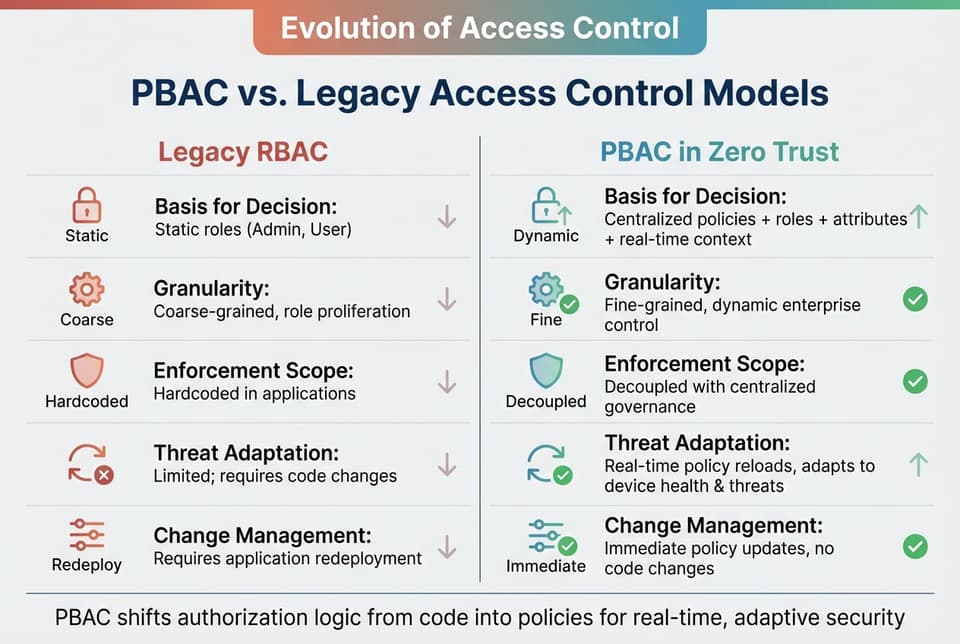
PBAC vs RBAC: Legacy vs Zero Trust Access Control Comparison
Implementation Steps
Putting PBAC (Policy-Based Access Control) into action strengthens Zero Trust principles like continuous verification and least privilege. It achieves this by automating dynamic access decisions. To integrate PBAC into a Zero Trust framework, you'll need a structured approach that ensures security without disrupting operations.
Start by cataloging everything in your infrastructure - cloud services, data sources, identity providers, device management systems, and resource metadata. This inventory forms the backbone of your implementation. Next, create a machine-readable authorization model that outlines entities, principals, actions, and resource types. This schema drives your policy logic.
With your environment mapped out, write declarative policies using a Policy-as-Code language like Rego or Cedar. This approach separates authorization from applications, making updates quick and straightforward. Deploy a Policy Decision Point (PDP), such as Open Policy Agent, to evaluate access requests in real time. You can run the PDP as a centralized service or as distributed sidecar containers. Policy Enforcement Points (PEPs) should then be placed at key locations like API gateways or middleware to enforce the decisions made by the PDP instantly.
Before enforcing new policies, test them in shadow mode. This lets you monitor access patterns and identify issues without affecting legitimate traffic. Focus first on service-to-service communication, as it usually makes up the bulk of cloud traffic and provides a strong security return. Aim for continuous monitoring and logging to achieve an authorization success rate of 99.9% and keep PDP latency below 50ms at the 95th percentile. Set up alerts for deployment failures or spikes in denials so you can quickly address any problems.
This modern approach stands in stark contrast to older methods, as the comparison below shows.
PBAC vs. Legacy Access Control Models
The differences between PBAC and traditional models like RBAC (Role-Based Access Control) highlight why PBAC is essential for modern Zero Trust security. Here's a side-by-side look:
| Feature | Legacy RBAC | PBAC in Zero Trust |
|---|---|---|
| Basis for Decision | Static roles like Admin or User | Centralized policies combining roles, attributes, and real-time context |
| Granularity | Coarse-grained, leading to role proliferation | Fine-grained, dynamic control across the enterprise |
| Enforcement Scope | Hardcoded within individual applications | Decoupled with centralized governance and distributed enforcement |
| Threat Adaptation | Limited; updates require code changes | Real-time policy reloads, adapting to device health and threat signals |
| Change Management | Requires redeploying applications | Policy updates take effect immediately without code changes |
Switching from RBAC to PBAC is more than just a technical upgrade - it changes the way organizations think about access control. As Nawaz Dhandala from OneUptime puts it:
"PBAC shifts authorization logic from application code into policies... Instead of scattering permission checks throughout your code, you write declarative policies that a policy engine evaluates at runtime."
Companies like Automate Security are taking this a step further by using AI to automate policy enforcement. This ensures security decisions can adapt to new threats while maintaining the speed and precision demanded in a Zero Trust environment.
Benefits of PBAC for Cloud Security
Granular Control and Auditability
PBAC offers precise access control by evaluating a wide range of factors, such as user clearance, resource sensitivity, device health, time of day, and location, for every access request. This detailed approach eliminates the need to manage an overwhelming number of overlapping roles, a common issue with traditional role-based systems.
By centralizing policy decisions into one engine, PBAC also creates a detailed and unchangeable record of who accessed what, when, and why. Companies using unified access control have reported completing audits 25% faster and resolving access misconfigurations 90% more quickly.
"Policy-Based Access Control (PBAC) represents a next-generation authorization model that separates decision logic from application code"
- Andrew Dennis, Senior Content Manager at Lumos.
This separation of decision logic allows security teams to update access rules across the board without waiting for developers to modify and redeploy applications. This capability is especially crucial for responding quickly to new threats. PBAC also uses automation to enhance its ability to adapt to risks in real time.
Real-Time Threat Adaptation Through Automation
PBAC aligns with Zero Trust principles by continuously verifying access decisions and adapting to evolving threats. Automated PBAC systems address the challenge of managing access at the speed required by AI-driven processes and automated workflows. These systems assess each access request against current risk factors, dynamically adjusting enforcement levels based on the latest threat intelligence.
A key feature of PBAC is just-in-time (JIT) access, which replaces permanent permissions with temporary, task-specific access. For instance, a support engineer may receive elevated database access only for the duration of their task. Once the task is completed, their access is automatically revoked.
Platforms like Automate Security use AI to calculate trust scores for both users and service accounts, adjusting policies based on compliance history and the severity of violations. This proactive approach ensures vulnerabilities are addressed without delay.
Simplified Cloud Access Management
PBAC streamlines cloud security by eliminating the need for outdated VPN configurations and MPLS networks. Traditional VPN setups often grant broad network access before authenticating users - a risky "connect then authenticate" model that exposes entire network segments. PBAC flips this process by authenticating users first and then granting session-based, granular access to specific applications, aligning with Zero Trust's "never trust, always verify" principle.
"ZTA eliminates the need for complex MPLS networks, complex perimeter-based security system controls, and VPNs - with fast, secure, direct-to-cloud access"
- Madinah S. Ali, President & CEO of Safe PC Solutions.
This modern approach reduces provisioning times from weeks to just minutes by automating self-service access requests.
For organizations operating in multi-cloud environments, PBAC provides a centralized enforcement layer that applies consistent policies across platforms like Snowflake, Databricks, and AWS. This prevents the creation of fragmented security silos.
"Our inability to centrally manage all of our data security policies across our data platforms hampered our ability to deliver value to the business in a timely manner. We needed a way to standardize and automate security control across all our tools, platforms, and clouds"
.
PBAC not only standardizes security across platforms but also allows cloud teams the flexibility they need to innovate, making it a cornerstone for implementing Zero Trust in cloud security.
Wrapping It Up
PBAC is reshaping how secure access works in cloud environments. It’s not just about locking things down - it’s about being smarter with access control. By weaving PBAC into a Zero Trust Architecture, security teams can better manage the complexities of AI-driven processes. This approach moves away from rigid, role-based permissions and instead makes decisions based on real-time context, like device health, user location, and potential threats.
For organizations leveraging automated PBAC, the benefits are clear: 90% faster remediation of misconfigurations, 25% quicker audits, and consistent policy enforcement across multi-cloud platforms like Snowflake, Databricks, and AWS - all without creating isolated silos.
"The enterprises that are winning with data today aren't the ones with the most restrictive access controls - they're the ones with the most intelligent ones." - TrustLogix
AI-powered tools, such as Automate Security, take this a step further by dynamically adjusting policies based on contextual insights. These platforms enable just-in-time access, eliminating static privileges that often lead to vulnerabilities.
FAQs
What data does PBAC use to decide access in real time?
Policy-Based Access Control (PBAC) makes real-time access decisions by assessing attributes tied to users, resources, actions, and the surrounding context. This approach ensures that access permissions remain flexible and align with current conditions, strengthening overall security.
How can you migrate from RBAC to PBAC without breaking applications?
To shift from RBAC to PBAC without causing disruptions, it’s important to take a step-by-step, policy-focused approach. Begin by reviewing your existing permissions and crafting adaptable, attribute-based policies. Introduce PBAC gradually by running it alongside RBAC, allowing you to test policies in real-world scenarios. Update your applications to interact with policy enforcement points for access decisions. Throughout this process, closely monitor how policies perform to ensure they match the original access controls. This method helps reduce risks and keeps the transition smooth.
Where should PDPs and PEPs run in a cloud Zero Trust setup?
In a cloud Zero Trust framework, Policy Decision Points (PDPs) function within a separate control plane. They typically integrate with identity and access management services to evaluate access requests based on predefined policies and contextual factors. Meanwhile, Policy Enforcement Points (PEPs) operate on the data plane, implementing these decisions in real time directly at the resource level. This division between decision-making and enforcement ensures ongoing verification and dynamic application of policies - core principles of a Zero Trust architecture.