
How AI Automates Penetration Testing for DevOps
Use AI in CI/CD to automate penetration testing—faster scans, fewer false positives, continuous monitoring, and prioritized fixes.
Penetration testing is evolving DevOps teams, deploying code daily, face a challenge: manual security tests are slow, costly, and often outdated. AI-powered penetration testing offers a solution by automating this process, delivering faster, more accurate results while cutting costs.
Here’s why AI is transforming penetration testing:
- Speed: AI reduces testing time by up to 90%, providing results in hours instead of weeks.
- Accuracy: AI flags only exploitable vulnerabilities, cutting false positives by 90%.
- Cost Efficiency: AI testing saves organizations an average of $1.76 million per breach.
- Continuous Monitoring: Integrated into CI/CD pipelines, AI ensures every code change is tested without delays.
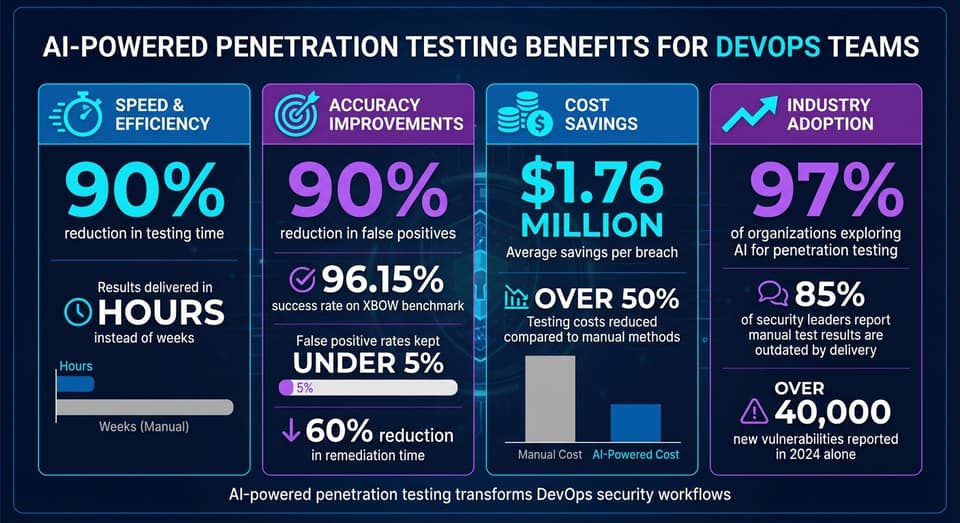
AI-Powered Penetration Testing: Key Benefits and Impact Statistics
Benefits of AI-Powered Penetration Testing
Faster Testing and Time Savings
AI-powered penetration testing can reduce testing time by as much as 90%. Instead of waiting weeks for results, DevOps teams can access actionable insights in just minutes or hours. This efficiency comes from autonomous reasoning loops, which allow AI agents to plan, execute, observe, and adapt in real time. Multi-agent systems further enhance this process by performing reconnaissance, exploitation, and validation simultaneously, enabling a comprehensive mapping of the attack surface.
"AI is already transforming pentesting. If you look at automated reconnaissance and scanning, finding those low-hanging fruits... it does it really well. It can even do fuzzing, exploit generation, and documentation - these are a few clicks away now".
- Jyoti Raval, Director of Cyber Security Engineering at Baker Hughes
This rapid approach not only speeds up detection but also improves the accuracy of security assessments.
Better Accuracy and Fewer False Positives
AI tools significantly reduce irrelevant alerts. Through reachability analysis, AI can determine whether a vulnerable library is actively used by your application, cutting down alerts by 90%. Policies designed to eliminate false positives ensure that only exploitable vulnerabilities are flagged. On benchmarks like XBOW, AI-powered tools achieve a success rate of 96.15%, with false positive rates kept under 5%. This precision enables teams to cut remediation time by up to 60%, allowing them to focus on addressing genuine risks. Such accuracy supports a more scalable and reliable security system.
Scalability and Continuous Monitoring
Traditional manual tests often struggle to keep up with the fast pace of development, but AI tools seamlessly integrate with DevOps tools and CI/CD pipelines, ensuring constant monitoring. While periodic testing leaves gaps, AI-powered systems initiate tests automatically with every code commit or container update, providing continuous coverage. These tools can manage thousands of endpoints at once, adjusting their strategies based on real-time feedback. They also excel at identifying transient cloud assets, containers, and microservices that annual tests might miss. By incorporating AI into their security processes, organizations save an average of $1.76 million per breach.
sbb-itb-d663cbd
How to Automate Penetration Testing with AI
Step 1: Review Your Current Security Setup
Start by assessing the gap between your rapid code deployments and the less frequent manual security tests. Identify your current testing frequency, pinpoint which applications are exposed externally, and locate where sensitive data is stored. This step helps you figure out which systems need continuous AI-driven testing first. Once you've mapped out these security gaps, you can move forward with selecting AI tools that align with your needs.
Step 2: Choose AI Tools for DevOps
Look for AI tools that use contextual reasoning and follow a "No Exploit, No Report" approach. This means they only flag vulnerabilities they can exploit with a working proof-of-concept. Research shows strong industry backing for AI-powered penetration testing. Tools like Automate Security are designed for DevOps workflows, offering AI-driven threat detection and incident response while integrating smoothly with cloud environments.
Step 3: Add AI to Your CI/CD Pipeline
Once you've chosen your tools, integrate them into your CI/CD pipeline for seamless functionality. Embed security checks at every stage of development: use SAST and secret detection before code commits, container scanning and IaC checks during CI, and AI-driven DAST in test environments. For local apps, secure tunnels like Pinggy can expose them to AI pentesters without requiring full deployment. This method has been shown to significantly lower the chances of vulnerabilities escaping into production.
Step 4: Set Up Feedback Loops
After integrating AI tools, establish automated feedback loops to validate remediation actions. Automate test reruns immediately after patches are applied to confirm vulnerabilities are resolved. AI can help by triaging findings and offering remediation guidance or even one-click fixes. For issues with lower confidence levels, involve experts to review and reduce remediation delays. Use confidence thresholds to ensure findings below a certain score are flagged for manual review, rather than blocking the pipeline.
Step 5: Track Performance Metrics
Keep an eye on metrics like Mean Time to Detect (MTTD), Mean Time to Remediate (MTTR), and Vulnerability Escape Rate using a centralized dashboard. Implement "fail-on-high" policies to stop code merges when High or Critical vulnerabilities are detected. By taking this data-driven approach, you can demonstrate the ROI of AI penetration testing - studies show it can cut testing costs by over 50% compared to traditional manual methods.
Complete Guide to AI Pentesting: Using agentic AI to hack your application
AI Features for Penetration Testing
AI-driven tools are transforming penetration testing by automating processes, improving threat detection, and refining risk management throughout the DevOps lifecycle.
Real-Time Threat Detection
AI tools for penetration testing provide continuous monitoring, identifying vulnerabilities the moment they appear. This constant validation is crucial, especially when 85% of security leaders report that manual penetration test results are often outdated by the time they’re delivered.
Using Chain-of-Thought reasoning, these tools analyze application behavior to uncover complex, multi-step attack paths that traditional scanners might miss. Instead of relying on static rules, AI adapts dynamically, performing rapid and thorough tests. For example, Automate Security offers real-time threat monitoring directly integrated with cloud environments, enabling DevOps teams to address vulnerabilities before attackers exploit them. This seamless process bridges real-time insights with actionable data, ensuring vulnerabilities are addressed promptly.
Automated Vulnerability Scanning
AI has redefined vulnerability scanning, moving beyond basic checklists to include advanced techniques like reachability analysis. This approach evaluates source code to determine if a vulnerable library is actively used, allowing teams to focus on genuine risks.
Take the Shannon AI pentester as an example - it achieved a 96.15% success rate on the hint-free, source-aware XBOW Benchmark. In February 2026, Aikido Infinite agents identified seven CVEs in the Coolify platform, including critical vulnerabilities like privilege escalation and remote code execution (RCE) as root, across more than 52,000 exposed instances. They also uncovered CVE-2026-25545, a server-side request forgery (SSRF) in the Astro Node.js adapter, and "SvelteSpill", a cache deception flaw in SvelteKit on Vercel, by analyzing 150,000 lines of code. These examples highlight how AI can uncover critical risks that might otherwise remain hidden.
Risk Assessment and Prioritization
AI doesn’t just detect vulnerabilities - it also helps prioritize them by combining technical severity scores with business context. For instance, vulnerabilities on sandbox servers are treated differently from those on payment gateways, ensuring teams focus on the most pressing risks. This context-driven prioritization can reduce remediation time by up to 60%.
One standout capability is attack path chaining, where AI evaluates how multiple low-severity issues can combine to create critical breach paths. In a 2026 comparison, AI tools uncovered a critical e-signature forgery flaw in a document signing application - something manual testers missed after two weeks of effort. Organizations leveraging AI for security workflows save an average of $1.76 million per breach, making intelligent prioritization not just a technical advantage but a financial one as well.
Conclusion
AI-powered penetration testing has become a game-changer for DevOps teams, especially with over 40,000 new vulnerabilities reported in 2024 alone. Traditional audits simply can't keep up with the speed of modern development cycles. Shifting from periodic testing to continuous, AI-driven security checks is the way forward for safeguarding applications.
Start by focusing on external-facing web applications and APIs, as these are the most developed use cases for AI-driven testing. By integrating AI into your pipeline, every code push can trigger an automated security audit, giving developers instant feedback. This approach not only strengthens your security but can also lead to measurable cost savings. It's a step toward a collaborative system where AI and human expertise complement each other.
The industry is steadily moving toward a hybrid model. AI takes care of scalable, systematic testing, while human experts focus on business logic and more creative attack scenarios. Continuous monitoring and dynamic feedback from this partnership boost both efficiency and innovation. As Jyoti Raval, Director of Cyber Security Engineering at Baker Hughes, puts it:
"We are going to transform pentesters into AI operators. They'll need to really use the capability that AI brings in and then understand how to guide, validate, and interpret those AI-driven assessments".
With 97% of organizations exploring AI for penetration testing, early adopters stand to gain a competitive edge. A smart starting point is parallel testing - use AI alongside traditional manual testing to compare speed and coverage. Opt for tools with "Safe Mode" exploitation features to demonstrate vulnerabilities without risking production systems. Prioritize high-value assets by using threat intelligence sources like CISA's KEV catalog to zero in on the most pressing vulnerabilities.
FAQs
Is AI pentesting safe to run in production?
AI-powered penetration testing can be safely conducted in production environments when specific safety measures are followed. These measures include maintaining strict control over testing activities, avoiding disruptions to live systems, and securely handling any sensitive data involved. By implementing these precautions, organizations can reduce risks while using AI to strengthen their security efforts.
What should we automate first in our CI/CD pipeline?
Start by incorporating automated security checks such as SAST (Static Application Security Testing) and SCA (Software Composition Analysis) into your workflow for every commit. These tools help identify vulnerabilities at an early stage, minimizing risks before the code progresses further down the development pipeline. By embedding these checks into the process, you create a system where security becomes an integral part of development, allowing for continuous validation and quicker resolution of potential issues.
How do we validate AI findings before blocking merges?
To ensure AI findings are accurate before halting merges, it's important to set up a review process. This process should involve security teams or developers evaluating AI-generated alerts or proofs-of-concept for potential exploits. Doing so reduces false positives and ensures that only verified vulnerabilities lead to blocking actions. Incorporating manual verification or supplemental automated checks by experts is a smart way to avoid unnecessary interruptions while maintaining effective security measures.