
AI in Remediation Playbooks: Benefits and Use Cases
AI-driven remediation playbooks automate cloud fixes, cut remediation time and errors, and lower breach costs while scaling SOC operations.

Organizations face a daunting challenge: managing 500 vulnerabilities daily but addressing only 20 manually AI-driven remediation playbooks are transforming security operations by automating responses, reducing errors, and speeding up processes. These systems replace static guides with workflows that adapt in real-time, integrating threat intelligence and business priorities.
Key highlights:
- Efficiency: AI reduces remediation times by over 77% and cuts manual effort by up to 95%.
- Accuracy: Automated systems identify attack paths by analyzing interconnected risks like misconfigurations and overprivileged identities.
- Cost Savings: Companies see lower breach costs ($2.22M vs. $4.88M for manual methods) and reduced alert volumes (92% drop).
- Scalability: AI handles repetitive tasks at scale, allowing security teams to focus on complex threats.
Manual playbooks still have value for high-stakes incidents requiring human judgment but fall short in speed and scalability. With projections showing 85% of playbooks will be dynamically generated by 2027, AI is becoming indispensable for modern cloud security.
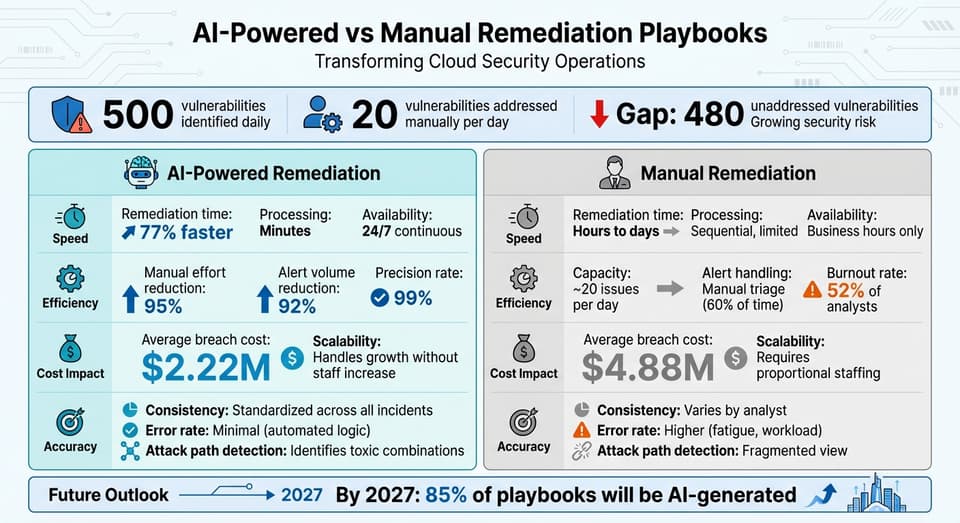
AI-Powered vs Manual Remediation Playbooks: Performance Comparison
From Playbooks to AI Agents: Redefining SOC Investigations
sbb-itb-d663cbd
1. AI-Powered Remediation Playbooks
AI-powered remediation playbooks transform static security guidelines into dynamic, context-aware workflows. Instead of relying on outdated, manually updated guides, these systems generate tailored remediation steps the moment a security alert is triggered. This shift directly improves how teams secure cloud environments by analyzing specific factors like "toxic combinations" of misconfigurations, vulnerabilities, and identity permissions. While these elements may seem harmless individually, together, they can create critical attack paths.
Continuous Learning
One of the standout features of AI-driven playbooks is their ability to learn from historical SOC telemetry and past investigations. When a new threat arises, the system pulls data from sources like threat intelligence feeds, asset inventories, and business priority maps, ensuring responses remain up-to-date. These systems even provide multiple remediation options - such as patching a vulnerability or removing external exposure - allowing teams to align responses with their specific risk tolerance.
For example, Microsoft's Copilot Guided Response system demonstrated impressive precision in its triage and containment models, achieving 99% precision for action models and 94% relevance in AI-recommended incident investigations. This level of adaptability ensures rapid and effective responses, setting the stage for faster execution.
Faster Execution
AI drastically reduces the time analysts spend on remediation by delivering instant commands in formats like CLI, Terraform, or CloudFormation. Tasks that would typically require hours of manual effort are now automated, significantly speeding up the remediation process across cloud environments. Microsoft's AI architecture, for instance, processes millions of incidents daily, with actionable recommendations delivered in 98% of cases and batch latency measured in minutes.
Fewer Errors
AI-powered systems bring consistency to remediation efforts, eliminating variability caused by human fatigue or error. By correlating signals from network exposures, vulnerabilities, and identities, these platforms identify complete attack paths instead of isolated issues. Safety guardrails - like dry-run modes, health checks, and rollback features - ensure automated actions can be reversed if needed.
Organizations using AI-driven auto-remediation report a 92% drop in alert volume, and specific tasks see up to a 95% reduction in manual effort. High-certainty remediations can execute automatically, while more complex cases escalate to human review. This approach not only minimizes errors but also enhances overall reliability and efficiency.
Cost Savings
The cost benefits of AI in remediation are evident in how resources are allocated. Manual remediation often demands continuous analyst attention for repetitive tasks, but AI handles these at scale without increasing staff. By providing clear, step-by-step instructions, AI enables developers to address risks without requiring deep security expertise. This frees up security analysts to focus on strategic initiatives.
As Lamont Orange, CISO of Sayera, aptly put it:
"Why wouldn't we have the AI system do that? The AI system doesn't need to sleep." – Lamont Orange, CISO, Sayera
Organizations leveraging AI for cloud incident response benefit from faster threat identification and containment, leading to significant cost savings. Additionally, as alert volumes grow, the need for proportional staffing increases diminishes. With projections indicating that 85% of detection and response playbooks will be dynamically generated by mid-2027, these economic advantages are only set to grow.
Automate Security's AI-powered cybersecurity solution showcases these benefits, offering real-time threat detection, compliance management, and incident response. These tools empower DevOps teams and security leaders to maintain strong cloud security while optimizing resources.
2. Manual Remediation Playbooks
While AI-driven playbooks offer speed and adaptability, manual remediation still relies on fixed processes and human expertise to address security incidents.
Manual remediation playbooks involve static procedures carried out by analysts - everything from reviewing logs to implementing fixes . These methods leverage human judgment, which is essential for complex situations, but they struggle to keep pace in modern cloud environments where speed and scalability are non-negotiable.
Adaptability
Manual playbooks shine when handling unique or high-stakes incidents that demand nuanced judgment and a deep understanding of business priorities. Analysts can assess situations in ways automated systems might overlook. However, this advantage quickly diminishes when security teams are overwhelmed by the sheer number of events. On average, manual remediation can only address about 20 issues per day, leaving many threats unresolved. This limitation often results in configuration drift in elastic cloud environments, where settings frequently change and require constant updating.
Speed of Execution
One of the biggest drawbacks of manual processes is the delay they introduce. Tasks like blocking malicious domains or updating firewall rules can take anywhere from minutes to hours when done manually . Meanwhile, modern cyberattacks can unfold in mere hours, making these delays critical. As Jonathan Fischbein, CISO at Check Point, explained:
"If you have an alert that you're not addressing, that alert might become an incident".
This lag in response time often turns manageable alerts into full-blown incidents.
Error Reduction
Human analysts, despite their expertise, are prone to errors influenced by fatigue, workload, or subjective judgment. For instance, they might address an exposed storage bucket and an overprivileged identity as separate issues without realizing these could combine into a larger attack path . This fragmented approach is exacerbated by alert overload: 91% of security professionals report that siloed tools and manual processes create blind spots. Adding to the challenge, manual triage consumes about 60% of a Tier 1 SOC analyst's time, contributing to a burnout rate of 52%. These inconsistencies not only increase risk but also drive up operational costs.
Cost Efficiency
Manual remediation is resource-intensive and doesn’t scale well with growing infrastructure demands. Security teams often struggle to handle the increasing volume of events, which leads to significant financial consequences. For example, the average cost of a data breach is $4.88 million when relying on manual response, compared to $2.22 million with automated prevention. Beyond the direct costs, manual processes burden teams with repetitive tasks, leaving less time for strategic initiatives. Additionally, organizations face the risk of losing critical institutional knowledge as staff turnover occurs .
Pros and Cons
When deciding between AI-powered and manual remediation playbooks, it's essential to weigh the trade-offs in areas like flexibility, speed, accuracy, and cost.
Flexibility
Manual remediation depends on predefined scripts and human judgment, which can be useful in high-stakes situations. However, it struggles to handle complex, interconnected risks - such as "toxic combinations" of misconfigurations, vulnerabilities, and exposed data. On the other hand, AI-powered playbooks leverage behavioral analysis to learn organizational patterns and link seemingly unrelated signals. This allows them to uncover threat pathways that manual processes might miss when focusing on isolated issues.
Speed
Manual processes often introduce delays, while AI-driven systems can drastically cut response times - from weeks to mere minutes. AI operates continuously, without the downtime associated with human intervention, effectively shrinking the window of opportunity for attackers.
Accuracy
Human-led approaches are prone to errors caused by fatigue or inconsistent interpretations, leading to varying results across similar incidents. AI systems, by applying standardized logic across environments, can filter out irrelevant noise and significantly reduce alert volumes. However, the effectiveness of AI relies heavily on the quality of its input data. Without proper oversight, automated actions might inadvertently disrupt legitimate exceptions or critical operations.
Cost
Manual remediation is labor-intensive and doesn't scale well with growing infrastructure needs. As systems expand, so does the demand for human effort. AI-powered remediation, however, can reduce manual workload in Security Operations Centers (SOCs) by up to 95% and cut remediation times by over 77%, allowing teams to enhance their security measures without increasing staff. Austin Cheung, Lead Security Engineer at TransUnion, captures this shift well:
"Automation is at the core of our cloud security strategies at TransUnion. It enables us to continuously scale our controls and effectively accelerate our response to identified security risk".
These comparisons underscore the growing importance of automation and intelligent systems in modern cloud security strategies.
Conclusion
AI-powered remediation playbooks are transforming how cloud security is managed. Research highlights impressive efficiency gains, such as drastically reduced remediation times, fewer alerts to handle, and lower overall breach costs. These advancements align with the growing demands placed on modern security operations.
The numbers tell a clear story: organizations identify roughly 500 vulnerabilities daily but only manage to address about 20 manually. AI steps in to close this gap by automating repetitive tasks, spotting "toxic combinations" of risks that lead to critical attack paths, and providing clear, actionable remediation steps that developers can follow without needing deep security expertise.
For organizations struggling to scale their security efforts without expanding their teams, AI-driven automation offers a lifeline. By taking on high-volume, repetitive tasks with consistent precision, these tools allow security teams to focus on strategic priorities and more complex investigations.
This is where AI-powered solutions truly shine. Platforms like Automate Security empower DevOps teams to tackle fast-evolving cloud threats with accuracy. By combining real-time threat detection, automated incident response, and compliance management, they deliver the speed and scalability essential for today’s cloud environments.
The evidence is undeniable: AI-driven remediation boosts speed, accuracy, and cost-effectiveness. The real question isn't whether to adopt these technologies but how soon you can implement them to safeguard your cloud infrastructure.
FAQs
What should we automate first with AI remediation playbooks?
Start with automating low-risk, high-volume tasks - things like fixing common misconfigurations, cutting down on unnecessary permissions, and tackling well-known vulnerabilities. These are straightforward to automate and can significantly reduce the mean time to remediate (MTTR).
To build trust in the process, focus on repetitive problems first. Use safeguards such as rollback options and thresholds to ensure any changes can be undone if needed. As you gain confidence, gradually move toward automating more complex scenarios, keeping the transition controlled while exploring advanced AI-driven remediation.
How do AI playbooks avoid breaking production changes?
AI playbooks help keep production running smoothly by guiding the transition from development to deployment. They focus on integrating AI systems into existing setups while reducing risks and ensuring stable performance in live environments.
What data does AI need to create accurate remediation steps?
AI depends on contextual data to provide accurate steps for remediation. This involves information like the specifics of vulnerabilities, application libraries in use, alert details, incident characteristics, and the environment where the issue arises. Supplying detailed and relevant data allows the AI to offer clear and actionable solutions to address problems effectively.