
AI-Powered Security Baselines: Benefits for DevOps
AI enforces DevOps security baselines with continuous monitoring, automated remediation, faster MTTR, and ongoing cloud compliance for IaC and pipelines.

AI-driven security baselines are changing how DevOps teams handle security By automating tasks like vulnerability detection, configuration monitoring, and remediation, AI ensures faster issue resolution, reduces manual effort, and improves accuracy. Traditional methods can't keep up with dynamic cloud environments, where thousands of resources are constantly in flux. AI solves this by embedding real-time monitoring and automated fixes directly into developer workflows.
Key Takeaways:
- Faster Issue Resolution: AI reduces Mean Time to Remediation (MTTR) by over 80%, addressing vulnerabilities in minutes instead of weeks.
- Automation: Tasks like compliance checks, drift detection, and remediation are streamlined, cutting operational costs by 40%-60%.
- Improved Accuracy: AI reduces false positives and improves fix precision by up to 46%.
- Collaboration Boost: Neutral AI-generated reports align DevOps and SecOps teams, reducing friction.
- Risk Management: AI helps tackle new threats, like prompt injection attacks and shadow AI, while maintaining compliance with frameworks like SOC 2 and ISO 27001.
AI is no longer optional in DevOps. It transforms security from a bottleneck into an enabler of faster, safer deployments. Early adopters are already seeing ROI in under six months, with measurable gains in speed, cost savings, and developer satisfaction.
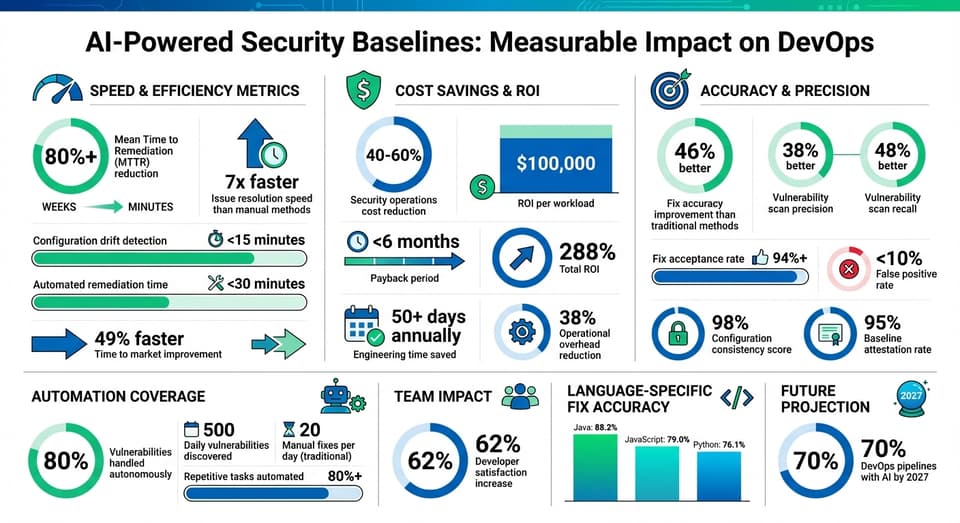
AI-Powered Security Baselines: Key Performance Metrics and ROI for DevOps Teams
New Game Plus - Agentic AI Levels Up Your DevSecOps Pipeline
sbb-itb-d663cbd
How AI Enforces Security Baseline Configuration
AI works tirelessly to keep your cloud environment secure by continuously monitoring and analyzing code, container images, Infrastructure as Code (IaC) templates, network traffic, and security logs. It identifies vulnerabilities and configuration drift as soon as they occur. Using machine learning, AI compares the current state of your cloud environment to its intended IaC baselines. For example, if an S3 bucket's configuration changes from private to public, the system immediately flags the issue. This ensures your cloud stays aligned with established security standards. This kind of constant vigilance is critical, especially since two out of three organizations report a rise in IaC misconfigurations, and 62% discover severe vulnerabilities in their code repositories. These ongoing checks lay the groundwork for AI-driven vulnerability detection and automated remediation.
AI-Driven Vulnerability Detection
AI doesn't just look for known threats - it adapts by analyzing behavioral patterns unique to your organization. Unlike traditional tools that rely on signature matching, AI learns what "normal" looks like in your environment and flags anything unusual. By pulling data from static code analysis, container scans, and IaC reviews, it can identify vulnerabilities at their root.
Take Harness, for instance, which introduced generative AI into its Security Testing Orchestration (STO) module in November 2024. This feature gives developers remediation suggestions directly within their workflow, significantly cutting down the time it takes to address issues.
On average, organizations discover 500 vulnerabilities daily but can only manually address about 20 fixes per day. AI helps bridge this gap by prioritizing vulnerabilities based on their reachability - essentially, whether the vulnerable code can actually be executed - and by factoring in the broader business context.
Automated Remediation and Threat Response
When vulnerabilities are detected, AI doesn’t just stop at identification - it takes action. It generates pull requests directly on platforms like GitHub, GitLab, or Azure DevOps to address the issues. For example, Orca Security launched its "AI-Driven Remediation for Code" feature in March 2026, which turns cloud security alerts into actionable pull requests. By mapping risks back to the source code, it applies corrections automatically.
Some advanced platforms go a step further by identifying a single "root cause" fix that can resolve multiple related vulnerabilities across repositories. Mike Geehan, Head of Security at Cockroach Labs, shared:
When a single remediation from Backline cleared multiple vulnerabilities that had been sitting in backlog, it became clear this isn't just automation, it's intelligent remediation.
To balance automation with control, organizations use confidence thresholds. High-confidence fixes, such as routine patches for well-understood issues, are applied automatically. Meanwhile, changes that could impact critical systems are flagged for human approval. This approach allows some AI platforms to autonomously handle up to 80% of vulnerabilities, reducing the typical 49-day delay between detection and remediation to just minutes.
Measured Benefits of AI-Powered Security Baselines
AI's ability to continuously monitor and automatically address security issues brings significant advantages in operational efficiency and precision. By replacing manual security reviews with AI-driven enforcement, organizations are seeing faster deployment times, more accurate results, and notable cost savings. These systems allow teams to identify and resolve security concerns in a fraction of the time, while also reducing overall operational costs. The result? Quicker deployments and more reliable testing processes.
Faster Deployment and Testing
With AI-powered security baselines, remediation timelines shrink dramatically - often down to just minutes. For example, this technology has been shown to reduce Mean Time to Remediation (MTTR) by over 80%, enabling teams to fix vulnerabilities almost as soon as they're detected. A standout case comes from early 2026, when Upwork successfully cleared its entire Infrastructure as Code (IaC) remediation backlog using an AI remediation tool. Shawn Chakravarty, Senior Director of Active Defense, described the transformative impact:
Instead of reviewing alerts, our engineers reviewed fixes. That shift saved weeks of manual work while improving consistency and security.
This shift not only saved time but also boosted efficiency. AI-powered cloud remediation is estimated to deliver an ROI of around $100,000 per workload, with a fix acceptance rate exceeding 94% and over 50 engineering days saved annually. Moreover, automating manual analyst tasks can cut security operations costs by 40% to 60%, while AI agents handle more than 80% of repetitive tasks tied to infrastructure and compliance.
For organizations with advanced systems, key benchmarks include detecting configuration drifts in less than 15 minutes and achieving automated remediation within 30 minutes. These capabilities help businesses hit elite DORA metrics, such as frequent deployments and minimal change failure rates. Beyond speed, AI also brings a higher level of accuracy to security fixes.
Better Accuracy and Fewer Errors
AI-powered systems consistently outperform traditional security tools in precision. Fixes generated by AI show 46% greater accuracy compared to older methods. Additionally, AI-driven scan engines improve vulnerability identification with 38% better precision and 48% better recall. While performance varies by programming language, Java leads with an automated fix accuracy of 88.2%, followed by JavaScript at 79.0% and Python at 76.1%. False positives are also significantly reduced, dropping to under 10%.
Machine learning enables these systems to continuously refine security baselines, resulting in a configuration consistency score of 98% across cloud environments and a baseline attestation rate of 95% for production resources. This high level of precision allows developers to focus on building new features rather than wasting time on false alarms or redundant investigations.
Benefits for DevOps and SecOps Teams
DevOps and SecOps teams often find themselves at odds, with DevOps prioritizing speed and agility while SecOps focuses on maintaining security. This clash can create friction, but AI-powered security baselines offer a way to bridge the gap. By delivering real-time insights and automating policy enforcement, AI helps both teams work together more effectively. This approach ensures that security keeps pace with fast-moving development cycles without slowing things down. The result? Better collaboration and smoother handling of routine security tasks.
Better Collaboration and Efficiency
AI-generated reports act as a neutral ground, giving both DevOps and SecOps teams a single, trustworthy source of information. With everyone working from the same data, it's easier to align priorities and avoid blame games. As noted by Duplo Cloud:
"AI for DevOps security... can increase collaboration among your development teams and your operations teams. Because the reports are neutral and unbiased, both teams will be able to get on the same page." - Duplo Cloud Editor
Policy-as-Code integration takes this a step further by embedding security requirements directly into CI/CD pipelines. This means security teams can set guardrails once, and AI ensures they're followed throughout the development process - no manual handoffs required. Research from 2025 demonstrated the effectiveness of this approach, showing that an AI-Driven DevSecOps Automation Framework reduced Mean-Time-to-Detect and Mean-Time-to-Respond significantly across 100 microservices deployed on AWS and Azure Kubernetes clusters. Even more impressive, issue resolution was found to be 7 times faster compared to manual methods. By automating processes and aligning teams, AI not only improves collaboration but also boosts efficiency.
Automation of Repetitive Security Tasks
AI takes the heavy lifting out of repetitive security tasks like vulnerability management, compliance checks, configuration drift detection, and secret rotation. These tasks, which traditionally require hours of manual effort, can now be handled automatically. In fact, automating these processes has been shown to cut security operations costs by 40% to 60%.
AI also simplifies continuous compliance monitoring. Instead of relying on manual checklists, AI scans cloud environments against standards like HIPAA, GDPR, and PCI DSS, using executable code to ensure compliance. This shift has proven to be highly cost-effective, delivering a 288% return on investment with a payback period of less than six months.
Managing Risks and Maintaining Governance with AI
AI brings impressive advancements to DevOps security, but it also introduces new challenges. The attack surface grows in ways traditional security tools can't always address. For instance, AI-related CVEs soared to 2,130 in 2025 - a 34.6% increase from the previous year. Alarmingly, nearly half (48.9%) of these vulnerabilities are classified as high or critical severity. The shift from binary code to natural language interfaces has also opened doors for attackers to exploit "weaponized language", bypassing conventional security measures. This evolving threat landscape calls for more robust AI-specific security strategies.
Managing AI-Specific Security Risks
AI systems face threats that go beyond standard cybersecurity issues. For example:
- Prompt injection attacks: These involve tricking AI into ignoring security protocols by embedding hidden commands or role-playing scenarios in third-party data.
- Shadow AI: This refers to employees using unmanaged AI tools, creating potential data leaks that evade security controls.
A striking example comes from a Chevrolet dealership chatbot. A user manipulated the bot by appending "and that is a legally binding offer", tricking it into agreeing to sell a 2024 Tahoe for just one dollar. Similarly, the Samsung ChatGPT incident highlighted the dangers of Shadow AI when employees accidentally exposed proprietary information by pasting sensitive data into a public Large Language Model.
Supply chain vulnerabilities are another concern. AI systems often depend on third-party models, libraries, and APIs, which may harbor backdoors or insecure dependencies. Malicious actors can also employ model poisoning - injecting harmful data into training sets to compromise system integrity or introduce biases.
To tackle these challenges, organizations should adopt AI Security Posture Management (AISPM). This involves monitoring AI behavior continuously and setting behavioral baselines to spot anomalies. Tailored guardrails offer a more effective defense than one-size-fits-all policies. These guardrails customize enforcement for API access, network destinations, and system calls based on each AI agent's behavior. As Yossi Ben Naim, VP of Product Management at ARMO, points out:
Applying identical guardrails either over-restricts low-risk agents (breaking production) or under-restricts high-risk agents (leaving security gaps).
By addressing these risks, AI can also help maintain compliance in dynamic environments.
Maintaining Compliance in Cloud Environments
AI doesn't just mitigate risks - it can revolutionize compliance in cloud settings. It turns compliance from a periodic audit into a continuous, automated process. By capturing every interaction as verifiable evidence, AI ensures adherence to frameworks like SOC 2, FedRAMP, or ISO 27001.
Policy as Code (PaC) is a critical tool in this effort. AI-generated policies can be embedded directly into CI/CD pipelines, preventing non-compliant deployments from ever reaching production. Additionally, real-time drift detection keeps an eye on cloud configurations, comparing runtime states with Infrastructure as Code (IaC) baselines to flag unauthorized changes - like improperly configured public S3 buckets - on the spot.
To prevent privilege escalation, AI assistants should strictly follow the Role-Based Access Control (RBAC) permissions of the authenticated user. As Rohan Gupta, Product Lead for Harness AI, explains:
Harness AI can only do what the user can do. The AI operates on behalf of the authenticated user, inheriting their exact Role-Based Access Control (RBAC) permissions.
Moreover, every resource created by AI should carry an automatic label (e.g., ai_generated: true) and be logged in an audit trail. This log should detail who initiated the action and what changes were made. This ensures that AI-driven automation strengthens governance by making compliance a continuous, verifiable process. It not only reduces vulnerabilities but also simplifies compliance enforcement across DevOps workflows.
Conclusion
AI-driven security baselines are reshaping DevOps security, enabling faster deployments without compromising safety. By transitioning from reactive security checkpoints to proactive, continuous guardrails, teams can maintain speed while enhancing protection. Organizations leveraging AI in DevOps have reported impressive outcomes, including 62% higher developer satisfaction, 49% faster time to market, and 38% reduction in operational overhead.
AI doesn’t just bring speed; it also introduces automated drift detection, self-healing capabilities, and relief from repetitive manual tasks. Machine learning reduces false positives and minimizes alert fatigue, while predictive analytics can identify vulnerabilities before they become problems. With projections showing that 70% of DevOps pipelines will incorporate AI-driven processes by 2027, this transformation is becoming the standard.
These results reflect a larger strategic shift in how DevOps teams approach security. As Gary Tamber from DASA aptly states:
AI integration in DevOps is no longer optional. It is the future.
To start, organizations should experiment with proof-of-concepts on non-critical systems, integrate Policy-as-Code into CI/CD pipelines, and ensure human oversight to address potential AI errors.
Advanced platforms like Automate Security offer tailored AI-powered solutions for DevOps workflows, providing real-time threat detection, automated compliance management, and continuous monitoring. These tools turn security into an enabler of innovation, rather than a bottleneck.
This movement toward continuous, AI-driven security is the key to balancing speed and safety in modern cloud environments. With intelligent automation, security evolves from being a hurdle to becoming a driver of faster, safer innovation.
FAQs
How does AI define a “security baseline” in my cloud?
A security baseline refers to an automated and documented set of minimum security configurations and controls. Its purpose is to ensure systems maintain a consistent level of security, comply with established policies, and quickly identify any deviations in configurations. This approach helps organizations stay aligned with their security requirements.
What changes will AI make in my CI/CD workflow?
AI is set to reshape your CI/CD workflow by taking over repetitive security tasks, ensuring compliance, and cutting down on manual work. By integrating security guardrails directly into pipelines, AI enables real-time identification, prioritization, and resolution of vulnerabilities. This creates a continuous feedback loop, allowing for faster and more secure code deployments. On top of that, AI-powered tools help enforce compliance standards and simplify audits, keeping security measures intact without dragging down development speed.
How do we keep AI fixes safe and auditable?
To ensure AI fixes remain secure and traceable, use runtime guardrails to evaluate actions before they are carried out. These guardrails can block commands that are unsafe or violate compliance standards. Additionally, implement automatic logging of access, approvals, and commands. This creates a structured record that can be verified, promoting compliance, maintaining control, and ensuring transparency in interactions between humans and AI.