
AI Tools for IaC Vulnerability Detection
AI tools detect and auto-remediate IaC misconfigurations in real time, integrate with CI/CD, and cut remediation from months to minutes.
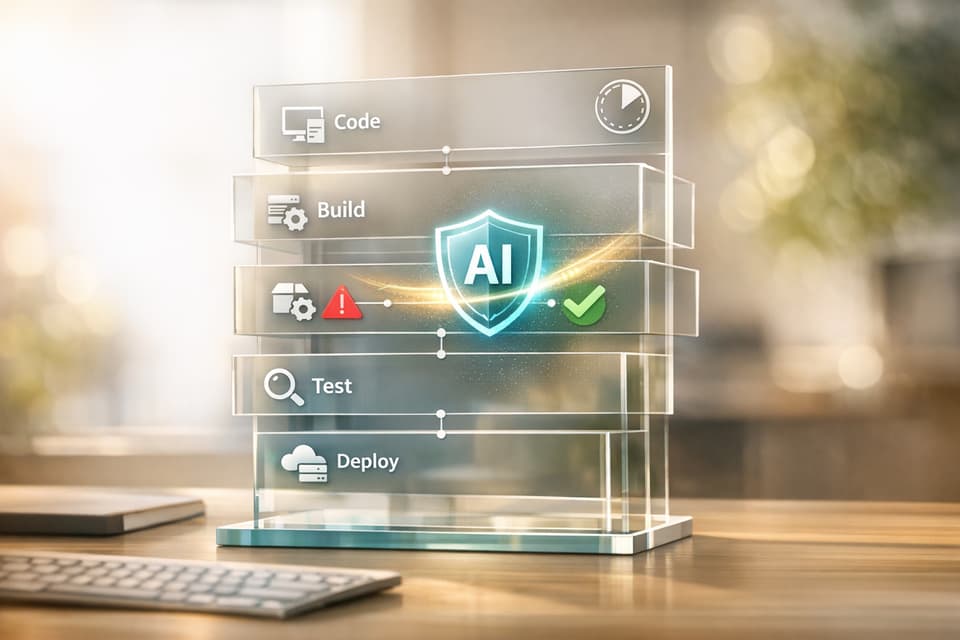
Misconfigurations in Infrastructure as Code (IaC) are responsible for over 95% of cloud security failures With IaC adoption growing rapidly, addressing these risks has become critical. AI-powered tools now offer real-time detection, automated fixes, and CI/CD integration to solve these challenges. Here’s what you need to know:
- Why it matters: 25% of cloud security incidents stem from misconfigured infrastructure, costing organizations millions.
- AI advantages: AI tools reduce manual remediation by 80%, cut misconfiguration risks by 11x, and fix vulnerabilities in minutes instead of months.
- Key features to look for: Real-time detection, automated remediation, and CI/CD integration are essential for effective IaC security.
Top tools include Automate Security, Checkov, and Tenable Cloud Security. Each offers unique strengths in detection, automation, and integration. Choose based on your team’s needs, platforms, and budget.
Quick Tip: Shift security left by integrating these tools into your development pipeline to catch issues early, reduce costs, and improve efficiency.
AWS re:Inforce 2025 - Supercharge IaC security with AI: From commit to auto-remediation (APS441)
sbb-itb-d663cbd
Key Features to Look for in AI-Powered IaC Security Tools
When choosing AI-powered tools for infrastructure-as-code (IaC) security, three standout features separate the best solutions from the rest: real-time vulnerability detection, automated remediation, and seamless integration with your CI/CD pipelines. These capabilities are essential for identifying misconfigurations early, resolving them efficiently, and maintaining developer productivity. Let’s dive into what makes these features so impactful.
Real-Time Vulnerability Detection
Speed matters when it comes to catching misconfigurations. Modern AI tools can generate fixes in less than a second - up to 20 times faster than traditional scanners like KICS, Trivy, or Checkov. This rapid feedback helps developers stay focused on coding instead of constantly shifting gears to address security alerts.
The most reliable tools rely on deterministic AI rather than generative models. Deterministic AI ensures predictable, accurate fixes by referencing up-to-date cloud provider documentation from AWS, Azure, and GCP. Unlike generative AI, which can produce unreliable or incorrect suggestions, deterministic models analyze your specific infrastructure (whether it’s Terraform, CloudFormation, or Pulumi) and provide remediation aligned with security policies. Some platforms even update their knowledge base nightly to reflect the latest cloud service changes and best practices.
To reduce noise, AI-powered triage plays a crucial role. For example, tools like Automate Security filter out low-priority alerts, reducing the volume by about 95% and focusing only on high-impact vulnerabilities that need immediate attention.
Automation and Efficiency
AI tools shine when they move beyond detection to full automation. By automating remediation, these platforms address one of the biggest bottlenecks in traditional IaC security - manual patching. Advanced solutions don’t just flag issues; they generate ready-to-merge pull requests that align with your security policies and engineering standards. This eliminates ticket backlogs and accelerates deployment timelines.
"By far the biggest and most important problem in AppSec today is vulnerability remediation. Amplify Security's technology automatically fixes vulnerable code for developers at scale is the solution we've been waiting decades for."
– Jeremiah Grossman, Founder | Investor | Advisor
Automation significantly shortens remediation cycles. Tasks that once took months can now be completed in minutes. This speed is critical, especially since more than 95% of cloud security failures are caused by customer misconfigurations. By automatically addressing issues during the commit process, these tools help maintain a self-healing infrastructure that stays secure without manual oversight.
Some platforms even offer pipelineless scanning, identifying risks as code is pushed without delaying your CI/CD pipeline or deployments.
Integration with CI/CD Pipelines
Seamless integration is key to embedding security into developers' daily workflows. The best tools operate directly within developers' environments - whether that’s IDEs, CLIs, pull requests, or CI/CD platforms like Jenkins, Azure DevOps, or Terraform Cloud. Feedback is delivered through familiar channels like PR comments, Slack, or Microsoft Teams, so developers don’t need to monitor separate dashboards.
"Developers appreciate that we're able to, with Arnica, provide feedback early and provide it with the tools they're already using."
– Mali Gorantla, VP of Security
Effective integrations go beyond feedback. They include automated gating and policy enforcement, which block non-compliant builds or deployments automatically. This ensures that misconfigurations are caught early - at the commit or pull request stage - before they can reach production.
Context-aware remediation is another critical feature. AI tools must understand your specific infrastructure and engineering standards to provide fixes that won’t disrupt deployments. This tailored approach ensures consistent, reliable results that align with your policies and workflows.
Top AI Tools for IaC Vulnerability Detection
Here’s a look at three tools that excel in real-time detection, automation, and smooth integration into CI/CD pipelines.
Automate Security
Automate Security is designed to tackle modern cloud threats with features like real-time detection, compliance management, and automated incident response. By focusing on automation and proactive defense, this platform helps teams safeguard their cloud environments without disrupting development timelines. It directly addresses the challenge of manual remediation, which often causes deployment delays.
With seamless integration into cloud environments, Automate Security minimizes exposure risks while keeping up with rapid deployment schedules. For those seeking open-source alternatives, Checkov offers a different approach.
Checkov
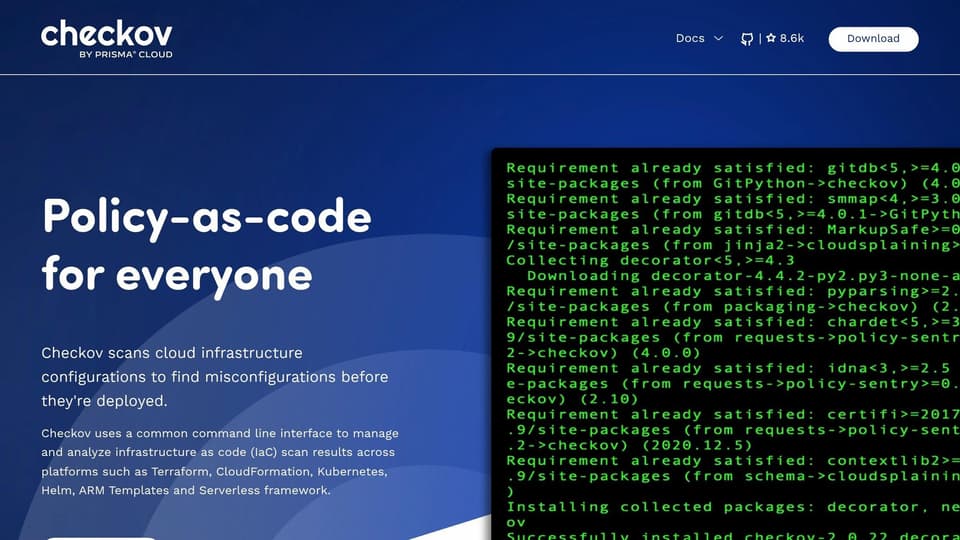
Checkov uses static code analysis to identify security and compliance issues across platforms such as Terraform, Kubernetes, Helm, and the Serverless framework. Its policy framework combines Python-based attribute policies with YAML-based graph policies, enabling it to analyze complex cloud resource relationships. This ensures it can detect vulnerabilities that simpler checks might miss.
By catching misconfigurations in static code, Checkov allows teams to address issues early in development. As an open-source tool with active community support, it provides extensive policy coverage without locking users into a specific vendor. For teams focusing on pre-production detection, Tenable Cloud Security offers another robust option.
Tenable Cloud Security
Powered by the open-source Terrascan engine, Tenable Cloud Security identifies misconfigurations before they reach production. It simplifies the process with one-click remediation and leverages the Open Policy Agent (OPA) framework, allowing teams to create custom security rules tailored to their needs. The platform supports Terraform, Kubernetes, Helm, CloudFormation, and ARM templates, offering over 500 pre-built policies to scan infrastructures against standards like the CIS Benchmark.
For example, IntelyCare, a healthcare technology company, improved operational efficiency with Tenable Cloud Security. Larry Viviano, Director of Information Security at IntelyCare, shared:
"Automation allowed us to complete in minutes what previously required months of manual work."
This kind of automation is especially valuable for smaller security teams tasked with managing complex and expansive cloud environments.
Comparison of AI Tools for IaC Vulnerability Detection
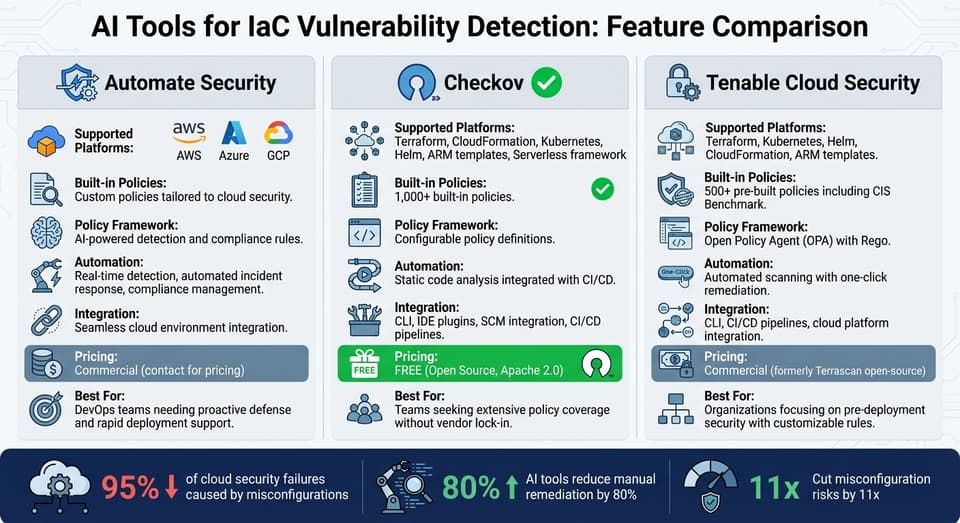
Comparison of Top AI-Powered IaC Security Tools: Features and Capabilities
Comparison Table
Here's a straightforward look at how different tools stack up when it comes to automating security and integrating with existing workflows. Use this comparison to align your choice with your team's needs, budget, and operational goals.
| Feature | Automate Security | Checkov | Tenable Cloud Security |
|---|---|---|---|
| Supported Platforms | Cloud environments (AWS, Azure, GCP) | Terraform, CloudFormation, Kubernetes, Helm, ARM templates, Serverless framework | Terraform, Kubernetes, Helm, CloudFormation, ARM templates |
| Built-in Policies | Custom policies tailored to cloud security | Over 1,000 built-in policies | 500+ pre-built policies including CIS Benchmark |
| Policy Framework | AI-powered detection and compliance rules | Configurable policy definitions | Open Policy Agent (OPA) with Rego |
| Automation Capabilities | Real-time detection, automated incident response, and compliance management | Static code analysis integrated with CI/CD | Automated scanning |
| Integration Options | Seamless integration with cloud environments | CLI, IDE plugins, SCM integration, and CI/CD pipelines | CLI, CI/CD pipelines, and cloud platform integration |
| Pricing Model | Commercial (contact for pricing) | Free (Open Source, Apache 2.0) | Commercial (formerly Terrascan open-source engine) |
| Ideal For | DevOps teams needing proactive defense and rapid deployment support | Teams seeking extensive policy coverage without vendor lock-in | Organizations focusing on pre-deployment security with customizable rules |
Checkov stands out for its extensive platform coverage and zero licensing costs. Tenable Cloud Security shines with its OPA-based customizable rules and solid pre-built policy library. Meanwhile, Automate Security focuses on continuous, real-time threat detection and automated incident response, ensuring protection throughout the deployment lifecycle.
The level of automation is a key differentiator. Automate Security prioritizes real-time threat detection and incident management, while Checkov excels in static code analysis, and Tenable Cloud Security emphasizes customizable pre-deployment scans. Each tool brings a unique approach to automation, making it essential to align your choice with your security strategy and deployment needs.
Conclusion and Best Practices
Cloud misconfigurations are responsible for more than 95% of failures. Instead of relying on reactive fixes, organizations are now focusing on proactive prevention by using AI-powered Infrastructure as Code (IaC) vulnerability detection. This approach integrates security directly into the development process, ensuring it’s no longer an afterthought.
By adopting a shift-left strategy, vulnerabilities can be identified during commits or pull requests. Configuring your CI/CD pipeline to block builds with critical issues prevents insecure code from reaching production. This not only reduces the risk of leaks but also significantly lowers remediation costs. Fixing vulnerabilities before deployment is far less expensive than addressing breaches in live environments. These pre-deployment checks create a seamless link between detection and automated remediation, fostering ongoing improvements.
Automation doesn’t stop at detection - it should also handle remediation. Tools that provide merge-ready fixes can eliminate the backlog of security tickets that often overwhelm teams. Leading organizations have demonstrated that this approach saves weeks of effort while maintaining consistent security practices.
Context-aware AI platforms further enhance security by achieving 85%-95% accuracy. They prioritize exploitable vulnerabilities and use drift detection to identify manual changes that might compromise resources or indicate shadow IT.
To build on a secured CI/CD pipeline, adopt a strategy of continuous improvement. Track metrics such as time-to-remediation, false positive rates, and the number of security issues caught per sprint. Implement Policy as Code to version-control your security rules alongside infrastructure definitions. Standardize pre-approved secure modules for developers to reuse, and layer your defenses by combining IaC scanning with secrets detection, software composition analysis, and runtime monitoring. This iterative improvement process ensures your AI-powered IaC security remains robust, delivering strong protection without slowing down developers.
FAQs
How do AI IaC tools cut false positives?
AI-powered Infrastructure as Code (IaC) tools improve accuracy by focusing on targeted, pattern-specific scans to pinpoint precise IaC constructs. By leveraging AI for deeper analysis, these tools filter out irrelevant alerts, reducing false positives. This process cuts through the noise, ensuring that only actionable vulnerabilities are flagged for attention.
Where should IaC scanning run in CI/CD?
Integrating Infrastructure as Code (IaC) scanning into CI/CD pipelines is a smart way to catch misconfigurations and vulnerabilities early in the development process. By addressing these issues before deployment, you can ensure your infrastructure is secure and ready for production.
This approach isn't just about security - it also helps maintain reliable and compliant cloud environments. When you identify problems early, you save time, reduce risks, and avoid costly fixes down the road. Plus, it helps teams stay aligned with regulatory requirements and industry standards, making the entire process smoother and more efficient.
What should an auto-fix PR include?
An auto-fix pull request needs to deliver fixes that prioritize security and inspire confidence. It should clearly outline the misconfiguration or vulnerability being addressed and provide line-by-line diff comparisons to highlight every change made. This approach ensures that reviewers can thoroughly validate the adjustments before approving and merging them.