
Why DevOps Teams Need Dynamic Policy Updates
How automated Policy-as-Code updates reduce compliance gaps, speed CI/CD, and prevent permission creep in fast-changing cloud environments.

Dynamic policy updates are essential for DevOps teams to secure fast-changing cloud environments. Traditional static policies can’t keep up with the speed and complexity of modern infrastructure, leading to delays, compliance gaps, and security risks. Here's why dynamic policies are the solution:
- Faster Security Updates: Cloud security automation ensures security rules evolve in real-time with infrastructure changes, eliminating manual bottlenecks.
- Improved Compliance: Continuous enforcement catches misconfigurations early, reducing audit preparation time and ensuring adherence to standards like GDPR and HIPAA.
- Reduced Risks: Dynamic policies prevent security debt by limiting over-permissioned access and addressing configuration drift immediately.
- Integration into CI/CD Pipelines: Tools like Policy-as-Code provide instant feedback during development, improving efficiency and reducing errors.
Static policies slow down workflows and leave gaps in security. Dynamic policy updates, powered by automation and tools like Open Policy Agent, help teams stay secure without sacrificing speed. To see these tools in action, schedule a demo with our security experts.
Policy as Code - DevSecOps Implementation Project | Demo Included
sbb-itb-d663cbd
Problems with Static Policy Management
Static policies create three major challenges that can compromise both security and speed in modern DevOps environments.
Delayed Updates and Configuration Errors
Manual updates simply can't keep up with the fast-moving nature of cloud infrastructures. Over 70% of organizations admit that manual security checks slow down their release cycles, and nearly 90% say their security processes lag behind the speed of CI/CD pipelines. It's impossible to manage a resource that changes every five minutes with a review process that takes 30 days.
This mismatch puts teams in a tough spot. Security teams often have to manually review tickets, cross-check documentation, and map requests to specific zones or IP ranges. By the time they finish, the service in question may have already been refactored or shut down. To avoid these delays, some DevOps teams skip reviews altogether, leading to "shadow deployments" that bypass security processes.
The delays in manual reviews also push teams into granting broad, long-term permissions, which leads to "permission creep". Since updating static policies frequently is difficult, teams often resort to granting overly generous "standing privileges" to cover potential future needs. This approach directly conflicts with the Principle of Least Privilege.
These delays and oversights also create compliance challenges, as discussed next.
Compliance Gaps and Tracking Problems
Static policies struggle to detect "drift", making audits a nightmare. Only 8% of organizations are considered "highly cloud-mature", largely because their governance operates continuously rather than only during deployments.
The core issue is visibility. If you only enforce governance when code is deployed, you miss most of the changes that lead to security incidents. Changes made during emergencies via manual console actions, automated scripts, or updates from cloud providers can bypass static deploy-time checks. On top of that, less than 40% of organizations perform security checks on every code commit, and only about 33% scan their code daily. This leaves significant gaps between when issues arise and when they are addressed.
Static documentation-based compliance adds another layer of complexity. Gathering manual evidence for audits can take weeks, whereas automated compliance solutions can cut audit prep time by 80–90% by providing real-time proof of controls.
When combined with the inability to quickly revoke outdated permissions, these compliance gaps increase the risks tied to dynamic and constantly changing infrastructures.
Higher Risk When Infrastructure Changes Frequently
Frequent changes to infrastructure amplify the risks caused by delayed updates and compliance failures. Every change expands the attack surface, and when policies can't keep up, misconfigurations - not advanced cyberattacks - become the leading cause of cloud security incidents. Static policies are also ill-equipped to clean up outdated permissions, which accumulate over time and create "security debt".
Take the "2 a.m. console change" scenario: during a production emergency, engineers might bypass pipelines to fix issues directly in the cloud console, leaving security groups wide open until the next manual audit. Organizations that adopt automated policy enforcement have reported up to 40% fewer security policy violations because they can catch and fix these out-of-band changes in real time.
"In a world of constant change, static policy isn't governance - it's a risk." - Secberus
How Dynamic Policy Updates Solve These Problems
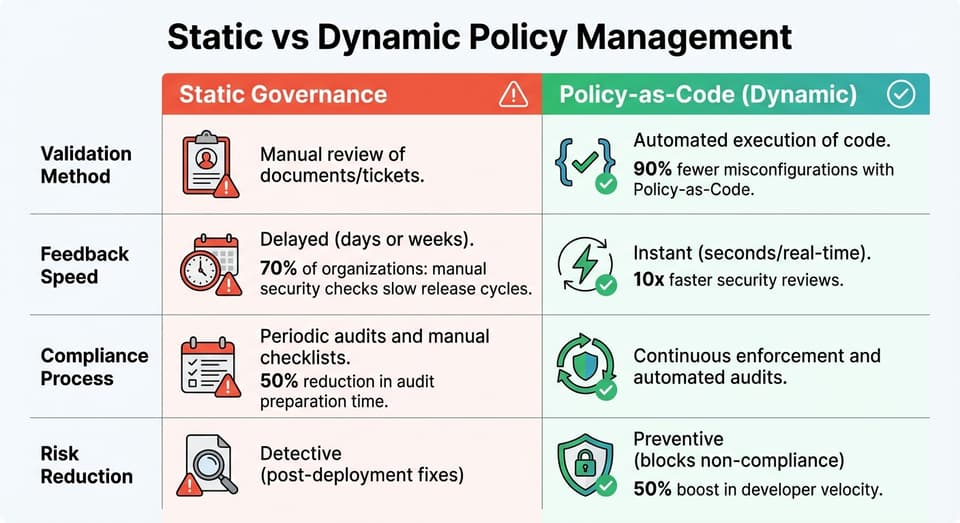
Static vs Dynamic Policy Management: Key Differences for DevOps Teams
Dynamic policy updates tackle the delays, compliance gaps, and risks tied to static policy management by offering a fast, automated solution.
This approach treats security rules as executable code instead of static documents. Using Policy-as-Code (PaC) frameworks, security and compliance can be enforced in seconds. By separating policy decisions from application and infrastructure code, security teams can update and apply rules instantly across all environments.
Switching from detective controls - those that identify issues only after deployment - to preventive guardrails makes it possible to catch problems before they occur. For instance, a misconfigured S3 bucket can be flagged during the pull request stage rather than during a lengthy audit. This preventive approach could have avoided incidents like the 2019 Capital One data breach.
Policy-as-Code: Automated and Real-Time Updates
Policy-as-Code frameworks, such as Open Policy Agent (OPA) and HashiCorp Sentinel, convert security requirements into machine-readable code. This code is executed at multiple stages of the development lifecycle. For example, these tools can evaluate infrastructure plans like Terraform configurations against pre-set rules, blocking any non-compliant changes before deployment.
Enforcement occurs at four critical stages:
- Locally, within the developer's IDE.
- During the CI/CD pipeline, before code is merged.
- At admission control, as resources enter a cluster.
- During runtime, through continuous scanning.
This multi-layered approach catches issues early and prevents changes that bypass established pipelines.
Real-world results back up the effectiveness of this method. Organizations using Policy-as-Code report 90% fewer misconfigurations and complete security reviews 10 times faster than manual processes. For example:
- A global e-commerce platform saw unauthorized access attempts drop by nearly 90% after integrating policy checks into its GitOps flow.
- A healthcare SaaS provider achieved an 85% reduction in data breach attempts by aligning with HIPAA standards in real-time and using continuous scanning.
"Sentinel is going to be that bouncer in a club that allows you to go in or out. For us, that gives us 100% confidence that anything provisioned by Terraform is following our security postures." – ADB
By automating enforcement, Policy-as-Code strengthens security throughout the CI/CD pipeline.
How Dynamic Policies Improve CI/CD Pipelines
Dynamic policies reshape CI/CD pipelines by embedding security checks early in the development process - a practice often called "shift-left enforcement". Developers get violation alerts within minutes of submitting pull requests, complete with actionable guidance, rather than learning about issues weeks later during an audit.
This immediate feedback eliminates manual bottlenecks. By integrating continuous feedback loops, dynamic policies address challenges like configuration drift and permission creep. Organizations that adopt Policy-as-Code report a 50% boost in developer velocity by removing manual roadblocks. These policies apply consistently across development, testing, and production, reducing errors tied to "tribal knowledge" and static governance.
Examples from industry leaders highlight these advantages:
- Netflix uses OPA to unify authorization across microservices, reducing security risks while speeding up feature deployment.
- NVIDIA DGX Cloud relies on Kyverno to enforce Kubernetes Pod Security Standards, ensuring secure AI workloads and cutting operational overhead.
- A Fortune 500 bank integrated HashiCorp Sentinel with Terraform to enforce infrastructure policies, lowering risks during cloud migrations and accelerating service delivery.
"Policy as code gives you an automated way to check, in minutes or seconds, if your IT and business stakeholders' requirements are being followed in your infrastructure deployments." – Kashaf Salaheen and Mitch Pronschinske, HashiCorp
Policy-as-Code vs. Static Governance
The contrast between dynamic and static approaches becomes clear when comparing their features:
| Feature | Static Governance | Policy-as-Code (Dynamic) |
|---|---|---|
| Validation Method | Manual review of documents/tickets | Automated execution of code |
| Feedback Speed | Delayed (days or weeks) | Instant (seconds/real-time) |
| Compliance Process | Periodic audits and manual checklists | Continuous enforcement and automated audits |
| Risk Reduction | Detective (post-deployment fixes) | Preventive (blocks non-compliance) |
Dynamic policies also simplify audits. With Policy-as-Code, every decision is logged as a code-based event, and automated SOC 2 compliance can cut audit preparation time by 50%.
How Automate Security Enables Dynamic Policy Automation
Automate Security takes the concept of dynamic policy updates and applies it to safeguard cloud infrastructures that are constantly evolving. By leveraging AI-driven dynamic policy management, it provides DevOps teams with the tools they need to stay secure and efficient.
What Automate Security Offers
Automate Security dives deep into cloud configurations, traffic patterns, IAM roles, and audit logs to create optimized Policy-as-Code security policies. Through its analysis of network access and database activity, the platform recommends IAM policies that follow the principle of least privilege. These policies are seamlessly integrated into CI/CD pipelines, ensuring consistent enforcement across the board.
The platform also includes anomaly detection to identify and respond to unusual activity. For instance, it can automatically adjust security group rules or isolate compromised resources to address threats. Real-time scanning ensures compliance with regulations like GDPR, HIPAA, and PCI DSS. This is especially important considering that 78% of organizations leave IAM roles inactive for more than 90 days, which significantly increases security risks.
Solutions Built for DevOps Teams
Automate Security’s features are tailored to meet the needs of DevOps teams. It introduces security checks early in the development process by alerting developers as soon as pull requests are made. This “shift-left” strategy catches issues early, cutting remediation costs by up to 50% compared to traditional post-deployment fixes.
The platform offers two modes: "detect-and-report" and "detect-and-enforce." Teams can start by annotating pull requests with security findings, helping developers understand and address issues. Over time, they can transition to automated rollbacks that block misconfigurations - like public storage buckets or unencrypted databases - from reaching production. Organizations that adopt these automated remediation features typically reduce their Mean Time to Remediate (MTTR) by 50% within just 90 days.
This automation highlights how dynamic policy updates can protect the fast-paced workflows of DevOps environments.
Automate Security Plan Comparison
| Plan | Key Features | Best For | Scalability |
|---|---|---|---|
| Basic | Threat detection, compliance management, basic incident response | Small teams with limited cloud environments | Entry-level security needs |
| Professional | Real-time monitoring, automated responses, advanced policy groups | Growing businesses with expanding infrastructure | Medium-scale deployments |
| Enterprise | Custom security strategies, auto-fixing remediation, full audit traceability, HITRUST compliance | Large organizations requiring comprehensive security | Unlimited infrastructure scale |
The Enterprise plan stands out with advanced features like auto-fixing remediation and full audit traceability. By 2028, it’s projected that 65% of organizations will adopt such measures.
Conclusion
Static policies just can't keep up with the ever-changing nature of cloud infrastructure. While cloud resources shift in minutes, manual reviews can take days - leaving critical security gaps in their wake. This mismatch between speed and security creates vulnerabilities that static policies simply aren't equipped to handle.
The solution? Dynamic policy updates. In today's fast-paced cloud environments, adapting security policies in real time isn't just helpful - it's a necessity.
This is where Automate Security steps in, turning a challenge into an opportunity. By integrating AI-driven policy automation directly into DevOps workflows, the platform analyzes everything from cloud configurations to traffic patterns and IAM roles. The result? Optimized policies that enforce least privilege access. With Policy-as-Code embedded into CI/CD pipelines, Automate Security ensures that security evolves alongside your infrastructure. Plus, it allows teams to start on a smaller scale and expand as their needs grow.
Dynamic policies not only close security gaps but also enhance DevOps efficiency. When policies automatically adjust to infrastructure changes, security becomes a driving force for progress, not an obstacle.
FAQs
What triggers a dynamic policy update?
Dynamic policy updates respond to real-time changes in conditions, infrastructure, or context that require swift action to uphold security and compliance. Typical triggers include unexpected infrastructure changes, configuration updates made outside of CI/CD pipelines, or newly identified risks. These updates are essential for keeping systems secure and compliant as circumstances shift.
Where should Policy-as-Code run in CI/CD?
Policy-as-Code is best integrated into CI/CD pipelines at critical points, like before code merges and during deployment. By doing this, compliance and security policies are automatically applied, ensuring workflows stay secure and reliable without manual intervention.
How do dynamic policies reduce permission creep?
Dynamic policies address the issue of permission creep by adapting access permissions in real time, based on the current context. This ensures that users only have the access they require at any specific moment, preventing the accumulation of unnecessary or excessive privileges over time.