
AI in Custom Threat Intelligence for Cloud Security
AI threat intelligence boosts cloud security with real‑time detection, fewer false positives, automated remediation, and scalable multicloud/Kubernetes...
AI is reshaping cloud security by addressing challenges that traditional tools struggle with, such as handling massive telemetry data and detecting modern threats. Advanced platforms use machine learning and behavioral analytics to reduce false positives, speed up detection, and automate responses. Key players like Automate Security, CrowdStrike Falcon, Palo Alto Networks Prisma Cloud, SentinelOne, and Check Point CloudGuard offer solutions tailored for real-time detection, automation, scalability, and seamless integration with cloud environments.
Key Takeaways:
- Automate Security: Focuses on behavioral detection and real-time responses, reducing manual rule updates.
- CrowdStrike Falcon: Employs AI for high-accuracy detection and proactive threat management in CI/CD pipelines.
- Palo Alto Networks Prisma Cloud: Targets AI-specific threats and misconfigurations with tools like Prisma AIRS 2.0 and Copilot.
- SentinelOne: Combines AI engines for deep threat analysis and automated remediation.
- Check Point CloudGuard: Leverages global AI networks for threat intelligence and real-time protection.
Quick Comparison:
| Platform | Detection Focus | Automation Highlights | Integration Scope | Scalability Features |
|---|---|---|---|---|
| Automate Security | Behavioral anomalies | Automated containment | AWS, Azure, GCP, Kubernetes | Adapts to infrastructure growth |
| CrowdStrike Falcon | Indicators of Attack | Falcon Fusion SOAR workflows | CI/CD pipelines, AI services | Lightweight agent for cloud workloads |
| Palo Alto Prisma Cloud | AI-specific threats | Terraform code generation | Azure AI, OpenAI, Kubernetes | Flexible credits model |
| SentinelOne | Multi-engine AI | Protect Mode for auto-responses | Public, hybrid, private clouds | Unified CNAPP platform |
| Check Point CloudGuard | Zero-day malware | CloudBots framework | AWS, Azure, Google Cloud | 10,000 gateways with Smart-1 Appliances |
AI-powered threat intelligence platforms offer faster detection and response, reduced alert fatigue, and tailored solutions for complex cloud environments. However, success depends on high-quality data, proper implementation, and balancing automation with human oversight.
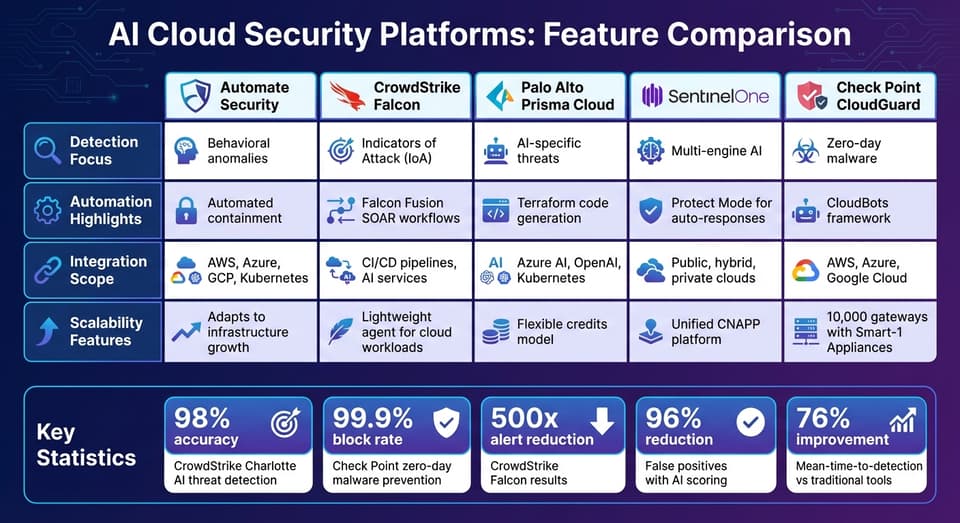
AI Cloud Security Platform Comparison: Features and Capabilities
Welcome to Cyber Risk Series: Cloud-Native to AI-Native Edition
sbb-itb-d663cbd
1. Automate Security
Automate Security uses an AI-powered approach to cloud threat intelligence, moving away from traditional signature-based detection. Instead, it establishes behavioral baselines through machine learning, deep learning, and natural language processing to define what "normal" cloud activity looks like. This shift allows it to detect threats that conventional tools might overlook.
Real-Time Threat Detection
With its AI-driven baselines, Automate Security keeps a close eye on your cloud environment in real time. It continuously analyzes cloud telemetry to identify any deviations from typical behavior. For example, if unusual API calls, unexpected data transfers, or irregular access patterns occur, the platform's AI algorithms can flag these anomalies within seconds. This dynamic approach adapts as your infrastructure evolves, reducing the need for constant manual updates to detection rules.
Automation and Incident Response
Automate Security doesn’t just detect threats - it acts on them. Its automated response features can take immediate containment measures, such as isolating affected hosts, blocking malicious IPs, or disabling compromised accounts. These actions happen in seconds, keeping attackers from moving laterally and minimizing potential damage. The platform also helps your SOC team by filtering and prioritizing massive amounts of security data, enabling them to focus on the most critical issues.
Integration with Cloud Environments
The platform seamlessly integrates with major cloud environments like AWS, Azure, GCP, Kubernetes clusters, and hybrid systems. Using cloud-native connectors, it centralizes logs and telemetry from these diverse sources. This ensures around-the-clock visibility across distributed environments, eliminating the coverage gaps often associated with manual monitoring.
Scalability and Customization
Automate Security grows with your cloud infrastructure, no matter how complex it becomes. It works alongside detection tools like SIEM and EDR as well as action tools like firewalls and IAM systems. Whether you're managing a handful of workloads or thousands of containers, the platform scales to meet your needs. It also customizes its threat detection by learning from your specific environment, enhancing its ability to provide a tailored and comprehensive defense strategy.
2. CrowdStrike Falcon Cloud Security
CrowdStrike Falcon takes a modern approach to threat detection by focusing on behavioral indicators of attack (IoAs) rather than relying on traditional malware signatures. This is especially important since 75% of initial access attacks now bypass malware entirely, often exploiting stolen credentials instead.
Real-Time Threat Detection
The platform's Charlotte AI automates tasks like threat triage, investigation, and response with over 98% accuracy. This level of precision can save security teams more than 40 hours a week by drastically reducing false positives.
CrowdStrike also integrates AI Security Posture Management (AI-SPM) to protect cloud-based AI services throughout the software development lifecycle. By offering agentless visibility into services like OpenAI, Amazon Bedrock, SageMaker, and Vertex AI, AI-SPM helps identify and address misconfigurations before they turn into vulnerabilities. This proactive approach ensures swift, automated responses to potential threats.
Automation and Incident Response
With Falcon Fusion SOAR, the platform enables instant, customizable workflows, while its Cloud Detection and Response capabilities use event streaming to deliver alerts in seconds - leaving behind the slower, batch-processing methods that can take 15 minutes or more. In June 2025, CrowdStrike showcased how Charlotte AI autonomously analyzed cross-domain alerts and created prioritized investigative questions. This allowed the platform to neutralize the DPRK-linked adversary LABYRINTH CHOLLIMA at machine speed, cutting down what traditionally takes hours or days into mere moments.
Integration with Cloud Environments
Falcon Cloud Security seamlessly integrates into CI/CD pipelines, scanning container images for vulnerabilities and maintaining real-time inventories of AI workloads across AWS, Azure, and Google Cloud.
"Alerts have dropped by 500x, and 98% are true positives. There's no noise, no junk." - Brett Fernicola, Senior Director of Security Operations at Anywhere Real Estate.
Scalability and Customization
CrowdStrike Falcon is designed to scale effortlessly with the demands of cloud environments. Its single, lightweight-agent architecture allows for quick deployment across endpoints and cloud workloads without adding unnecessary complexity. By using techniques like knowledge distillation and quantization, the platform ensures its AI models operate efficiently, even in resource-limited settings, while supporting scalable data classification. Additionally, the Falcon Flex consumption-based model gives organizations the flexibility to adjust their security spending and consolidate services as their needs evolve.
3. Palo Alto Networks Prisma Cloud
Palo Alto Networks uses Precision AI™ to secure cloud environments across every stage of development. With cloud systems now responsible for 80% of exposures and breach-to-exfiltration times dropping from 44 days to just 5, fast and automated defenses have become a necessity.
Real-Time Threat Detection
Prisma Cloud's AI Security Posture Management (AI-SPM) offers full visibility into the AI ecosystem - covering models, applications, and resources. It identifies training data sources and flags "shadow AI" along with other suspicious activities in AI pipelines. Prisma AIRS 2.0 adds another layer of defense, targeting AI-specific threats like prompt injection, context poisoning, tool misuse, and memory tampering.
Through autonomous red teaming, the platform runs over 500 tailored adversarial simulations, scanning millions of models and identifying more than 25 unique threat patterns across 20+ model formats. This kind of real-time detection forms the backbone for automated responses to emerging risks.
Automation and Incident Response
Prisma Cloud Copilot simplifies investigations with natural language queries, eliminating the need for complex RQL commands. This feature speeds up documentation searches by a factor of 24 compared to manual methods. It also pinpoints misconfigurations in Infrastructure as Code (IaC) templates during the build phase - an essential feature as every organization now incorporates AI-assisted coding into their processes.
"Prisma Cloud Copilot's AI-driven threat detection and proactive security measures have revolutionized the way we manage our cloud environment. It's been instrumental in identifying potential vulnerabilities before they impact our operations."
- George Lewis, Director of Global Information Security
These automated capabilities integrate seamlessly with various cloud ecosystems, making it easier to secure complex environments.
Integration with Cloud Environments
Prisma Cloud works natively with platforms like Microsoft Azure AI Foundry through the Prisma AIRS AI Runtime Security API. This integration allows developers to scan prompts and responses within their workflows. The platform offers model-agnostic protection, supporting large language models from providers like OpenAI, Meta, Mistral, and DeepSeek.
For Kubernetes environments, Prisma Cloud monitors east-west traffic, enabling microsegmentation to block lateral movement of threats.
"Trust is the foundation of AI adoption. Our collaboration with Palo Alto Networks brings model agnostic, policy-driven protection into Microsoft Foundry so teams can ship innovation with confidence at enterprise scale."
- Sarah Bird, Chief Product Officer, Responsible AI, Microsoft
Scalability and Customization
Prisma Cloud uses a flexible credits consumption model, allowing companies to shift resources as needed between legacy virtual firewalls and modern AI/container workloads without requiring new purchases. Its elastic architecture handles the high-throughput, unpredictable traffic typical of generative AI applications.
Organizations can also create "Custom Topics" to filter content categories based on their internal policies, tailoring protection to their specific needs. This scalability ensures the platform adapts to evolving demands while maintaining robust, AI-driven cloud security.
4. SentinelOne Cloud Security
SentinelOne’s platform uses AI to deliver real-time protection against fast-moving attacks. It employs a multi-engine system that includes Static AI, Behavioral AI, Application Control, Cloud Threat Intelligence, and STAR Rules. With over a decade of refinement and nearly 1 billion malware samples analyzed, this platform is built to tackle modern cloud security challenges .
Real-Time Threat Detection
SentinelOne’s Static AI Engine uses supervised learning to analyze files before execution, identifying known threat patterns . The Behavioral AI Engine focuses on kernel-level processes and memory metrics, uncovering advanced threats while the patented Storyline™ technology connects the dots between process threads. This approach minimizes alert fatigue and uncovers an attack’s root cause and scope.
Its Offensive Security Engine™ takes it a step further by simulating red-team exercises to find "Verified Exploit Paths." This ensures that the focus remains on real risks rather than theoretical ones. The platform also conducts over 2,000 resource configuration checks and identifies more than 750 types of sensitive cloud secrets and keys.
"Singularity Cloud Security has helped us significantly reduce Mean Time to Detect (MTTD) by pinpointing the exact location of vulnerabilities, including mapping CVEs to specific assets and containers. Its AI-powered insights provide clear visibility into exposed areas, enabling faster, targeted responses." - Ashwath Kumar, Head of Security, Razorpay
This precise detection feeds directly into automated responses, neutralizing threats as they arise.
Automation and Incident Response
SentinelOne’s Purple AI™ combines generative and agentic AI for intuitive threat hunting and real-time responses. It can terminate malicious processes, quarantine files, and even execute no-code remediation workflows through integrations with tools like Slack, Jira, and ServiceNow .
For even greater efficiency, organizations can activate "Protect Mode", allowing the AI to carry out remediation actions automatically, rather than just generating alerts . Security teams can also transform effective threat-hunting queries into custom STAR rules, automating the detection of specific indicators of compromise.
Integration with Cloud Environments
SentinelOne is compatible with various cloud setups, including public (AWS, Azure, Google Cloud), private, hybrid, and on-premise environments. Its platform secures containers, Kubernetes clusters, virtual machines, and serverless workloads, supporting 14 Linux distributions and two decades of Windows Server versions.
The Threat Detection for Amazon S3 (TD4S3) feature scans files locally within AWS networks using the Static AI Engine, ensuring sensitive data stays protected. Additionally, SentinelOne employs eBPF technology to provide deep kernel-level visibility without compromising system stability, while agentless scanning can be integrated into CI/CD pipelines to catch vulnerabilities in Infrastructure-as-Code templates before deployment .
Scalability and Customization
SentinelOne’s unified CNAPP platform offers a hybrid security approach, combining agentless deployment for quick Cloud Security Posture Management with agent-based runtime protection. This setup scales effortlessly across high-performance environments. Backed by a 4.9 out of 5 G2 rating and trusted by four of the Fortune 10 as well as hundreds of Global 2000 companies, SentinelOne demonstrates how AI can reshape cloud security strategies .
5. Check Point CloudGuard
Check Point CloudGuard leverages advanced AI to deliver real-time threat intelligence across various cloud environments. At its core is Infinity ThreatCloud AI, a system that connects 150,000 networks and millions of endpoints globally. With over 50 AI engines, it achieves impressive results - blocking 99.9% of zero-day malware and stopping 99.7% of phishing attacks. When a threat is identified, the system instantly updates protections across its entire global network.
Real-Time Threat Detection
ThreatCloud AI processes massive amounts of data daily, including 3.7 billion sites, 250 million emails, and 86 million files. Unlike conventional tools that analyze IPs or URLs in isolation, this system identifies relationships between entities, offering deeper insights into complex attacks. Independent testing by Miercom confirmed its 99.9% accuracy in preventing zero-day malware.
The platform’s machine learning-based Web Application Firewall (WAF) adapts to live traffic instead of relying on static rules. It uses a dual-layer defense: a pre-trained model for global threat knowledge and an unsupervised model tailored to each customer’s cloud environment. For securing Generative AI (GenAI), CloudGuard employs a patent-pending Semantic Engine that interprets natural language inputs, defending against issues like prompt injections and data leaks. This feature supports over 100 languages.
"To secure GenAI, you must be as smart as an LLM, without actually running one – because cost and latency make that impossible." - Check Point Blog
Automation and Incident Response
CloudGuard simplifies incident response with CloudBots, a serverless framework that automates remediation at the click of a button. Four key refinement engines - User Behavior, Crowd Behavior, Trusted Users, and Semantic Engine - help tailor security to specific applications, reducing false positives to almost zero.
The WAF-as-a-Service can be deployed in minutes using a streamlined four-step process. By leveraging global Points of Presence, it filters traffic at the edge, offering proactive protection against zero-day vulnerabilities like Log4Shell without requiring manual updates.
"CloudGuard WAF is a largely set-and-forget solution. It has given us real peace of mind to know our web applications are protected 24/7 with minimal effort." - Shawn Fletcher, Senior Enterprise Architect, St. Joseph's Healthcare Hamilton
Integration with Cloud Environments
CloudGuard seamlessly integrates with AWS, Microsoft Azure, and Google Cloud. It combines cloud inventory with real-time logs from services like VPC Flow Logs and CloudTrail. This provides unified security management across on-premises firewalls, cloud-native setups, and SASE environments via a single SmartConsole interface. Users can also craft custom queries to analyze network activity and automate responses using the CloudBots framework.
The Log.ic Engine enhances raw log data with context, turning it into actionable insights that integrate smoothly with third-party SIEMs like Splunk or ArcSight. It also tracks ephemeral services such as AWS Lambda and Redshift, ensuring full visibility into cloud infrastructure over time.
Scalability and Customization
CloudGuard, when paired with Quantum Smart-1 Management Appliances, can manage up to 10,000 gateways. It offers 70% faster log processing speeds and up to 70TB of local storage for long-term data retention and compliance needs. Its unsupervised machine learning engine adapts to traffic patterns, maintaining a 99.5% detection rate with a low false positive rate of 0.56%.
Customization is enhanced by integrations with over 250 third-party solutions, including Microsoft Defender, Microsoft Entra ID, and CrowdStrike Falcon. Recognized as a Leader in the 2025 Gartner Magic Quadrant for Hybrid Mesh Firewalls, Check Point also earned the top spot in Miercom’s 2025 Enterprise & Hybrid Mesh Firewall Security Report.
"Our new Quantum Smart‑1 Management Appliances combine AI, speed, precision, and automation to help organizations manage on‑premise, cloud, and distributed IT deployments - faster and smarter." - Nataly Kremer, Chief Product Officer, Check Point
Pros and Cons
Custom AI solutions aim to strike a balance between automation, scalability, and data accuracy, addressing the trade-offs inherent in securing cloud environments. These tools come with both strengths and limitations, and understanding these factors helps DevOps and security teams choose solutions that align with their operational goals. Key areas to evaluate include detection, automation, scalability, and data integrity.
Detection accuracy is a critical factor that varies across platforms. For example, Check Point's Infinity ThreatCloud AI boasts a 99.9% block rate for new malware with nearly zero false positives, prioritizing prevention and reducing the need for manual intervention. On the other hand, traditional CSPM tools often flood teams with thousands of alerts, leading to alert fatigue and unresolved vulnerabilities. The quality of training data plays a significant role in achieving the right balance between false positives and false negatives.
Automation capabilities also differ in their implementation and reach. Some platforms use autonomous agents to proactively scan and remediate threats, but human oversight is still necessary to address potential errors. CrowdStrike's Threat AI, for example, leverages autonomous Hunt Agents that scan environments and reverse malware without human input. Similarly, Palo Alto Networks automates remediation by generating Terraform code changes and opening pull requests to fix cloud misconfigurations. Despite these advancements, human supervision remains indispensable to avoid errors caused by automation.
While automation simplifies responses, scalability introduces its own set of challenges, particularly when processing massive amounts of telemetry data. AI platforms excel at analyzing terabytes of data, with some reducing tier-1 security alerts requiring human review by over 85%. However, this capability comes with computational costs and the need for specialized security scanners. Advanced detection engines using ensemble learning models can outperform general-purpose AI by 35-60% in accuracy but require distributed architectures capable of handling sub-second latency.
A persistent challenge across all platforms is their data dependency. As Vijay Ganti from Google Cloud explains:
"AI is as valuable as the data it relies on. LLMs summarizing irrelevant, open-source intelligence add little value compared to manual review."
With 87% of companies adopting a multicloud strategy by 2024, maintaining consistent visibility across platforms like AWS, Azure, and Google Cloud adds another layer of complexity to cloud security operations.
Conclusion
AI-powered custom threat intelligence is transforming cloud security, but selecting the right solution hinges on your organization’s unique requirements. DevOps teams, in particular, gain substantial advantages from platforms that include conversational interfaces and automated rule deployment. These features streamline workflows, eliminating repetitive manual tasks and dramatically cutting down the time needed for root cause analysis.
The benefits go beyond immediate operational improvements. Risk-based prioritization enables smarter, longer-term security strategies by focusing on real threats instead of sheer alert volume. Advanced AI scoring models can reduce false positives by up to 96% during alert generation and cut IOC noise by 97%. Custom AI systems, tailored to specific organizational needs, consistently outperform generic intelligence feeds - offering hundreds of unique advisories and identifying thousands of indicators of compromise.
For organizations using hybrid cloud environments across AWS, Azure, and on-premises infrastructures, unified visibility is essential. With 87% of companies adopting multi-cloud strategies, platforms that integrate diverse telemetry sources like SIEM, EDR, and cloud logs (e.g., VPC flow logs and CloudTrail) are critical for continuous monitoring and preventing security silos. Moreover, 69% of cybersecurity professionals report improved threat detection accuracy with AI, and 64% say it reduces detection time.
This analysis underscores the importance of tailored, AI-driven detection for modern cloud security. The central challenge, however, remains balancing speed with oversight. As Rauf Khan from TO THE NEW aptly puts it:
"The result is not just stronger protection, but also greater resilience and continuity in operations. Businesses that embrace AI-powered security today will be better positioned to outpace evolving cyber adversaries."
Even with AI-driven automated remediation cutting response times to seconds, human expertise is still critical for handling complex decisions. Real-time detection must work hand-in-hand with custom automation to strike the right balance. Platforms like Automate Security address this need by combining real-time threat detection, automated responses, and continuous improvement through human oversight.
As the trend toward autonomous defense accelerates, organizations must prioritize solutions with explainable AI frameworks and human-in-the-loop models. AI-powered platforms can improve mean-time-to-detection by 76% or more compared to traditional rule-based tools. However, success ultimately depends on high-quality data and proper implementation tailored to your specific cloud architecture.
FAQs
What data do AI threat-intel tools need to work well in the cloud?
AI threat intelligence tools draw from a variety of data sources to operate effectively within the cloud. These tools leverage open-source intelligence (OSINT) to gather insights on threat actors, vulnerabilities, and attack techniques. Additionally, they rely on real-time inputs like network traffic, system logs, and telemetry to monitor activity as it happens. To enhance detection and response capabilities, behavioral analytics and indicators of compromise (IOCs) - such as IP addresses, domain names, and file hashes - play a crucial role in identifying and addressing potential threats efficiently.
How do you balance automated response with human oversight?
Balancing automated responses with human oversight is crucial for effective cloud security. AI-driven automation shines when it comes to quickly identifying, analyzing, and responding to threats. It helps cut down on alert fatigue and efficiently handles repetitive tasks. However, human involvement plays an essential role in ensuring accuracy, understanding context, and making well-informed decisions. A hybrid approach works best: let AI handle workflows and initial responses, while humans step in to review and manage critical actions. This combination allows for adaptability to emerging threats while keeping control firmly in place.
How can AI improve detection in multicloud and Kubernetes setups?
AI is transforming how we monitor and secure multicloud and Kubernetes environments by offering real-time, adaptive insights that traditional tools often fail to deliver.
In Kubernetes, where containers are ephemeral and networks constantly shift, AI steps in to identify anomalies that might otherwise go unnoticed. It spots unusual behaviors in these dynamic environments, helping to uncover potential threats as they evolve.
For multicloud setups, AI simplifies complexity by consolidating data from providers like Google Cloud Platform (GCP) and Azure. It automates tasks like root cause analysis and remediation, saving time and reducing human error.
This shift from reactive to predictive operations not only strengthens security but also enhances overall threat intelligence, making it easier to stay ahead of potential risks.