
How AI Detects Anomalies in Cloud Security
How AI learns cloud baselines and uses models to detect credential abuse, data exfiltration, lateral movement, and other anomalous cloud activity.

AI-powered anomaly detection is transforming cloud security by identifying unusual activities that traditional tools often miss. Here's the key takeaway: AI learns normal behavior patterns in your cloud environment and flags deviations that could indicate threats, such as phishing, credential misuse, or data theft
- Why it matters: With 90% of cyberattacks starting with phishing emails, AI provides a dynamic and scalable solution to detect threats in real-time.
- How it works: AI analyzes user logins, API calls, network traffic, and resource usage to establish baselines and spot anomalies.
- Key techniques: Supervised and unsupervised learning models like Isolation Forest, Autoencoders, and LSTMs are used to detect known and unknown threats.
- Challenges: High volumes of data, false positives, and dynamic cloud environments require robust contextual analysis and continuous model updates.
- Implementation: Integrating AI with tools like SIEM and SOAR, while establishing baselines using at least 14–30 days of historical data, ensures effective threat detection.
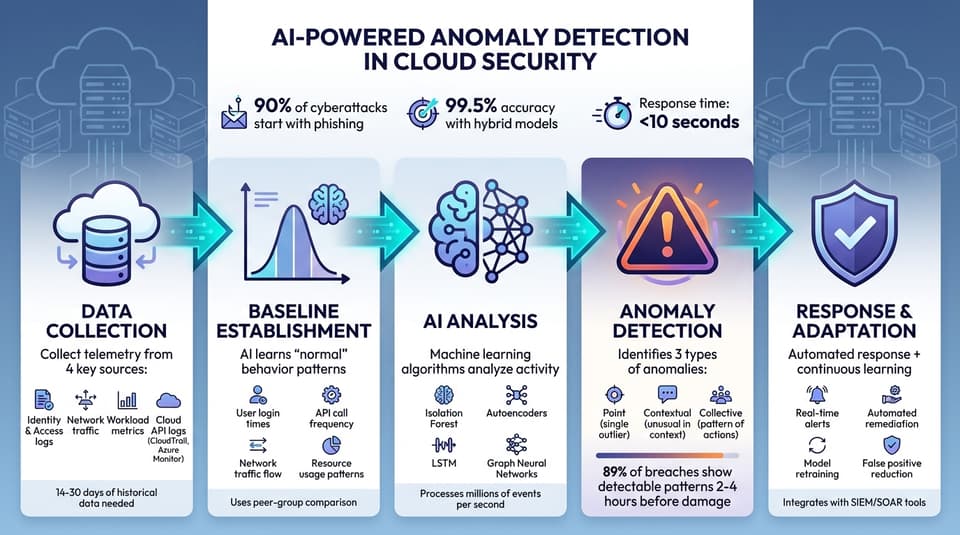
How AI Detects Cloud Security Anomalies: 5-Step Process
Taming LLMs to Detect Anomalies in Cloud Audit Logs
sbb-itb-d663cbd
What Are Anomalies in Cloud Security
In cloud security, an anomaly refers to any unusual pattern, behavior, or data point that deviates from the established "normal" baseline. These deviations signal events that stand out from the typical flow of operations. Examples include unexpected user activity, irregular API calls, or surprising spikes in resource usage.
AI plays a key role in defining what’s "normal" by analyzing historical data. This process involves contextual analysis, such as identifying a role's first-time execution of a "describe instances" command or detecting access through an unfamiliar VPN.
"In many cases, the difference between completely innocent and normal user activity day-to-day and threat actor activity that's taking place via credentialed access or compromised credentials, is often a matter of nuance."
– Craig Chamberlain, Director of Algorithmic Threat Detection, Uptycs
Since cloud environments lack traditional network perimeters, anomaly detection relies heavily on API logs, such as AWS CloudTrail, which capture every transaction initiated by users or automated systems.
Types of Anomalies
Anomalies in cloud security generally fall into three categories, each requiring a unique detection approach:
| Anomaly Type | Description | Cloud Security Example |
|---|---|---|
| Point Anomaly | A single data point that stands out as an outlier. | A login from an unexpected region. |
| Contextual Anomaly | An action normal in one context but unusual in another. | A developer logging in at 3:00 AM instead of 9–5. |
| Collective Anomaly | A series of actions that together form an unusual pattern. | A sudden spike in sharing snapshots to external accounts. |
Point anomalies are the simplest to detect - think of a single login from a country where your organization has no presence. Contextual anomalies require a deeper dive into the situation, like a developer logging in during odd hours. The most complex are collective anomalies, where individual actions may seem harmless, but the overall pattern - such as a surge in snapshot sharing - can indicate malicious behavior.
Recognizing these types of anomalies is essential for tackling the practical hurdles of anomaly detection.
Challenges in Identifying Anomalies
Detecting anomalies in cloud environments is no small feat. With massive volumes of transactions, security teams face the daunting task of finding critical "needles" in an enormous "haystack". For example, a single cloud account can involve up to 13,000 different types of actions carried out by hundreds or thousands of users. Manual inspection simply isn’t feasible.
Adding to the complexity, cloud infrastructure is highly dynamic. Containers and serverless functions are spun up and torn down automatically, which can make legitimate auto-scaling appear as abnormal resource usage. Static detection rules often fail to adapt to these changes, leading to an overwhelming number of false positives.
Sophisticated contextual analysis is key to separating real threats from harmless irregularities. Many cloud services - like message queues, logging systems, and code execution platforms - cannot be monitored using traditional endpoint agents. Instead, API logs serve as the primary source for auditing, but their complexity requires AI to analyze relationships between users, roles, sessions, and resources.
Attackers often exploit this complexity by using techniques such as VPNs or altering log retention policies to obscure their activity. Detection systems must identify unusual log modifications while ignoring legitimate administrative changes. The challenge lies in distinguishing between routine tasks and credential-based attacks.
AI Techniques and Algorithms for Anomaly Detection
AI has significantly improved how we identify threats, particularly through AI-powered cloud security solutions. Two key approaches - supervised learning and unsupervised learning - play a central role in spotting anomalies. Each method has its strengths, and knowing when to use them is crucial for effective detection.
Supervised and Unsupervised Learning
Supervised learning works with labeled datasets, where security teams have already identified which events are safe and which are not. Algorithms like Decision Trees, Random Forest, and Deep Neural Networks use this "answer key" to predict whether new activities are legitimate or malicious. The challenge? It needs a large amount of labeled historical data, which can be hard to obtain due to the constantly changing nature of threats.
Unsupervised learning, on the other hand, doesn't require labeled data. Instead, it identifies "normal" patterns in unlabeled datasets and flags deviations as potential threats. This makes it particularly useful in cloud environments, where zero-day attacks and unexpected behaviors are common. Techniques like Isolation Forest, K-Means clustering, and One-Class SVM excel at defining normal behavior and highlighting anomalies.
While supervised models are great for detecting known threats, they rely on labeled data. Unsupervised models, though more resource-intensive, are better at spotting new and unknown threats. Both approaches lay the foundation for the algorithms commonly used in practice.
Common Algorithms in Practice
Several algorithms stand out for their effectiveness in cloud anomaly detection:
- Isolation Forest: This algorithm isolates anomalies by creating decision tree partitions. Outliers tend to have shorter paths, making them easier to detect. For fraud detection, setting the contamination parameter (expected proportion of outliers) between 0.01 and 0.05 is a good starting point.
- Autoencoders: These neural networks compress and reconstruct data, measuring reconstruction loss to detect anomalies. Anomalous data typically shows much higher reconstruction errors.
- K-Means Clustering: By grouping similar behaviors together, this algorithm is simple yet effective for identifying unusual patterns.
- LSTM (Long Short-Term Memory): Ideal for time-series data like sequential cloud logs, LSTMs capture long-term dependencies effectively.
- Graph Neural Networks (GNNs): For Identity and Access Management (IAM) logs, GNNs outperform sequential models by modeling users, roles, and resources as nodes in a graph. They capture complex relationships, achieving an impressive F1-score of 0.92 in experimental evaluations, compared to 0.85 for LSTM and 0.80 for Random Forest models. Adding an attention mechanism further improves GNN threat recall by 6.3%.
| Algorithm | Learning Type | Best Use Case | Key Strength |
|---|---|---|---|
| Isolation Forest | Unsupervised | High-dimensional data | Fast and doesn't assume data distribution |
| K-Means | Unsupervised | Grouping similar behaviors | Easy to implement |
| Autoencoder | Deep Learning | Complex, non-linear patterns | Detects anomalies via reconstruction loss |
| GNN | Deep Learning | IAM and relational logs | Captures complex entity relationships |
| LSTM | Deep Learning | Time-series/Sequential logs | Great for long-term dependencies |
These algorithms form the backbone of anomaly detection and pave the way for hybrid models that combine their strengths.
Hybrid Models for Better Accuracy
Hybrid models take the best of both worlds by combining different techniques to improve accuracy and reduce false positives. A common approach uses unsupervised learning to detect unknown threats while relying on supervised learning to classify known attack patterns. By cross-referencing results from various algorithms, hybrid models help address one of the biggest challenges in cloud security: false positives.
In September 2025, researchers introduced a hybrid framework that combined Isolation Forest, Autoencoder, and Convolutional LSTM. Tested on the KDD Cup 1999 dataset, it achieved 99.5% accuracy and a 98.2% F1-score. This model outperformed single-method baselines by efficiently recognizing spatial-temporal patterns while isolating outliers.
In March 2026, the ZenGuard framework was unveiled. By integrating Isolation Forest and One-Class SVM with SIEM and SOAR systems, it achieved response times under 10 seconds for lateral movement and data exfiltration. The system processed over one million events per hour, demonstrating its scalability and speed.
For real-time monitoring, it’s essential to balance computational efficiency with accuracy. Algorithms like Isolation Forest are ideal for initial detection, while resource-intensive models like LSTMs can handle deeper temporal analysis. Before deploying active anomaly detection, use at least 30 days of historical data to establish a reliable baseline. Regular retraining of AI models can further reduce false positives by 4.8%. This blend of techniques highlights the need for adaptable and dynamic solutions in cloud security. Modern AI-powered cybersecurity for DevOps provides the necessary framework to implement these models at scale.
How to Implement AI in Cloud Security
Setting up AI-powered anomaly detection in your cloud environment involves three critical steps: defining behavioral baselines, minimizing false positives, and integrating AI with your existing security tools. Here's how to approach each step effectively.
Establishing Behavioral Baselines
Before AI can detect anomalies, it needs to understand what "normal" behavior looks like. Behavioral baselines rely on statistical models to map typical patterns across various activities - like user behavior, network traffic, and data access. These baselines capture details such as time-of-day trends, weekly routines, and common action sequences.
Start by gathering telemetry data from sources like API calls, authentication logs, and network activity. Tools like AWS CloudTrail or Azure Monitor can help collect this data. A historical window of 14 to 30 days is recommended to cover at least two full weekly cycles. For example, Orca Security uses a moving average of actions over the last 14 days.
Peer-group baselining is another key tactic. Instead of treating all entities equally, compare similar roles or workloads. For instance, a database administrator accessing servers at 2 AM might be perfectly normal, but the same action from a marketing account would raise red flags. Exclude one-off events like maintenance windows or migrations from your training data to avoid skewing the model.
When setting sensitivity thresholds, start conservatively. Using 3 standard deviations helps reduce false positives, and you can adjust to 2 standard deviations if critical anomalies are being missed. Nawaz Dhandala, an engineer at OneUptime, highlights this approach:
"Static thresholds are the blunt instrument of monitoring... Anomaly detection solves this by learning what 'normal' looks like for each metric".
Once baselines are in place, the next step is tackling false positives.
Reducing False Positives
False positives can overwhelm analysts and obscure real threats. To address this, contextual enrichment is essential. Pair behavioral data with cloud-specific context, such as identity permissions, network exposure, and data sensitivity. For example, unusual activity in a sandbox environment is far less concerning than the same behavior in a production system.
Introducing a human-in-the-loop process allows analysts to classify alerts, creating a feedback loop that refines detection over time. Justin Lachesky, Director of Cyber Resilience at Redis, shares:
"We have been seeing really interesting things out of the SecOps AI Agent already. It is driving faster decision-making and dispositioning of alerts, especially in cases of anomalous behavior".
To keep up with changes in your infrastructure, continuous model retraining is critical. This prevents "concept drift" as deployment patterns evolve. Incorporate temporal patterns, like time-of-day and day-of-week trends, to avoid flagging legitimate activities - such as off-hours maintenance or seasonal traffic spikes - as suspicious.
Regularly fine-tune your thresholds and retrain models to adapt to new cloud activities. Use automated responses only for high-confidence alerts, such as blocking suspicious IPs or isolating compromised resources. This minimizes disruption while ensuring critical threats are addressed promptly.
Integrating AI with Existing Security Tools
Modern AI tools can integrate seamlessly with cloud platforms like Microsoft 365 and Google Workspace through API-native connections. These connections provide visibility into internal activities, such as authentication events, without disrupting workflows or requiring changes to email routing. This method is particularly effective for detecting identity-based threats.
To prevent data silos, ensure your AI system works with tools like SIEM, SOAR, and identity providers. Focus on pulling telemetry from four main areas:
- Identity & Access: Login logs, MFA events, and OAuth grants
- Network Traffic: Packet headers, session logs, and flow data
- Workload/System: CPU usage, memory metrics, and process activity
- Cloud Control Plane: Logs from AWS CloudTrail, Azure Monitor, or GCP
Before feeding data into your detection system, clean and normalize it to ensure accuracy.
Lastly, explainability is key to building trust with analysts. Choose tools that clearly show why an alert was triggered, such as unusual API usage or access from a new location. This transparency helps teams validate or dismiss alerts quickly and confidently, speeding up investigations.
How AI Detects Anomalies in Practice
AI systems in cloud environments tackle issues like unauthorized access, suspicious network behavior, and unusual resource usage. Here's how these systems work in real-world scenarios.
Detecting Unauthorized Access
AI has shifted from simple blacklisting to creating dynamic baselines for individual identities. This approach, known as User and Entity Behavior Analytics (UEBA), establishes behavioral baselines by analyzing historical activity and peer group patterns for users, service accounts, and roles.
By examining factors such as login times, geolocations, device fingerprints, and MFA failure rates, AI can detect suspicious behavior. Instead of focusing on isolated events, it connects multiple signals - like a new device registration followed by a mailbox rule change and an OAuth grant - to identify high-confidence account takeovers.
Take the example of impossible travel: if a user logs in from three different countries within an hour, AI flags this as suspicious. Since more than 90% of cyberattacks start with phishing emails aimed at stealing cloud credentials, this kind of detection is critical. Modern credential harvesting kits are alarmingly effective, boasting a 99.7% success rate. David van Schravendijk from Abnormal AI explains:
"The question is no longer whether the login was legitimate, but whether the identity's behavior remains consistent with its historical baseline".
Interestingly, 89% of successful breaches show detectable anomalous patterns two to four hours before any real damage occurs. This early detection window gives security teams a chance to act before attackers cause harm.
OAuth grants, which provide long-term access that persists even after password resets or MFA re-enrollment, are another focus area. AI systems with API-native integration can detect threats like internal phishing or OAuth abuse - things that traditional email gateways or firewalls often miss. By automating responses to account takeovers, organizations can save an estimated 1,454 hours annually in manual work.
From here, AI extends its capabilities to monitor network traffic and spot data exfiltration attempts.
Monitoring Network Traffic and Data Exfiltration
Building on identity-based detection, AI examines network traffic by creating dynamic baselines for communication patterns between users, hosts, and workloads. This approach goes beyond signature-based detection, identifying deviations specific to the environment.
The system tracks session-based data transfers between internal and external IPs to detect spikes in activity or lateral movement. It can even monitor broader trends, such as data movement to specific Autonomous System Numbers (ASNs) or hosting organizations, to catch distributed exfiltration across multiple IPs.
To uncover low-and-slow exfiltration attempts, AI analyzes hourly traffic volumes and long-term trends. Techniques like K-Means clustering group network log features, flagging outliers based on their distance from cluster centroids. Additionally, data points that deviate significantly - three standard deviations above the mean - are flagged.
AI enhances its analysis with contextual enrichment, tagging network traffic with metadata like ASN, reputation scores, and cloud provider details. This helps differentiate legitimate traffic from high-risk activity. Geolocation outlier detection is particularly effective, identifying unusual API commands or traffic originating from unexpected locations, which can be more reliable than tracking source IPs.
Craig Chamberlain from Elastic highlights a common oversight:
"Cloud API logs are a significant blind spot for many organizations... they tend to resist detection using conventional search rules".
AI also watches for unusual activity in cloud metadata services. For example, it can detect rare processes (like curl) or unauthorized users trying to retrieve credentials. In one case, a Prisma Cloud customer narrowly avoided a breach when an employee accidentally posted a private key on GitHub. Within minutes, AI identified three TOR nodes attempting to use the key to provision 50 compute instances, allowing the customer to delete the secret before any major damage occurred.
Detecting Abnormal Resource Usage
AI identifies unusual resource usage by calculating moving averages and standard deviations over specific periods, such as 14 days. Algorithms like Isolation Forest help pinpoint outliers in resource usage without needing prior knowledge of attack patterns.
One common indicator is unusual compute provisioning - like spinning up an excessive number of virtual machines or containers - which often signals cryptojacking or account compromise. Cryptojacking has become a growing issue, affecting 23% of cloud environments in 2021, up from just 8% in 2018.
To distinguish legitimate cloud bursting from malicious activity, AI correlates resource usage with IAM roles, geographic data, and known exit nodes. Rachel Deng from Palo Alto Networks notes:
"The key to detecting anomalous compute provisioning activity, then, is to define what constitutes an organization's normal boundaries".
AI also detects critical performance issues, such as a sudden 90% drop in database read throughput, which could signal a failing node or a targeted attack. Leveraging generative AI and large language models, security teams can query audit logs in natural language to identify anomalies like unauthorized file changes or unusual data egress volumes.
These detection methods integrate seamlessly with automated response frameworks. Responses include real-time alerts via tools like Slack or Teams, and automated actions such as pausing rogue jobs, resizing over-provisioned nodes, or halting idle workloads. New machine learning models in services like Amazon GuardDuty have reduced false alarms for anomalous account activity by over 50% while tripling monitoring coverage.
Automate Security's AI-Powered Anomaly Detection Features
Automate Security builds on tried-and-true anomaly detection methods by incorporating advanced AI to safeguard cloud infrastructures for DevOps teams and security leaders. The platform processes vast amounts of security data, using machine learning models to establish behavioral norms and instantly flag unusual activity.
Real-Time Threat Monitoring
Automate Security keeps a close eye on traffic, logs, and telemetry across endpoints, identities, and workloads. Thanks to API-native integration with cloud platforms, it monitors internal communications, authentication events, and OAuth grants - areas often overlooked by traditional gateways.
Its machine learning capabilities can differentiate between legitimate business events, like a traffic surge after a marketing campaign, and actual threats, such as DDoS attacks.
Lucia Stanham, Product Marketing Manager at CrowdStrike, highlights the importance of early detection:
"AI anomaly detection identifies potential issues early, allowing organizations to address them before they escalate. This helps minimize disruptions, mitigate risks, and prevent damage to operations or reputation".
These real-time detection tools create a foundation for security strategies that can evolve to meet new challenges.
Adaptive Security Strategies
The platform's AI models are designed to learn continuously from new data, adapting to both emerging attack techniques and the ever-changing nature of cloud environments. This is vital, as 87% of global organizations reported AI-driven security incidents last year, with attackers leveraging methods like hyper-personalized phishing and adaptive malware.
Automate Security uses hybrid models that combine unsupervised learning with human oversight, improving accuracy and reducing false positives. To prevent detection capabilities from degrading over time (a phenomenon known as model drift), security teams must retrain these models using fresh data.
By analyzing signals from network traffic, system logs, and user interactions, the platform can detect intricate threats that single-source tools might overlook. This approach is particularly effective against issues like lateral movement, credential misuse, and insider threats.
To cater to diverse organizational needs, Automate Security offers different plans with varying levels of detection and remediation features, as detailed in our cloud security FAQ.
Features by Plan
Automate Security provides three tiers of service, tailored to organizations of different sizes and complexities:
| Plan | Core Capabilities | Best For |
|---|---|---|
| Basic | Threat detection, compliance management, basic incident response | Small teams with limited cloud infrastructure |
| Professional | Includes all Basic features plus real-time monitoring and automated responses | Growing businesses expanding their cloud operations |
| Enterprise | Includes all Professional features plus custom adaptive strategies and continuous improvement | Large organizations needing extensive security measures |
The Professional and Enterprise plans also feature AI-powered auto-remediation, allowing teams to automate responses to detected anomalies. By integrating with DevSecOps pipelines, the platform can analyze telemetry and user interaction data during development, providing proactive protection in an increasingly complex threat landscape.
Challenges and Solutions for AI Deployment
Deploying AI systems in dynamic cloud environments can be tricky. While AI methods offer great potential for cloud anomaly detection, several challenges can disrupt implementation. One significant issue is poor data quality. Effective AI models need large amounts of clean, labeled data, which is often hard to come by in real-world cloud setups. Cloud environments generate massive amounts of logs daily - terabytes, in fact - but much of this data is either unstructured or noisy, leading to reduced model performance.
Another hurdle is alert fatigue. AI systems often flag benign activities, overwhelming security teams with false positives. On average, security teams spend about 25% of their time investigating these false alarms. A practical way to address this is through context-aware detection, which considers factors like user roles, access timing, and asset importance to cut through the noise and focus on high-risk events.
Real-time processing is another challenge, as systems often handle millions of events per second. Techniques like Principal Component Analysis (PCA) and per-cloud baselining can help manage computational demands. This is especially critical since attackers in cloud environments now act within minutes rather than hours.
Compounding these technical challenges is the skill gap. Many organizations lack professionals skilled in both AI and cloud security. On top of that, relying on disconnected tools can make it harder to get a clear view of threats. Sharon Farber from Palo Alto Networks sums it up well:
"AI isn't the first technology shift to which security teams have had to adapt quickly. But the current generation of AI tooling comes with its own unique characteristics that pose distinct challenges for traditional security frameworks".
These hurdles highlight the need to balance technical precision with regulatory requirements.
Managing Data Privacy and Compliance
Another layer of complexity comes from balancing AI deployment with data privacy regulations like GDPR and CCPA. To address this, organizations need thoughtful architectural planning. For example, multi-layer sanitization pipelines can strip out personally identifiable information (PII) and sensitive details while retaining the logical relationships necessary for security analysis.
A more advanced approach is differential privacy, which uses techniques like the Laplace mechanism to add calibrated noise to sensitive data. This protects metrics like network traffic volumes while still enabling accurate threat detection. Similarly, consistent hashing can map resource relationships (such as linking security groups to instances) without revealing actual identifiers.
Given that 92% of organizations use a multi-cloud strategy and the average enterprise manages 1,295 cloud services, these methods are crucial. The rise of Compliance-as-Code (CaC) is also changing the game. By encoding regulatory policies directly into deployment pipelines, organizations can automate compliance monitoring. Generative AI is even being used to translate legal texts into actionable monitoring rules, a vital step as cyberattacks now average 1,925 per week - a 47% increase from 2024.
Additional safeguards include cryptographic verification of model weights to prevent tampering, GPU memory isolation to avoid cross-tenant data leakage, and tracking policy drifts with real-time configuration data and API logs. Adhering to Supply-chain Levels for Software Artifacts (SLSA) guidelines and using validated container images further strengthens the security framework.
Ensuring Scalability and Performance
To maintain performance at scale, organizations must make strategic architectural choices. For instance, integrating AI-driven detection into existing Security Information and Event Management (SIEM) pipelines prevents siloed data flows that could overwhelm analysts. This is especially important given the sheer volume of data generated by modern cloud environments, where misconfigurations account for 15% of all initial attack vectors in breaches.
AI pipelines can also automate the normalization of multi-cloud logs, transforming unstructured data into a standardized format for quicker event correlation. Greg Leonardo, a Cloud Architect, explains the shift in focus:
"The future of forensics won't be about finding the needle in the haystack. It will be about building machines that understand the entire haystack instantly".
This kind of temporal context is vital for handling unpredictability from AI agents and large language models - issues that traditional monitoring tools weren't designed to tackle. Organizations adopting Zero Trust architectures are already seeing benefits, such as a 44% reduction in attackers' lateral movement capabilities.
When it comes to resource-intensive techniques like autoencoders and CNNs, it's important to strike a balance between model complexity and available computational resources. Interestingly, simpler models with well-engineered features often outperform more complex architectures in fast-changing, high-dimensional cloud environments.
Conclusion
The future of cloud security hinges on AI's ability to uncover threats that traditional methods often miss. AI-powered anomaly detection has become a cornerstone in this effort. As Lucia Stanham from CrowdStrike explains:
"Modern anomaly detection efforts employ algorithms that use machine learning (ML), AI, or both to analyze vast amounts of data and identify complex and subtle anomalies that would be difficult, if not impossible, to find using traditional methods".
With the sheer volume of cloud logs, manual analysis simply can’t keep up.
The move from signature-based detection to behavior-driven systems marks a major shift in how organizations protect their infrastructure. By using dynamic baselines that adapt over time - learning from past behaviors - AI can detect the "unknown unknowns." These include lateral movements and intricate attack patterns that slip past traditional detection methods.
The advantages are clear. Studies reveal that 89% of successful breaches exhibit detectable anomalies 2 to 4 hours before any damage occurs. Additionally, correlating signals across multiple layers can cut investigation times by more than 90%.
However, success doesn’t come automatically. It requires setting clear baselines, integrating AI-powered security solutions with existing tools, and maintaining human oversight through feedback loops to refine accuracy and minimize false positives. As Greg Leonardo, Cloud Architect, puts it:
"The future of forensics won't be about finding the needle in the haystack. It will be about building machines that understand the entire haystack instantly".
While challenges like data privacy, scalability, and the demand for skilled personnel remain, the pace of attacks and the vast data generated by cloud environments make AI-driven anomaly detection indispensable. This adaptive approach forms the backbone of modern cloud security strategies.
FAQs
What data sources should I feed into AI anomaly detection in the cloud?
To get the most out of AI-driven anomaly detection in the cloud, it's crucial to gather data from a variety of sources. This includes logs, metrics, and events generated by cloud services, virtual machines, containers, and serverless functions. Key data to focus on includes:
- Audit logs: Track user activity and configuration changes.
- Network traffic: Monitor data flow to spot unusual patterns.
- Resource usage: Keep an eye on CPU, memory, and storage consumption.
- Security logs: Capture details like access attempts to identify potential threats.
For businesses using multiple cloud providers, such as AWS or Azure, normalizing the data is essential. This ensures that information from different platforms is consistent, making it easier to analyze and uncover security threats or performance issues.
How do I tune AI anomaly detection to cut false positives without missing attacks?
To cut down on false positives while still catching attacks, focus on adjusting thresholds and applying filtering techniques. Start by setting precise anomaly thresholds to distinguish between regular and suspicious activities more effectively. You can also filter out anomalies linked to known housekeeping tasks or infrequently used processes. Fine-tuning hyperparameters and building custom filter lists tailored to your environment can sharpen accuracy without losing the ability to detect genuine threats.
How often should I retrain anomaly detection models as my cloud environment changes?
Retraining models on a regular basis is key to staying aligned with the evolving nature of your cloud environment. The timing for these updates largely depends on how frequently new attack patterns emerge or significant data changes occur. In some cases, this might mean continuous retraining, while in others, periodic updates may suffice. It all comes down to the complexity and pace of change within your specific environment.